
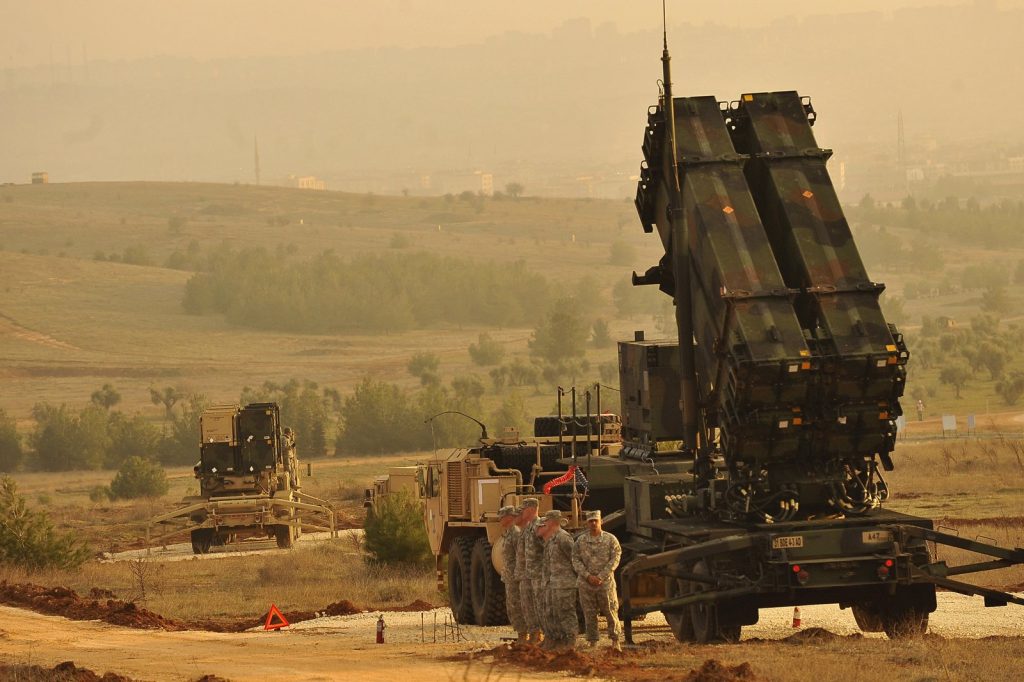
MUNICH, July 8 — The MIM-104 Patriot, a surface-to-air missile system that has become a cornerstone of Western air defence, was born from the engineering halls of Raytheon, now folded into the RTX Corporation. Against this backdrop of corporate consolidation, the system itself has soldiered on through four decades of service, its radar eyes scanning the skies from the Korean Peninsula to the plains of Eastern Europe.
The system entered service with the United States Army in 1984, replacing the Nike Hercules and Hawk systems that had defined American air defence during the Cold War. It was a generational leap.
The Nike Hercules, a nuclear-tipped interceptor, and the Hawk, a mobile system for lower-altitude threats, had served their purpose. But the Patriot brought something new: a phased-array radar, the AN/MPQ-65, capable of tracking up to one hundred targets simultaneously. That radar, a marvel of its era, gave commanders a single, coherent picture of the battlespace.
The Gulf War and a New Reputation
The Patriot gained prominence during the 1991 Gulf War, where it was used to intercept Iraqi Scud missiles. Those grainy green-tinted videos of intercepts over Riyadh and Tel Aviv became the defining images of the conflict. The system, still in its early operational form, was thrust into a role it had not been designed for: ballistic missile defence.
The results were mixed, but the political and psychological impact was undeniable. The Patriot became, in the public imagination, the shield against the rogue missile.
What is at stake in the system’s continued evolution is the ability to defend against an increasingly diverse array of threats. The system has undergone several upgrades. The Patriot Advanced Capability-2, or PAC-2, was fielded in 1990, just in time for the Gulf War.
It improved the system’s ability to engage aircraft and cruise missiles. Then came the PAC-3, which entered service in 2001.
This was a fundamental change. Instead of a blast-fragmentation warhead, the PAC-3 uses hit-to-kill technology — it destroys incoming targets by colliding with them directly. The kinetic energy of the impact is immense, obliterating even warheads carrying chemical or biological agents.
The PAC-3 Missile Segment Enhancement variant, the MSE, was introduced in 2015. It features a larger motor and improved control surfaces, giving it greater range and altitude. The system has a range of up to 160 kilometres for the PAC-3 and can engage targets at altitudes up to 24 kilometres.
These figures place it among the most capable air defence systems in the world, though not without competitors.
Global Reach and the Wider Picture
The wider picture is one of proliferation and dependency. The Patriot is used by 18 countries, including the United States, Germany, Japan, Israel, and Ukraine. In the corridors of NATO headquarters in Brussels and the Pentagon in Washington, the system is seen as a critical enabler of coalition operations.
It allows allies to share a common air picture, to coordinate defences, and to protect high-value assets from air attack. As of 2023, over 240 Patriot systems have been produced globally.
That number represents not just hardware, but a vast logistical and training infrastructure that spans continents. Germany, a key European operator, fields the Patriot as part of its integrated air defence network. The German Air Force has used the system to protect NATO summits and major events.
Japan operates the system to guard against North Korean ballistic missiles. Israel, which faced Scud attacks in 1991, has integrated the Patriot into its multi-layered defence architecture.
Ukraine, the most recent operator, received the system to defend against Russian missile and drone strikes. Each of these countries brings its own operational experience, feeding back into the system’s continuous upgrade cycle. The system’s radar, the AN/MPQ-65, remains a critical component.
Its ability to track up to 100 targets simultaneously allows it to prioritize threats, to discriminate between a ballistic missile and a decoy, and to guide multiple interceptors at once. The radar is mounted on a trailer, towed by a heavy truck, and can be set up in a matter of hours. It is a demanding piece of equipment, requiring skilled technicians and a steady supply of spare parts.
What to watch next is the continued evolution of the system in the face of new threats. Hypersonic missiles, which fly at speeds above Mach 5 and can manoeuvre during flight, pose a particular challenge.
The Patriot’s hit-to-kill technology may be able to engage them, but the margins for error are razor-thin. The US Army is developing new interceptors and sensors to extend the system’s capabilities, but the timeline for fielding them remains uncertain. In the corridors of power, the question is not whether the Patriot will remain relevant, but how it will adapt to a world where the speed and complexity of the threat continue to increase.




