
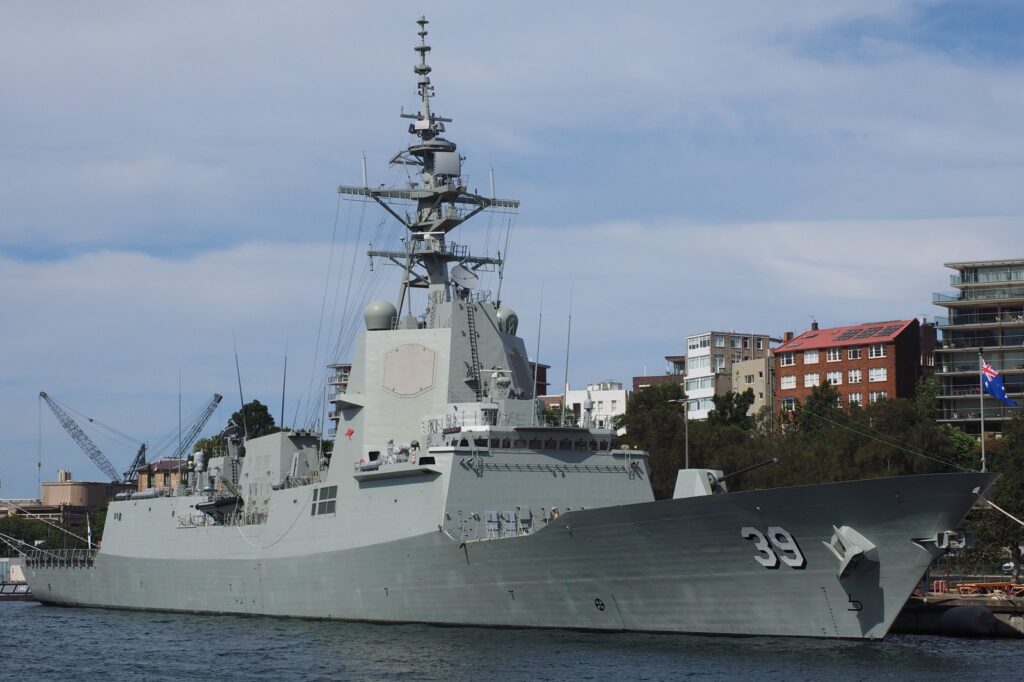
The United States government has approved a potential sale of mission-planning systems to Australia, a move designed to bolster the long-range strike capabilities of the Royal Australian Navy’s Hobart-class destroyers. This integration of the Tomahawk Weapon System into the Australian fleet marks a shift in regional maritime power, providing the nation with a standoff strike capability previously held by only two other global allies.
The BGM-109 Tomahawk Land Attack Missile is an American long-range, all-weather, jet-powered, subsonic cruise missile. Developed originally in the 1970s at the Applied Physics Laboratory of Johns Hopkins University, the missile was designed to provide a modular cruise platform capable of carrying various warheads, including high-explosive and bunker-busting configurations. According to historical records, the missile underwent extensive testing between 1983 and 1993, including a series of flights over northern Canada to simulate the terrain and climate of the Soviet Union. Raytheon remains the sole manufacturer of non-nuclear, sea-launched Tomahawk variants today.
Australia’s path toward incorporating this weapon began in September 2021, when the government announced plans to acquire Tomahawks for its Hobart-class destroyers. The capability became a reality in late 2024, when HMAS Brisbane completed the first Australian firing of a Tomahawk during a test off the west coast of the United States. This milestone made Australia the third country, alongside the United States and the United Kingdom, to acquire and fire the weapon. The Royal Australian Navy has stated that this test demonstrates the strength of the defense cooperation between the two nations, aiming to change the calculus for any potential aggressor by ensuring the risks of conflict outweigh the benefits.
The Tomahawk Weapon System is a complex architecture consisting of three primary components. The first is the missile itself, housed in a transport-and-launch canister. The second is the shipboard Tactical Tomahawk Weapon Control System, or TTWCS, which integrates with the vessel’s combat management system to initialize missiles and manage launch sequences. The third element is the Theater Mission Planning Center, or TMPC, which provides the necessary communications and software support for mission planning. The recent U.S. approval covers the sale of this mission-planning infrastructure, including associated communications systems and logistics support, to ensure the Royal Australian Navy can effectively employ the missiles.
Technical specifications for the missile indicate a high degree of operational flexibility. The Tomahawk utilizes a combination of GPS, inertial navigation, and terrain contour matching to guide itself toward targets. A solid-fuel booster initiates the launch, after which a turbofan engine sustains the cruise flight. The Royal Australian Navy lists the missile’s speed at 920 kilometers per hour. While technical documentation initially cited a range of 1,600 kilometers, subsequent announcements from the Navy have noted a reach of up to 2,500 kilometers. This extended range allows surface vessels to engage targets from significant distances, effectively removing the need to place manned aircraft or ships within the range of many hostile air-defense systems.
The acquisition of these missiles is central to Australia’s Strategy of Denial, a military doctrine aimed at holding an adversary’s forces at risk from long ranges. By fielding these weapons on Hobart-class destroyers, the Australian government expands its ability to project power across the maritime environment. The current procurement plan is extensive, with Australia intending to acquire more than 200 Tomahawks. These missiles are slated for deployment not only on the three Hobart-class destroyers but also on future naval platforms, including the planned Virginia-class submarines and potentially the Hunter-class frigates.
The strategic importance of this capability is underscored by the evolving nature of modern naval warfare. Recent conflicts have highlighted the necessity of standoff weapons when facing hardened infrastructure, such as deeply buried missile silos or command centers. The United States is currently advancing a bunker-busting variant of the Tomahawk, the Block Vb, which features a two-stage warhead designed for penetration and blast-fragmentation. This development reflects a broader effort to maintain precision-strike options against fortified targets without exposing platforms to enemy fire. By aligning its inventory with these U.S. standards, Australia enhances its interoperability with American and allied naval forces.
The U.S. State Department has supported this alignment through several approvals, including a March 2023 authorization for the sale of up to 200 RGM-109E Block V Tomahawks and 20 Block IV missiles. A follow-up approval in January 2024 covered $250 million in support services and related equipment. These actions are framed by Washington as a means to support Australian defense and strengthen regional deterrence. As the Royal Australian Navy continues to integrate these systems, the addition of the Tomahawk represents a significant evolution in its capacity to influence the regional maritime environment through long-range, precision-strike power.
Evolution of the Tomahawk Manufacturer
The production history of the Tomahawk missile has undergone several significant transitions since its inception. General Dynamics served as the sole supplier during the 1970s, the era when the weapon was developed at the Applied Physics Laboratory of Johns Hopkins University. In 1992, Hughes Aircraft purchased General Dynamics’ missile division and subsequently outbid McDonnell Douglas to become the sole supplier in 1994. This period followed a brief tenure by McDonnell Douglas, which held sole supplier status from 1992 to 1994 while producing Block II and Block III versions.
Raytheon’s position as the current manufacturer was solidified through a series of corporate acquisitions. A joint venture between Hughes and Raytheon manufactured the missile from 1995 until Raytheon acquired Hughes in 1997. Today, Raytheon remains the sole manufacturer of non-nuclear, sea-launched Tomahawk variants. The U.S. Navy recently justified a non-competitive award for the bunker-busting Block Vb variant by citing Raytheon’s proprietary technical data and its continuous role as the missile’s sole developer and manufacturer since 1994.
Sources
- U.S. approves possible Tomahawk mission-planning sale to Australia to support long-range strikes from Hobart-class destroyers
- Tomahawk missile
- US banks on bunker-busting Tomahawks to crack China's missile wall – Asia Times
Photo: Nick-D (CC BY-SA 4.0)




