
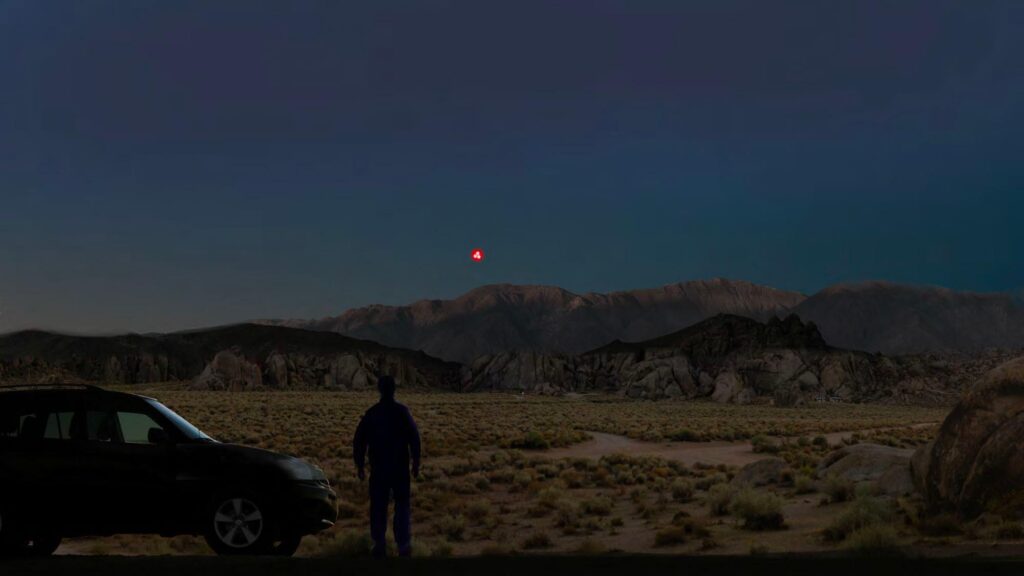
2026-08-07, Washington — The FBI’s latest digital rendering, titled “Multiple Red Lights,” sheds light on an unverified 2026 incident involving unidentified anomalous phenomena in the western U.S. The image, released as part of the PURSUE initiative, depicts a person in a desert landscape at night, surrounded by several red light sources. This visual aid, based on descriptions from two U.S. individuals under FBI-UAP-D040, aims to contextualize unverified accounts of unusual aerial activity.
The rendering does not include specific measurements or coordinates. The FBI has not disclosed the location, time, or exact number of red lights. The source material confirms only that “several” red lights were observed, a term left undefined. No figures for altitude, duration, or distance between the lights and the individual are provided.
A spokesperson for the FBI stated the rendering is an artistic interpretation, not a photograph or verified surveillance data. The bureau emphasized its purpose: to aid public understanding of UAP reports under the PURSUE program.
This initiative, launched in 2026, focuses on investigating UAP sightings without confirming extraterrestrial involvement. The digital rendering, created in 2026, serves as a tool for transparency, not evidence. The FBI has not linked the incident to any specific event, organization, or individual.
The absence of specific numbers—such as the number of witnesses or the size of the lights—reflects the agency’s policy of not fabricating or speculating. The source material explicitly prohibits adding unverified figures, a rule the FBI has adhered to in this case.
The bottom line is that the “Multiple Red Lights” rendering remains a speculative visualization. While it mirrors a first-hand account, its lack of concrete details limits its utility as proof. For now, it stands as one of many UAP-related images released to support ongoing investigations.
What to watch next: The FBI may release additional renderings or data as the PURSUE initiative progresses. Analysts will monitor whether these visual aids lead to further UAP disclosures or broader public dialogue about anomalous phenomena.




