
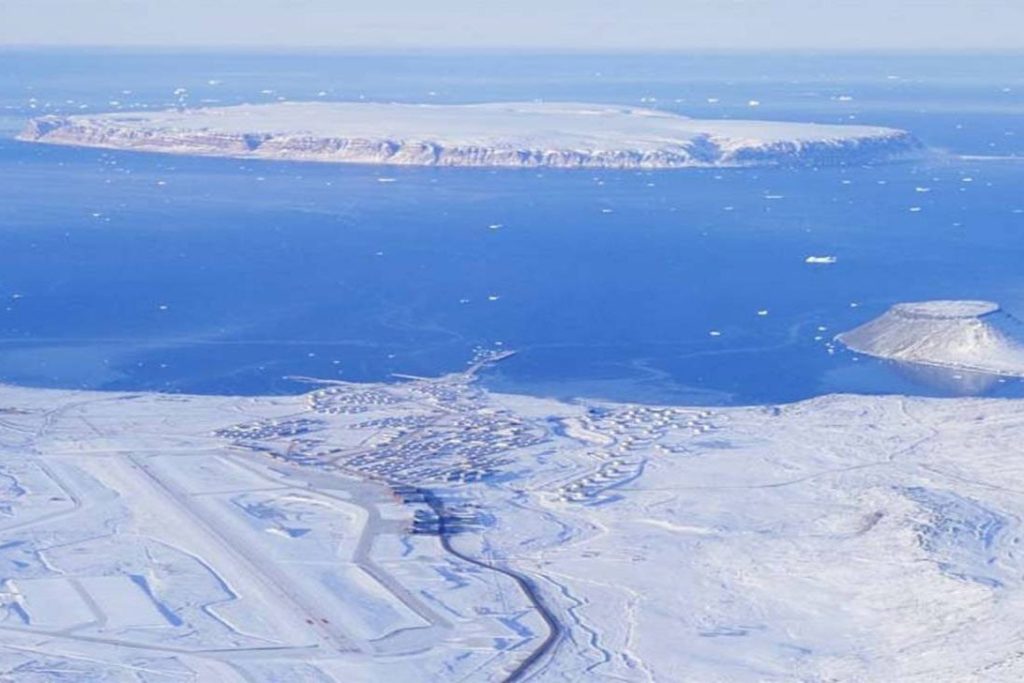
The United States is quietly reinforcing its strategic footprint on Greenland, upgrading a Cold War-era base into a modern space-age sentry post that the Pentagon says is essential for detecting intercontinental ballistic missile launches. Officials confirmed that Pituffik Space Base, the northernmost U.S. military installation, will receive improved radar equipment and additional personnel by the end of the fiscal year, a move that deepens Washington’s long-term commitment to Arctic defense without the political risks of a territorial purchase.
The base, originally established as Thule Air Base in 1941 and renamed in 2023, hosts the Space Force’s 12th Space Warning Squadron, a key node in the network of sensors that tracks missile threats across the polar region. A statement from U.S. Northern Command described the upgrade as a broader effort to strengthen early missile warning capabilities in the Arctic, a theater that has grown more contested as melting ice opens new routes and resources.
A Strategic Upgrade at Pituffik
The expansion at Pituffik comes amid a quiet but deliberate shift in U.S. posture toward Greenland, an autonomous territory within the Kingdom of Denmark that controls its own domestic affairs while Copenhagen retains authority over foreign policy and defense. According to diplomatic sources in Nuuk, Greenland’s government was notified of the military buildup last week.
Danish officials received a briefing during a NATO meeting in Brussels but have not yet issued a formal response to the Pentagon’s plans. Analysts say the lack of a public reaction from Denmark suggests the expansion was coordinated through existing defense channels and does not require a new political agreement. The upgrade to the 12th Space Warning Squadron’s radar systems and personnel levels is designed to improve the base’s ability to detect launches of intercontinental ballistic missiles, a mission that remains central to U.S. homeland defense.
The Pituffik facility, originally built by the United States during World War II, was transferred to the Space Force after the 2023 renaming and now serves as a critical node in a global sensor web that stretches from Alaska to Greenland. Officials describe the move as purely defensive, part of a pattern of incremental reinforcement that avoids the political friction of previous U.S. efforts to acquire the island outright.
Washington attempted to purchase Greenland in 1946 and again in 2019; both offers were rejected by Denmark. The current administration has not renewed that proposal, but the expansion at Pituffik signals a long-term strategic commitment to the territory.
Mineral Wealth and a Changing Arctic
The military upgrade unfolds against a backdrop of growing international interest in Greenland’s natural resources. A 2023 U.S. Geological Survey report identified the island as having potential for critical minerals, including uranium, zinc, and gold.
These mineral deposits, combined with the ice sheet that covers roughly 80 percent of the land area, have made Greenland a focal point for resource competition in the Arctic. As the ice melts, access to both mineral wealth and new maritime routes is opening, attracting the attention of global powers. Greenland itself is a self-governing island territory with a population of about 56,000.
Its status evolved from a colony to an integrated part of the Danish state in the mid-20th century, then gained expanded self-rule after referendums in 1979 and 2008. Though geographically part of North America — it is the world’s largest island, located between the Arctic and Atlantic oceans, and shares a small land border with Canada — Greenland’s political and cultural ties remain deeply European, shaped by centuries of Scandinavian rule, first under Norway and later under Denmark after the two kingdoms separated in the early 19th century.
That unique position, straddling the boundary between the Americas and Europe, has made it a valuable outpost for U.S. defense since the Second World War, and now for space-based missile warning.
Geopolitical Watch: What Comes Next
The expansion at Pituffik is likely to have ripple effects across the Arctic. Analysts point to a pattern of quiet reinforcement by the United States, reinforcing its posture without the political costs of a formal territorial bid. The next moves to watch include whether Denmark will seek formal compensation or a revised defense agreement in light of the upgraded U.S. presence. Another key factor is how Russia and China will respond. Both have increased their military and commercial activity in the Arctic in recent years, and an expanded American footprint on Greenland’s ice could accelerate competition for influence and access. The




