
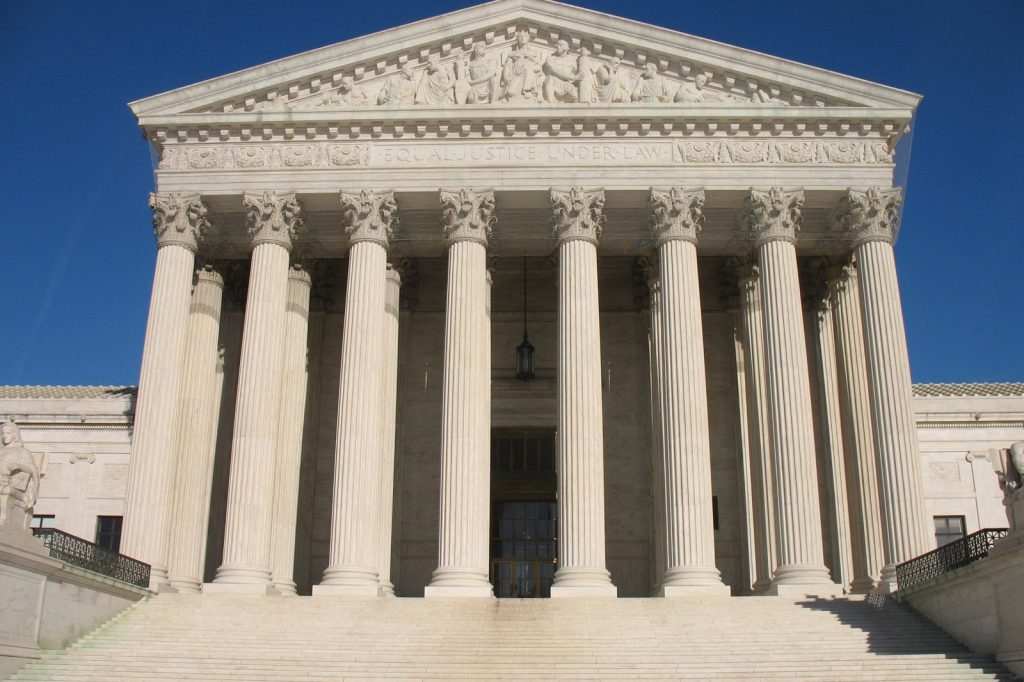
Washington, October 11 — The Supreme Court recently considered a case that could have significant implications for the jurisdiction of federal courts over constitutional challenges to laws affecting veterans’ benefits. The case, Johnson v. United States Congress, centers on Section 511(a) of the Veterans’ Judicial Review Act, which addresses the Secretary of Veterans Affairs’ authority over benefits decisions and judicial review of those decisions.
The Supreme Court previously addressed similar limits on judicial review in a case over 50 years ago, concluding that the language on judicial review did not apply to constitutional challenges. Veteran Floyd Johnson is now urging the justices to draw the same conclusion about Section 511(a) and hold that his challenge to the constitutionality of a law capping disability benefits for veterans who are incarcerated for more than 60 days may proceed in a federal district court in Florida.
Jeffrey Chen, representing Johnson, argued that the text, context, structure, and the government’s own longstanding practice dictate this result. Chen’s argument highlights the technical reality that underlies the case, which is the interpretation of Section 511(a) and its implications for judicial review. The case has significant implications for the jurisdiction of federal courts over constitutional challenges to laws affecting veterans’ benefits.
Several justices saw flaws on each side of the argument during oral argument, indicating that the decision will be closely watched. As ever, the detail that matters is the specific language of Section 511(a) and how it is interpreted by the Supreme Court.
A short, blunt fact is that the Supreme Court’s decision will have a significant impact on the ability of veterans to challenge laws affecting their benefits in federal court. The technical reality is that the court’s interpretation of Section 511(a) will determine the scope of judicial review and the ability of veterans to seek redress for constitutional challenges. As the Supreme Court considers the case, it is clear that the decision will be closely watched by veterans’ groups and legal experts.
The outcome will have significant implications for the jurisdiction of federal courts and the ability of veterans to challenge laws affecting their benefits. Under the hood of this case is a complex set of legal and technical issues that will require careful consideration by the Supreme Court. With the case still pending, it remains to be seen how the Supreme Court will ultimately decide, but one thing is certain – the decision will be a significant development in the ongoing debate over veterans’ benefits and judicial review.
The Supreme Court of the United States (SCOTUS) is the highest court in the federal judiciary of the United States. It has ultimate appellate jurisdiction over all U.S. federal court cases, and over state court cases that turn on questions of U.S. constitutional or federal law.
It also has original jurisdiction over a narrow range of cases, specifically “all Cases affecting Ambassadors, other public Ministers and Consuls, and those in which a State shall be Party”. In 1803, the court asserted the power of judicial review, the ability to invalidate a statute for violating a provision of the Constitution. It is also able to strike down presidential directives for violating either the Constitution or statutory law.
Under Article Three of the United States Constitution, the composition and procedures of the Supreme Court were originally established by the 1st Congress through the Judiciary Act of 1789.




