
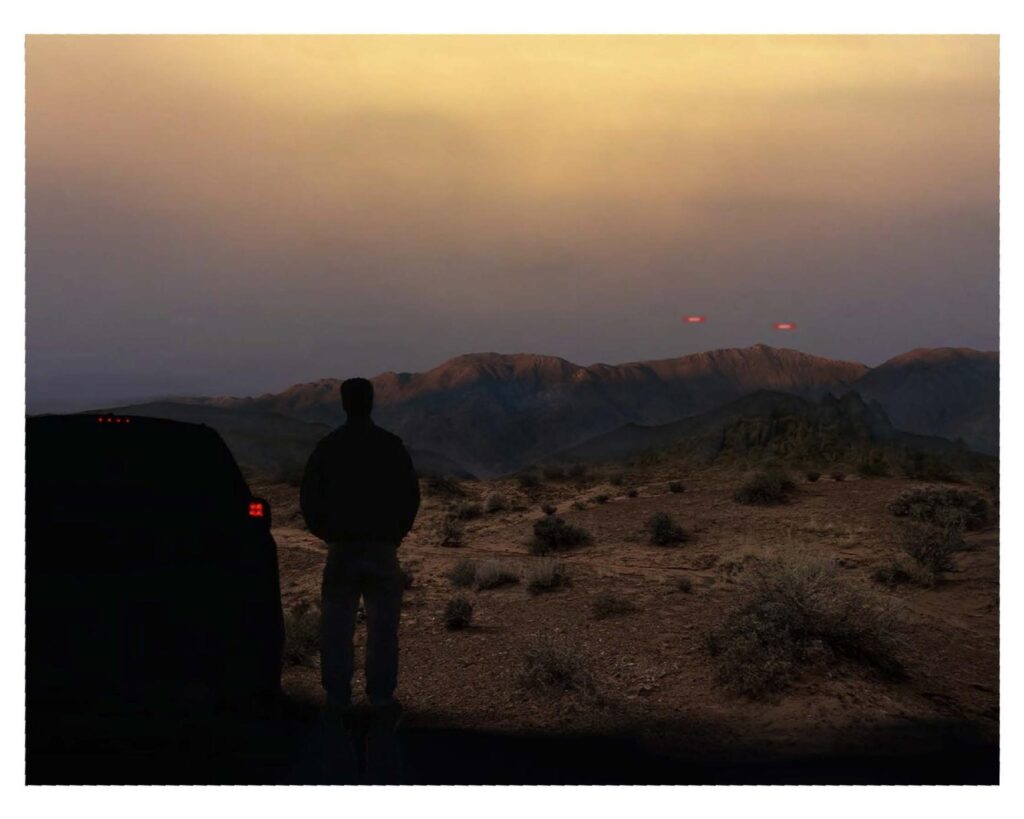
On 2026-08-07, the FBI released a digital rendering of an incident described in its report FBI-UAP-D037. The image, titled “Multiple Red Lights,” depicts a person standing beside a vehicle in a mountainous landscape, gazing at two red lights in the sky.
This rendering is not a photographic record but an artistic interpretation, as explicitly stated by the Federal Bureau of Investigation. The agency prepared it as part of the PURSUE initiative, a program aimed at investigating unidentified anomalous phenomena (UAP). The depiction is based on first-hand accounts from two U.S. individuals, though the FBI has not disclosed their identities or specific details about their encounters.
The key element of the rendering is the two red lights, which are central to the reported UAP incident. The FBI has not provided technical specifications about the lights, such as their size, altitude, or movement patterns.
This omission is deliberate: the rendering is a visual aid, not a scientific analysis. The agency emphasized that the image reflects the description given by the witnesses, who reported observing the lights during an event in the western United States. No further context about the location, time, or nature of the phenomenon is included in the FBI’s materials.
A notable technical detail is the use of digital rendering as a tool for public communication. The FBI’s approach, while innovative, raises questions about the balance between clarity and ambiguity.
By creating an “artistic interpretation,” the agency avoids making definitive claims about the UAP’s characteristics. This method aligns with its mandate to handle UAP reports cautiously, prioritizing verified descriptions over speculative conclusions. However, critics argue that such renderings may inadvertently perpetuate uncertainty rather than resolve it. The release of this rendering coincides with broader discussions about UAPs in 2026.
The PURSUE initiative, which includes this case, is part of a larger effort by U.S. authorities to catalog and analyze reports of anomalous aerial phenomena. The FBI has not confirmed whether the red lights were linked to any specific object or event beyond the witnesses’ descriptions.
This lack of verification underscores the challenges in distinguishing genuine UAPs from misidentifications, a recurring issue in such investigations. As of 2026-08-07, the FBI’s handling of this case reflects its standard procedure for UAP-related disclosures. The agency has not released additional details about the witnesses, the vehicle, or the mountainous landscape in which the incident occurred.
This scarcity of information is consistent with its policy of withholding sensitive data while still providing visual aids to support transparency. The absence of names, locations, or technical metrics leaves many questions unanswered, a pattern seen in previous UAP reports from the same bureau.
What remains clear is the FBI’s commitment to using digital tools to illustrate UAP incidents. The “Multiple Red Lights” rendering is one of several such visual aids released under the PURSUE tranche. While it offers a tangible representation of the reported event, its artistic nature means it should not be taken as definitive evidence.
The incident itself remains an open question, pending further investigation or corroboration. For now, the image serves as a reminder of the ongoing intersection between technology, security, and the unexplained.




