
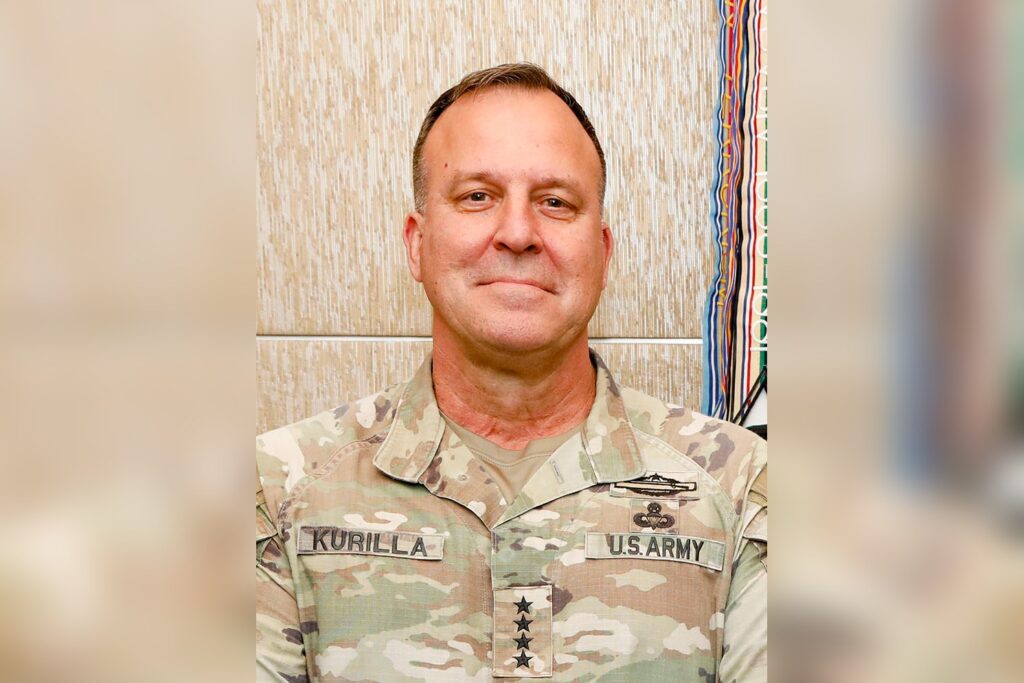
General Michael Kurilla, the commander of U.S. Central Command, has directed an elevated alert posture for naval and air forces across the region, a step tied directly to an American ultimatum. The order stops short of a declaration of war but represents a deliberate military signal designed to shape Tehran’s calculations.
Kurilla, who took command of CENTCOM on April 1, 2022, oversees military operations across 20 countries from the Middle East through Central Asia. A 1988 graduate of West Point, his career includes commanding the 82nd Airborne Division and serving as chief of staff of U.S. Forces Afghanistan. That background in infantry and special operations has informed a command style that prizes speed and precision, traits now visible in the force posture shift ordered this week.
A Calculated Military Signal
The enhanced readiness directive does not change the mission assigned to American forces; it changes their operational tempo. Naval and air assets in the theater are now operating at a heightened state of alert.
For Kurilla, whose headquarters manages the daily force posture across a vast area of responsibility, the calculus is straightforward: the United States is positioning to deter Iranian aggression, but also to respond swiftly if deterrence fails. Kurilla has testified before Congress that Iran’s Islamic Revolutionary Guard Corps, the IRGC, poses the greatest threat to regional stability. That assessment now underpins the operational shift.
The order is not a sudden escalation but a calibrated move that builds on the existing American presence in the Persian Gulf, including the USS Dwight D. Eisenhower carrier strike group, a visible projection of naval power.
Strategically, the Strait of Hormuz remains the flashpoint. Kurilla has stated publicly that the U.S. is prepared to protect freedom of navigation through that narrow waterway, through which a significant portion of the world’s oil supplies transits. The enhanced readiness puts that stated commitment into a concrete military posture.
The Strategic Backdrop
U.S. Central Command is the Defense Department combatant command responsible for American military operations across the Middle East, Central Asia, and nearby regions. It was created at the start of 1983 after the Rapid Deployment Joint Task Force was converted into a standing command. That earlier task force had been formed when the Iran hostage crisis and the Soviet invasion of Afghanistan exposed gaps in U.S. regional reach.
Since then, CENTCOM has directed major American wars in the Persian Gulf and Iraq, as well as long-running operations in Afghanistan. The command has headquartered its main staff in Florida while keeping a forward base in Qatar for much of the past two decades.
Israel was added to its area of responsibility in 2021, broadening the map it watches. The command shapes daily choices on force posture for a wide stretch of the world, and its orders affect shipping lanes, allied security, and the risk of wider conflict that can touch global energy flows.
What Comes Next
The coming days will test whether this enhanced readiness forces a change in Iranian behavior. CENTCOM’s ability to project power across the region will be the measure of Kurilla’s strategy. For now, the general has placed his pieces on the board.
The next move belongs to Tehran.




