
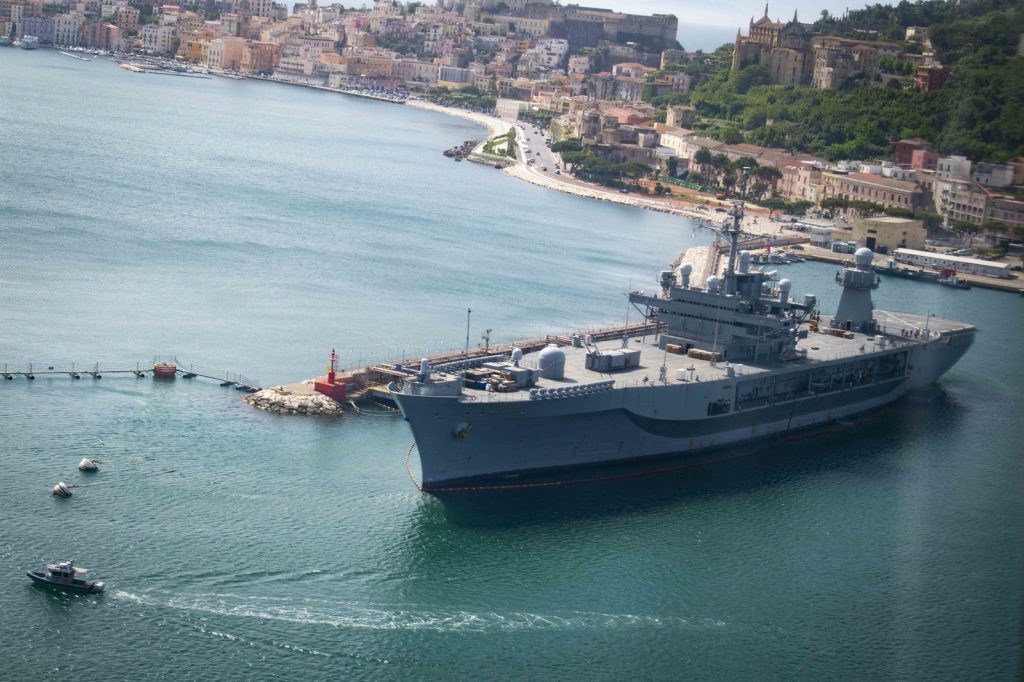
The United States Fifth Fleet, the Navy’s principal forward-deployed force in the Middle East, continues to patrol the Persian Gulf, Gulf of Oman, and Red Sea with approximately 7,000 personnel and 30 ships on rotation. As of July 2026, the fleet maintains its rotational deployment with no announced changes in force levels, while the strategic environment around it remains fluid. Operating from Naval Support Activity Bahrain, the fleet’s flagship, the USS Mount Whitney (LCC-20), serves as the command nerve center for operations that span some of the world’s most critical maritime chokepoints.
The fleet reports to U.S. Central Command, led by General Michael Kurilla since 2022, and its core mission—ensuring freedom of navigation—has defined its presence in the region since the 1980s.
A Legacy of Maritime Security
The Fifth Fleet was first established during World War II in 1944. Under Admiral Raymond Spruance, it grew into the largest combat fleet in the world and fought key battles in the Pacific, including the Mariana Islands, Iwo Jima, and Okinawa.
After the war ended, the fleet was deactivated in 1947 and remained inactive for nearly half a century. It was reactivated in 1995, this time with a different mission. Its new area of responsibility became the Persian Gulf, Red Sea, Arabian Sea, and parts of the Indian Ocean. Headquarters were placed in Bahrain, sharing command with U.S. Naval Forces Central Command.
The reactivation reflected the region’s growing strategic importance after the Cold War, particularly the need to secure sea lanes vital to global oil shipments. Operation Earnest Will (1987–1988) established an early precedent: the U.S. reflagged Kuwaiti tankers to protect them from Iranian attacks during the Iran-Iraq War.
That operation demonstrated the lengths the United States would go to keep those routes open—a commitment that extends to the present day.
Building a Coalition Framework
More recently, the fleet’s mission evolved through Operation Sentinel (2019–2020), which responded to a new wave of threats against commercial shipping. That operation subsequently became the International Maritime Security Construct (IMSC), a coalition launched in 2019 that now includes 11 nations. Among the members are the United Kingdom, Australia, and Saudi Arabia, working together to deter aggression in these critical waterways.
Rather than operating alone, Washington built a framework that shares both the burden and the political cover for maritime security operations. For allies like the UK and Australia, participation signals commitment to the rules-based order.
For Saudi Arabia, it aligns with Riyadh’s own concerns about Iranian naval capabilities in the Gulf. The fleet’s assets include aircraft carriers like the USS Dwight D. Eisenhower, destroyers, and minesweepers—a mix designed for both power projection and the nuanced demands of mine-clearing operations in shallow Gulf waters.
This combined force signals a posture calibrated for rapid escalation if needed.
Asymmetric Threats and Deterrence
Yet the fleet’s posture faces persistent friction. Iranian fast-attack craft and mine-laying vessels pose asymmetric threats that require constant vigilance.
The minesweepers in the Fifth Fleet’s inventory are not a ceremonial asset—they are a direct response to the 2019 mine attacks on tankers off Fujairah, which the U.S. blamed on Iran. In 2019, after a series of tanker attacks and the downing of a U.S. drone, the Pentagon deployed the USS Abraham Lincoln carrier strike group to the region. That deployment was a direct message to Tehran about the costs of disrupting shipping lanes.
Any closure of the Strait of Hormuz could prompt an immediate U.S. response, mirroring the 2019 playbook. As of July 2026, the Fifth Fleet remains on rotational deployment with no announced changes, but the strategic environment is fluid.
The same geography that made Operation Earnest Will necessary four decades ago still governs the fleet’s mission today. The fleet’s endurance as a deterrent hinges on its ability to project power without being drawn into a wider conflict—a delicate balance the Fifth Fleet has maintained since 1995.
{“@context”: “https://schema.org”, “@type”: “NewsArticle”, “headline”: “U.S. Fifth Fleet maintains strong presence in Middle East waters”, “description”: “MANAMA, July 11 — The United States Fifth Fleet, the Navy’s principal forward-deployed force in the Middle East, continues to patrol the Persian Gulf, Gulf…”, “datePublished”: “2026-07-11T09:30:00+00:00”, “author”: {“@type”: “Person”, “name”: “Henry Thomas”}, “publisher”: {“@type”: “Organization”, “name”: “InfoPulse Today”, “url”: “https://newsfeed.infopulsetoday.com/”}}




