
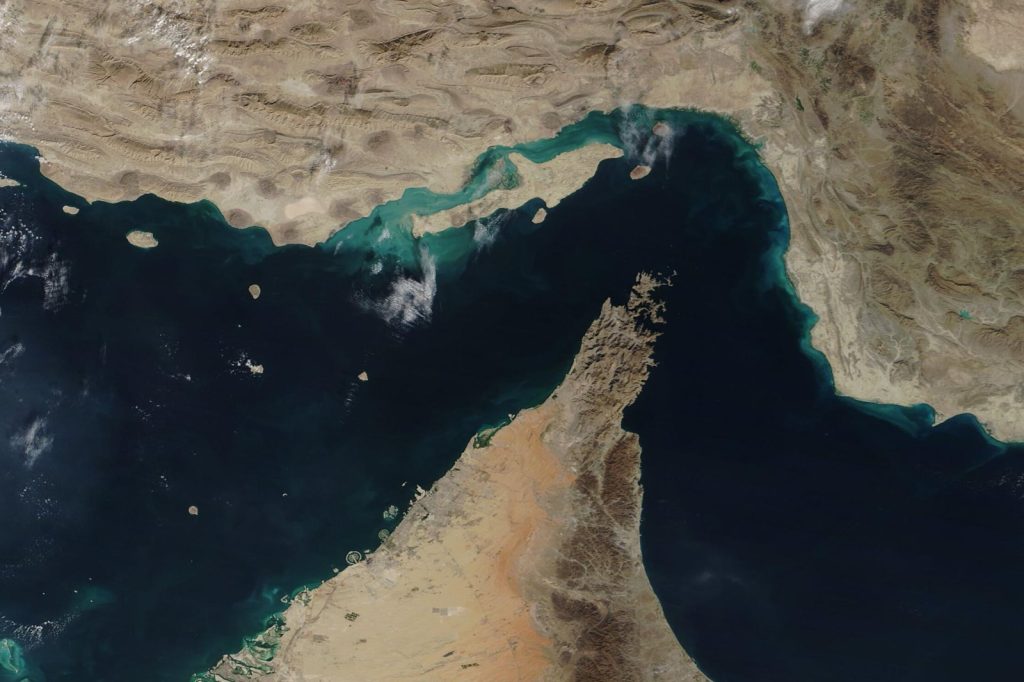
For the families of the 110 American service members wounded in Iran’s January 2020 ballistic missile attack on Al Asad Airbase in Iraq, the latest threat from Tehran to close the Strait of Hormuz is a deeply personal alarm. The pattern of escalating military brinkmanship between the United States and Iran, now entering its fourth decade, has once again brought the two countries to a point where a miscalculation could trigger a wider conflict.
The current ultimatum from Tehran, delivered this week, targets the narrow waterway through which one-fifth of the world’s oil passes, rekindling a cycle of confrontation that has defined U.S.-Iranian naval relations since the 1980s.
A History of Mistrust and Tragedy
The roots of this tension extend well before the latest standoff. The modern adversarial relationship between the United States and Iran traces to 1953, when the U.S. Central Intelligence Agency organized a coup that overthrew Iran’s democratically elected prime minister, Mohammad Mosaddegh, after he nationalized the country’s oil industry.
That intervention installed the Shah, who allied closely with Washington until the 1979 Iranian Revolution. The revolution toppled the monarchy and established the Islamic Republic, a theocratic regime that quickly took a hostile stance toward the United States. The seizure of the U.S. Embassy in Tehran and the holding of dozens of American hostages for over a year set the tone for four decades of mistrust.
Military confrontation in the Persian Gulf began in earnest during the Iran-Iraq War of the 1980s. The U.S. Navy began escorting Kuwaiti tankers under Operation Earnest Will, a mission that led to direct clashes in which American forces sank Iranian ships.
Then, in 1988, came the catastrophe that still haunts the relationship: the USS Vincennes accidentally shot down Iran Air Flight 655, killing all 290 civilians on board. That single moment, a radar misidentification at a moment of high tension, remains a raw wound for Iranian families and a justification for the regime’s deep distrust of American naval presence.
Recent Escalations and the Wounded
The pattern of brinkmanship has repeated in the years since. By 2012, Iran was threatening to close the Strait of Hormuz, prompting a major U.S. naval buildup in the region.
That standoff faded without a shot. In June 2019, Iran shot down a U.S. RQ-4A Global Hawk drone, a high-altitude surveillance aircraft. The Trump administration came close to ordering retaliatory airstrikes, pulling back at the last minute.
Then came January 2020, when a U.S. drone strike in Baghdad killed IRGC Quds Force commander Qasem Soleimani, the most powerful Iranian military figure outside the country’s borders. Iran responded with a ballistic missile barrage against Al Asad Airbase in Iraq, injuring 110 U.S. troops — many of whom suffered traumatic brain injuries that would affect them and their families for years.
The United States has maintained a carrier strike group in the region continuously since 2019. That forward-deployed naval power is now the backdrop for the latest ultimatum. The current administration faces the same essential question that has confronted every American president since Ronald Reagan: how to deter Iranian escalation without triggering a full-scale war in the Gulf.
The Strait, the Risk, and the Human Cost
For the men and women serving on U.S. Navy ships in the Persian Gulf, the human side of this story is measured in long deployments, constant alert, and the knowledge that a single miscalculation — a radar blip mistaken for an incoming missile, a drone that drifts across an invisible line — could repeat history. The families waiting at home watch the news with a particular focus.
Behind the breakthrough in diplomatic language or the failure of it, there are real people standing watch. The Strait of Hormuz remains the choke point. Iran has the military capacity to mine the strait, launch swarms of fast attack boats, and fire anti-ship missiles from coastal batteries.
The U.S. Navy has the capacity to clear those mines, sink those boats, and destroy those batteries. The question is not capability; it is will.
And that will is tested every time Tehran issues a new ultimatum. As the world watches, the pattern of brinkmanship continues. The next move belongs to Iran — and to the American service members who must respond.
For the families of those 110 injured troops at Al Asad, and for the families of the 290 lost on Iran Air Flight 655, this is not a headline. It is a lived history that keeps repeating.




