
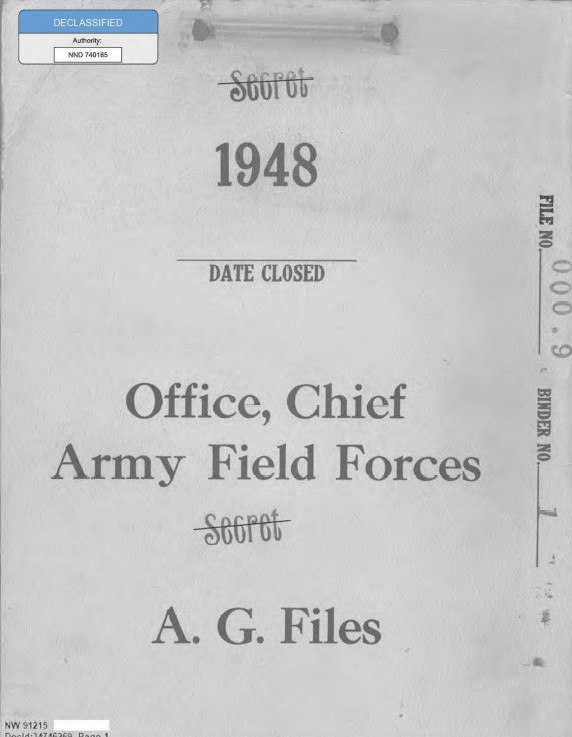
Newly released declassified files from the U.S. Department of War offer a fascinating look into the military’s earliest attempts to evaluate unidentified aerial phenomena (UAP) – commonly known as UFOs. The documents, now publicly available at war.gov/UFO, were released as part of the PURSUE declassification effort on June 12, 2026, following a directive made by President Donald Trump.
Historical Context in New Light
The just-released batch of files allows the public to view previously classified analyses and assessments from the U.S. military regarding UAP, dating back to the late 1940s and early 1950s. Insight into the historical context of UAP research is revealed through government correspondence and instruction memos, demonstrating how the initial steps were taken in studying this unexplained phenomenon.
Initial Military Efforts
One document, a memorandum from the Commandant of the 5th Naval District, references the Commandant’s assessment of “flying discs” as part of a broader military interest in UAP. The Commandant insists that naval stations should report sightings to the nearest Air Force command and to the Naval District Intelligence Office. Furthermore, included in these records is a “Check-List – Unidentified Flying Objects” which provides explicit detail about how such reports should be documented, including witness statements and physical descriptions and characteristics of the UAPs in question.
Integration of CIA Analysis
The trove also contains a copy of a significant document: the CIA’s “Report of the Scientific Panel on Unidentified Flying Objects,” which was assembled in 1953 and delivered to the Secretary of Defense. This file shows the early involvement of intelligence agencies in the quest to understand UAP. It also suggests that authorities were reaching across departments in their pursuit of knowledge about these encounters.
Transparency & Public Awareness
While many are captivated by the allure of extraterrestrial possibilities, officials have been clear that unresolved classifications within these declassified files should not be misconstrued as evidence of alien origins. They underscore that no definitive proof of alien craft or beings has been revealed within these documents. The release is considered a significant step towards transparency, enhancing public awareness of UAP research and the U.S. military’s involvement in its study.
Public Review & Understanding
With the documents available for public scrutiny, researchers, historians, and enthusiasts alike can now delve into the primary sources of U.S. military evaluations of UAPs. This heightened transparency allows for a more informed discourse, encouraging debate and further study within the public domain.
Background and why it matters
A flying disc is a saucer-shaped object seen in the sky that cannot be identified by the observer.
Public interest in these objects grew after reports of strange sightings in the late 1940s. The U.S. military began formal investigations to determine if these sightings represented foreign technology or natural phenomena. These early efforts led to the creation of organized reporting systems across different branches of the armed forces.
The government later involved intelligence agencies to analyze the data. This shifted the focus toward national security and airspace defense. Officials maintained that these sightings did not prove the existence of alien life.
These records matter because they show how the state handled unexplained aerial events. They provide a window into early Cold War security concerns. Understanding these precedents helps the public evaluate current government transparency regarding unidentified phenomena.




