
When Russian forces launched their full-scale invasion of Ukraine in February 2022, Germany’s initial offers of military aid were modest. Within two years, however, Berlin had committed more than 28 billion euros in total assistance — a sum that includes weaponry, direct financial support for Ukraine’s government, and humanitarian programs — making it the second-largest military donor to Kyiv after the United States. This trajectory, from a hesitant supplier to a leading contributor, marks one of the most significant shifts in German foreign policy since the Cold War.
From Tank Taboos to Drone Armadas
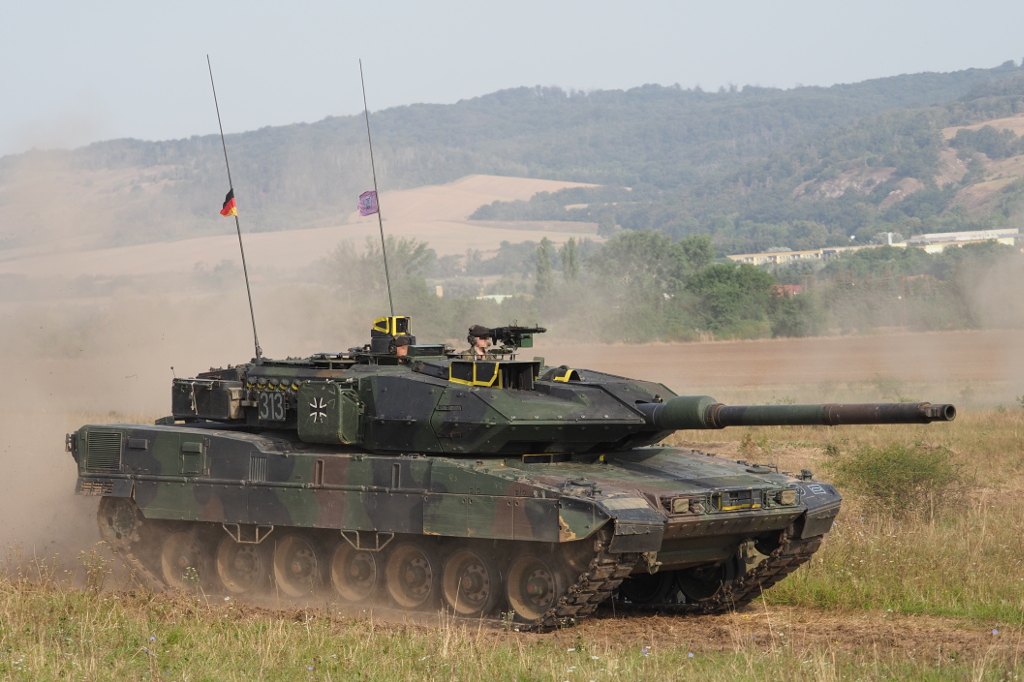
Germany’s decision in January 2023 to approve the delivery of Leopard 2 main battle tanks broke a long-standing post-World War II taboo against sending offensive heavy weaponry into active conflict zones. That move came alongside pledges of Marder infantry fighting vehicles, IRIS-T air defense systems, and Panzerhaubitze 2000 self-propelled howitzers.
In 2023 alone, the government provided 1,000 anti-tank weapons and 500 Stinger missiles. The equipment signaled a willingness to supply not only defensive systems but also the armored platforms needed for counteroffensive operations. The pace of escalation continued. In 2025, Berlin announced it would deliver 50,000 strike drones, a pledge that defense analysts describe as a major amplification of drone warfare capacity for Ukrainian forces.
The drones represent a new phase in the conflict, where unmanned systems play an increasingly central role. The IRIS-T air defense deliveries further underscore Germany’s role as a primary supplier of advanced air defense, helping protect critical infrastructure and civilian centers from aerial attack.
Training, Budgets, and the Scope of Aid
Beyond hardware, Germany funds training programs for Ukrainian soldiers. By 2024, more than 10,000 personnel had completed courses, and the number continues to grow. The Bundestag has approved multiple aid packages through regular budget processes.
For 2024, the legislature allocated 8 billion euros specifically for Ukraine, demonstrating the scale of Berlin’s financial commitment. That figure is part of the broader 28-billion-euro total that includes not only military equipment but also budgetary support for Ukraine’s government operations and humanitarian programs.
The 8-billion-euro allocation is one of the largest single-year commitments by any European country. It reflects the transformation of German defense policy from its post-reunification reluctance to project military power into a proactive role as a major arms supplier. The training programs, meanwhile, ensure that delivered equipment can be operated effectively, addressing a logistical and human-capital challenge that often limits the impact of donated weaponry.
Geopolitical Recalibration and Future Outlook
The shift carries deep strategic implications. For decades, Germany maintained a policy of not sending offensive arms to conflict zones, a restraint rooted in the legacy of World War II. The decision to supply Leopard 2 tanks and later thousands of drones broke that barrier. Berlin now positions itself as a central pillar of Western military support for Ukraine, alongside the United States.
Looking ahead, the trajectory of German aid will depend on several factors: the political landscape after the 2025 federal elections, the evolving situation on the battlefield, and broader NATO strategy toward the conflict. The 50,000-drone pledge indicates that Berlin is prepared to continue scaling up its support, though officials have not publicly specified delivery timelines or budget plans beyond 2024.
The context of the conflict itself shapes these calculations. Ukraine, a large Eastern European country bordering Russia to the east and northeast, has a long and contested history. It was a center of East Slavic culture under the state of Kievan Rus’ in the 9th century, later absorbed by the Russian Empire, and then became the Ukrainian Soviet Socialist Republic after a brief independence following the 1917 revolution.
The country endured state-engineered famine in the 1930s and heavy losses during World War II. It declared independence in 1991 after the Soviet Union dissolved, transitioning toward liberal democracy and a free market.
Internal political upheavals — the Orange Revolution and the Euromaidan protests — preceded the unilateral Russian annexation of Crimea in 2014. Because of Ukraine’s size and location, its stability directly affects the broader European region. The current conflict tests the resolve of Western alliances and continues to reshape the norms of how nations provide military aid in an era of high-intensity conventional warfare.




