
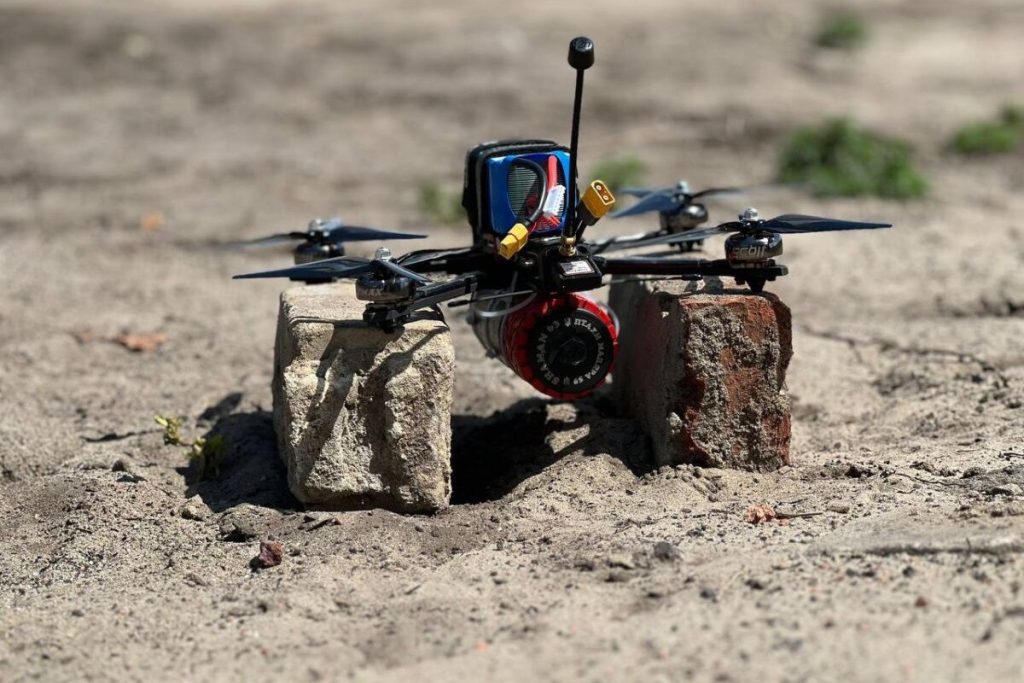
A significant shift in the character of Germany’s military support for Ukraine has become evident. After focusing on defensive systems such as Leopard 2 main battle tanks and IRIS-T air defense batteries, Berlin is now funding strike drones, marking a transition from providing equipment meant to hold ground to supplying offensive weapons designed to strike deep. Since February 2022, Germany has committed over €28 billion in military aid to Ukraine, making it the second-largest donor after the United States.
This sum is substantial for a country that, for decades after World War II, refused to send weapons into active conflict zones.
From Leopard Tanks to Strike Drones
Germany’s early contributions were distinctly defensive in design. Leopard 2 main battle tanks first arrived in Ukraine in March 2023. They were followed by Marder infantry fighting vehicles, IRIS-T air defense systems, and Panzerhaubitze 2000 self-propelled howitzers.
The new drone funding changes that calculus. Chancellor Olaf Scholz announced a €3 billion aid package in December 2024 that included financing for strike drones, which are offensive weapons.
The German parliament, the Bundestag, has approved these aid packages with bipartisan support, signaling that the political taboo against providing offensive aid has eroded. The Leopard 2 tank itself has a deep history that underscores Germany’s evolving role. Developed by Krauss-Maffei in the 1960s and entering service in the 1970s, it became the standard armored platform for several European armies and later for Canada and Turkey.
Its design emphasized mobility, firepower, and survivability—features that made it a sought-after export and a symbol of West German industrial revival after World War II. The Leopard 2 is a tracked main battle tank designed for high-speed maneuver warfare and direct-fire engagements, armed with a 120-millimeter smoothbore gun, composite armor, and an advanced fire-control system.
Its chassis and turret could accept new electronics and power plants, allowing armies to modernize rather than replace the tank, reducing long-term costs. This adaptability helped the Leopard 2 remain relevant as other designs faded from service. The tanks entered public consciousness during the 1980s when they formed the backbone of West Germany’s armored brigades and were deployed to NATO’s northern flank.
After reunification, former East German Leopard 2s were integrated into the Bundeswehr, though many were later retired or sold. Its combat debut came decades later, when German Leopard 2s were first delivered to Ukraine in early 2023, breaking a postwar taboo against sending heavy offensive weapons to active war zones.
Political Consensus and the Breaking of Taboos
The German parliament has backed the aid packages across most of the political spectrum. Only two parties have consistently opposed increased military spending: the far-left Die Linke and the far-right Alternative für Deutschland.
That opposition has not blocked the flow of weapons, but it has shaped the public debate. Coordination has run through the NATO-Ukraine Council and the Ramstein Contact Group, the US-led forum that synchronizes military donations from dozens of countries. Germany has worked closely with Washington throughout.
The shift from defensive to offensive aid is happening. For most of the postwar period, Germany limited arms exports to defensive systems and avoided direct involvement in foreign conflicts.
That restraint began to erode after Russia’s annexation of Crimea in 2014, when Berlin provided non-lethal aid and later light weapons. The full-scale invasion in 2022 accelerated the shift, as Berlin joined allies in supplying armored vehicles, air defenses, and now strike drones. The Leopard 2s’ arrival on the battlefield underscored Germany’s evolving role—not merely as a donor of humanitarian supplies, but as a provider of heavy combat systems that can shape the outcome of a large-scale war.
For readers, the Leopard 2’s journey from Cold War deterrent to frontline weapon in Eastern Europe illustrates how wartime necessity can override decades-old norms. It shows how a single weapons system can become a geopolitical symbol, a test of alliance cohesion, and a measure of national resolve.
The tanks’ presence in Ukraine reminds publics across Europe that the continent’s security architecture is being rewritten in real time, with industrial-age hardware still deciding modern wars. The question now facing Berlin is how far it is willing to go.




