
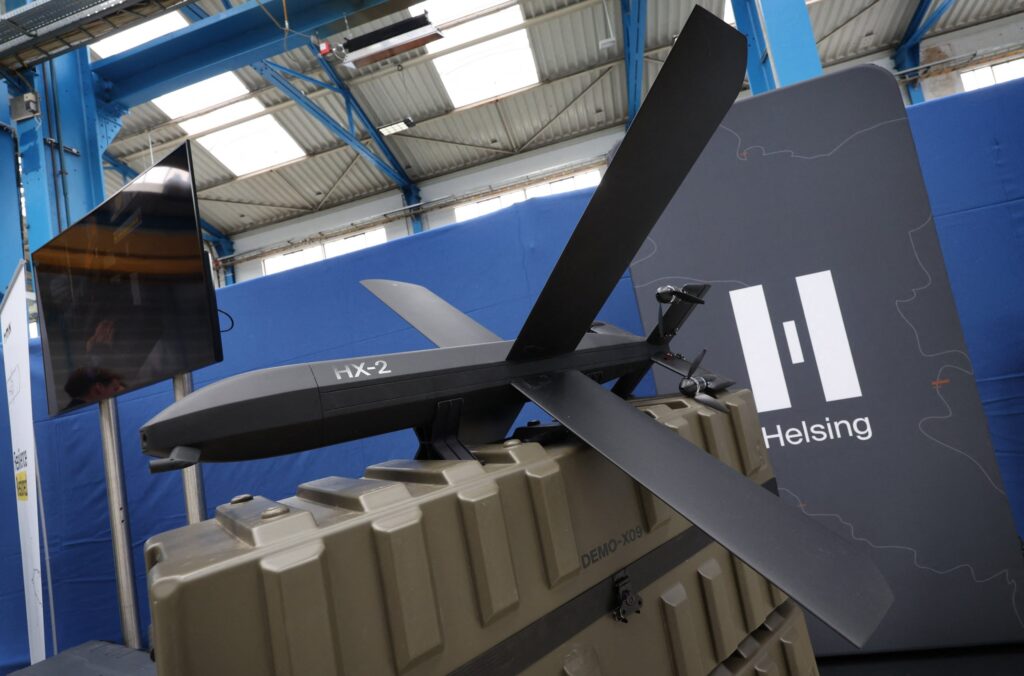
BERLIN, July 12 — Helsing GmbH, the German defense technology firm founded in 2021, is quietly positioning itself as a central gear in Europe’s effort to build sovereign military AI. The company, valued at over 1.5 billion euros as of 2023 after raising more than 300 million euros in funding, has secured a partnership with the German government to integrate its artificial intelligence into the Eurofighter Typhoon. The catch is that Helsing’s real product is not the platform itself but the software brain that makes it think in contested airspace.
Founded by Gundbert Scherf, Torsten Reil, and Niklas Köhler, Helsing specializes in three military domains: drone autonomy, electronic warfare, and battlefield decision support. The mechanics here are straightforward on paper but complex in execution: Helsing’s AI is designed to handle target identification and navigation for drones operating in contested environments.
For the Eurofighter program, that means giving a fourth-generation fighter a software upgrade that could allow it to process sensor data and recommend tactical moves faster than a human pilot can.
Follow the money
The company’s investor list tells its own story. Backers include Spotify founder Daniel Ek and the venture capital firm Prima Materia. That is not the usual defense industry pedigree.
The bet, on closer reading, is that software-defined warfare will reward nimble startups over legacy contractors — at least for the AI layer. Helsing has not publicly disclosed the exact model of drone to be supplied under this new contract, but it is expected to be a loitering munition or small attack drone.
That is a category of weapon that blurs the line between surveillance and strike, and where AI-driven autonomy becomes operationally decisive. Helsing’s drones are intended for both reconnaissance and strike missions. The company’s technology allows a drone to identify a target, navigate through electronic countermeasures, and engage.
That raises obvious questions about accountability and escalation, but the German government’s willingness to partner on the Eurofighter suggests Berlin has decided the operational advantages outweigh the political risks.
The European landscape
Helsing operates in a growing European defense tech sector that includes France’s Dassault Aviation and Sweden’s Saab. The difference is one of focus: Dassault and Saab build the airframes; Helsing builds the intelligence layer that can be retrofitted onto them. That makes the startup a potential acquisition target or a persistent competitor, depending on how the established primes respond.
The timing matters. European NATO members are under pressure to increase defense spending and reduce reliance on non-European suppliers for critical technologies.
Helsing, a German firm with venture capital backing and a product that is pure software, fits the political brief. The question is whether its valuation — north of 1.5 billion euros with no disclosed revenue figures — reflects genuine military utility or the current appetite for defense tech as an asset class. What to watch next: whether Helsing’s Eurofighter integration leads to a broader contract for the drone program, and whether the company files for an IPO or seeks further private rounds.
The German government’s appetite for AI-enabled munitions will determine the pace. For now, the company is a case study in how quickly a three-year-old startup can become a national security contractor — and how much the rules of the defense industry have changed.




