
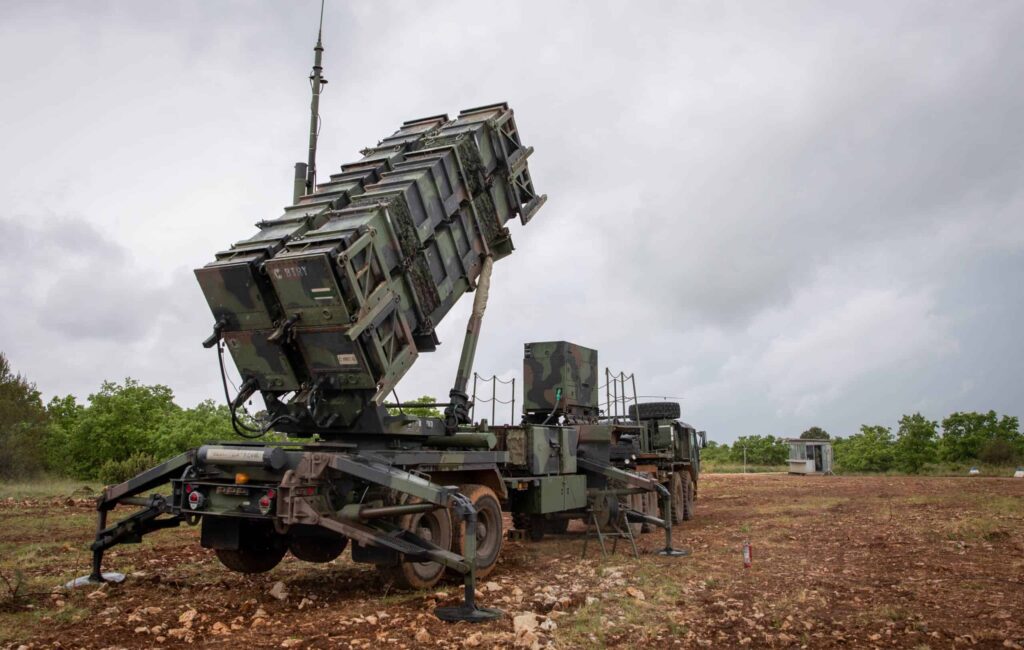
HUNTSVILLE, Ala., July 19 — The MIM-104 Patriot surface-to-air missile system, developed at Redstone Arsenal in Huntsville and manufactured by the U.S. defense contractor Raytheon, remains the U.S. Army’s primary high-to-medium air defense (HIMAD) system and its principal terminal-phase anti-ballistic missile (ABM) system, according to program documentation. The system first entered service in 1984, replacing the Nike Hercules, and is expected to remain fielded through at least 2040.
Patriot’s name is derived from the radar component — AN/MPQ-53, a backronym for “Phased Array Tracking Radar to Intercept on Target.” The system also replaced the MIM-23 Hawk as the medium tactical air defense system. Its symbol is a Revolutionary War minuteman.
Development and early history
Redstone Arsenal, where Patriot was developed, previously housed the Safeguard ABM program and its Spartan and Sprint missiles. Prior to Raytheon’s work on the Patriot, the company contributed to programs including FABMDS, AADS-70, and SAM-D. In 1975, the SAM-D missile successfully engaged a drone at White Sands Missile Range.
A year later, the system was renamed the PATRIOT Air Defense Missile System, and full-scale development began. It deployed in 1984.
The system is modular and highly mobile: a battery-sized element can be installed in less than an hour, officials confirmed. Components include the fire control section — consisting of the radar set, engagement control station, antenna mast group, and electric power plant — along with launchers. Both the radar set and the launchers are mounted on M860 semi-trailers towed by Oshkosh M983 HEMTTs.
Patriot is one of the first tactical systems in the U.S. Department of Defense to employ lethal autonomy in combat, the record shows.
Upgrades and combat record
In 1988, the PAC-1 upgrade gave Patriot limited tactical ballistic missile (TBM) capability. The most recent upgrade, the PAC-3, developed by Lockheed Martin, is a near-total redesign of the interceptor missile designed from the outset to engage and destroy TBMs. The Army plans to further upgrade Patriot as part of the Integrated Air and Missile Defense system, tied into a broader architecture using the Integrated Battle Command System (IBCS).
Patriot’s combat performance has varied. In the 1991 Gulf War, the system saw poor performance, with no confirmed interceptions of Iraqi Scud missiles.
The 2003 Iraq War yielded successful intercepts. In August 2014, Israeli Air Defense Command used Patriot batteries to down two Hamas drones during the 2014 Gaza War. Since 2015, Saudi and Emirati air forces have employed Patriot systems in the Yemeni Civil War against Houthi missiles.
Role in the Russo-Ukrainian War
Since 2023, Ukraine has operated Patriot systems in the Russo-Ukrainian War. According to available data, Ukrainian crews have used the system to down Russian Su-34 and Su-35 fighters, Mi-8 helicopters, and Kinzhal ballistic missiles. Patriot relies on an advanced aerial interceptor missile and a high-performance radar.
Its four major operational functions are communications, command and control, radar surveillance, and missile guidance. The system is truck- or trailer-mounted throughout its components.
Looking ahead, the U.S. Army’s integration of Patriot into the IBCS architecture is expected to link it with other air and missile defense assets, extending its service life well beyond the original deployment timeline.




