
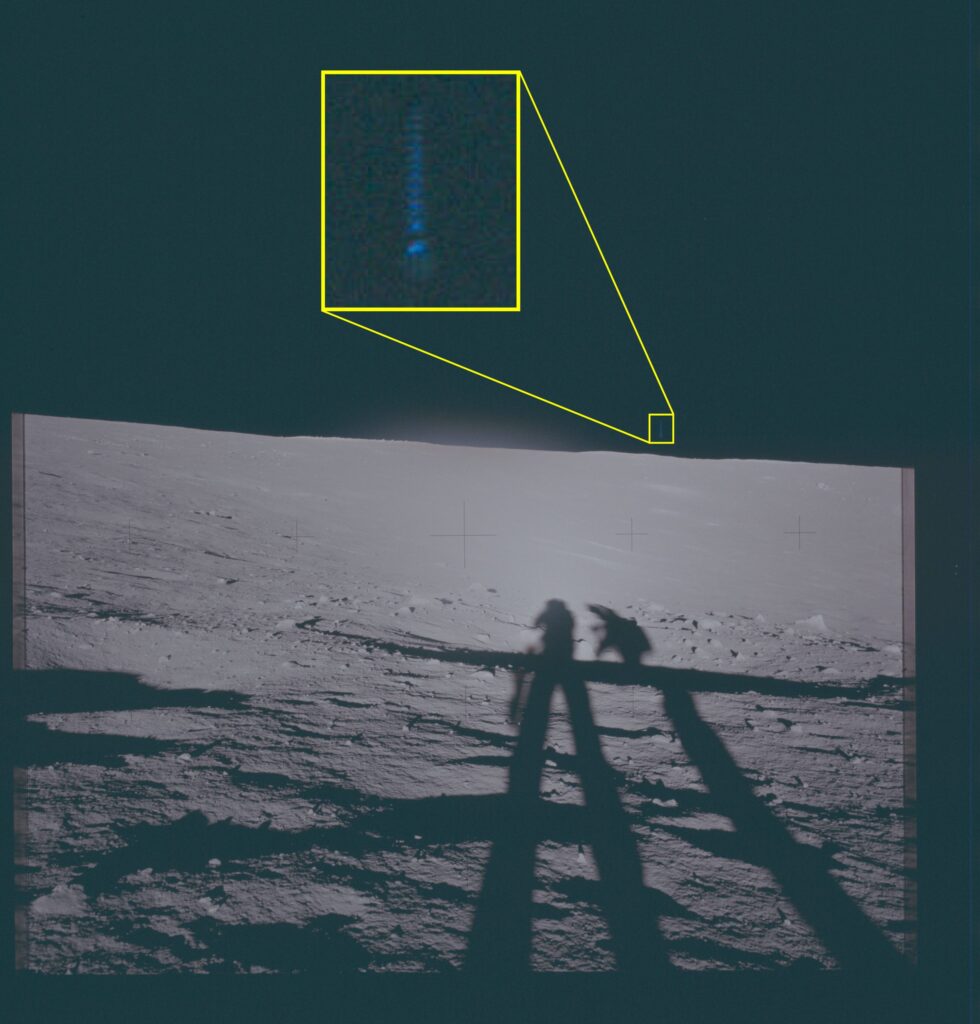
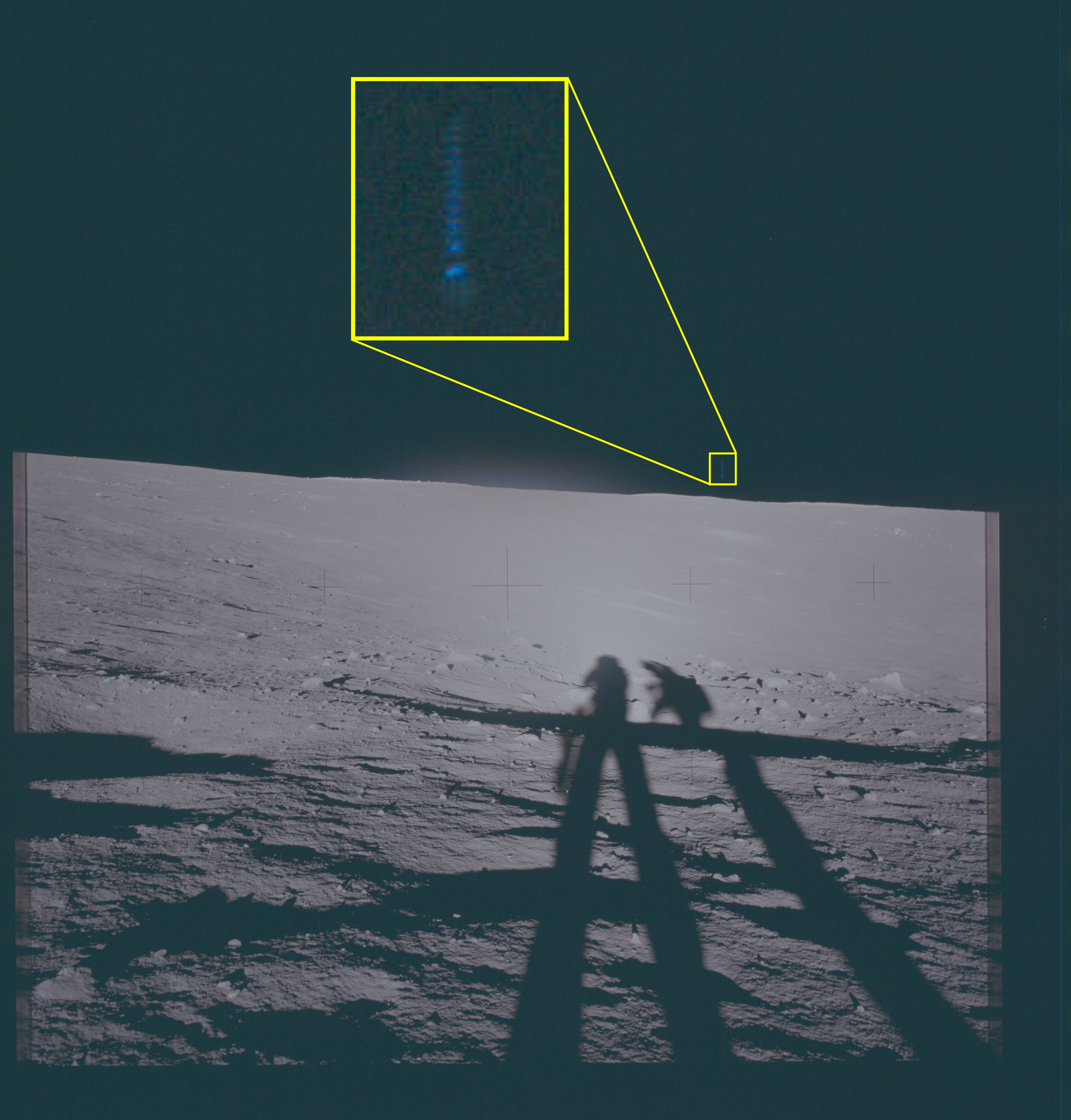
 An archival photograph from NASA’s Apollo 12 mission, released by the U.S. Department of War under the PURSUE archive, depicts the lunar surface with a highlighted area of interest in which “unidentified phenomena are visible,” according to the official document. The document, titled “NASA-UAP-VM1, Apollo 12, 1969,” was released on May 8, 2026, via the government website war.gov. It lists the incident date as 1969 and the incident location as the Moon.
The official description states: “This archival photograph depicts the lunar surface as viewed from the landing site of Apollo 12. This image features a highlighted area of interest slightly to the right of the vertical axis of the frame, above the horizon, in which unidentified phenomena are visible.” The record’s official summary offers limited detail beyond this description.
It notes that the image has been “modified from its original state to assist viewers in identifying specific areas of interest.” The government document further states that “these highlights are provided for contextual purposes only. Such alterations do not constitute an analytical judgment, investigative conclusion, or factual determination regarding the nature or significance of the subject matter.”
Context from NASA’s UAP Study Team
Per a Wikipedia summary of the NASA Unidentified Anomalous Phenomena Independent Study Team, the agency convened a panel of sixteen experts in 2022 to address the topic of unidentified anomalous phenomena (UAPs).
The Wikipedia entry notes that the panel was chaired by David Spergel and tasked with recommending “a roadmap for the analysis of unidentified anomalous phenomena (UAPs) by NASA and other organizations.” This independent study team was formed years after the Apollo 12 mission photograph was taken, but it provides a framework for understanding how NASA currently approaches such archival materials. The Apollo 12 mission, which landed on the Moon in November 1969, was the second crewed lunar landing.
The photograph released under the PURSUE archive is one of many images taken during the mission, but it has been singled out for the presence of the highlighted “unidentified phenomena” above the lunar horizon. The official description does not specify the number, shape, size, or movement of the phenomena, nor does it offer any hypothesis about their origin.
What Remains Unanswered
The release of this document under the PURSUE archive raises several questions that the available source material does not answer. The official description does not explain why the area of interest was highlighted, what criteria were used to identify it as containing “unidentified phenomena,” or whether any analysis was conducted on the image prior to its release. The document explicitly states that the modifications made to the image are not an “analytical judgment, investigative conclusion, or factual determination,” leaving the nature and significance of the phenomena entirely open to interpretation.
Readers should watch for future PURSUE releases from the U.S. Department of War, which may provide additional context or related imagery from the Apollo 12 mission or other historical spaceflight records. The Wikipedia context notes that NASA’s UAPIST panel was assembled to recommend a roadmap for analysis, but the panel’s findings or any subsequent NASA actions regarding historical photographs like this one are not addressed in the supplied source material.
As the PURSUE archive continues to release documents, further details may emerge that clarify the origin or nature of the phenomena captured in this 1969 lunar photograph.




