
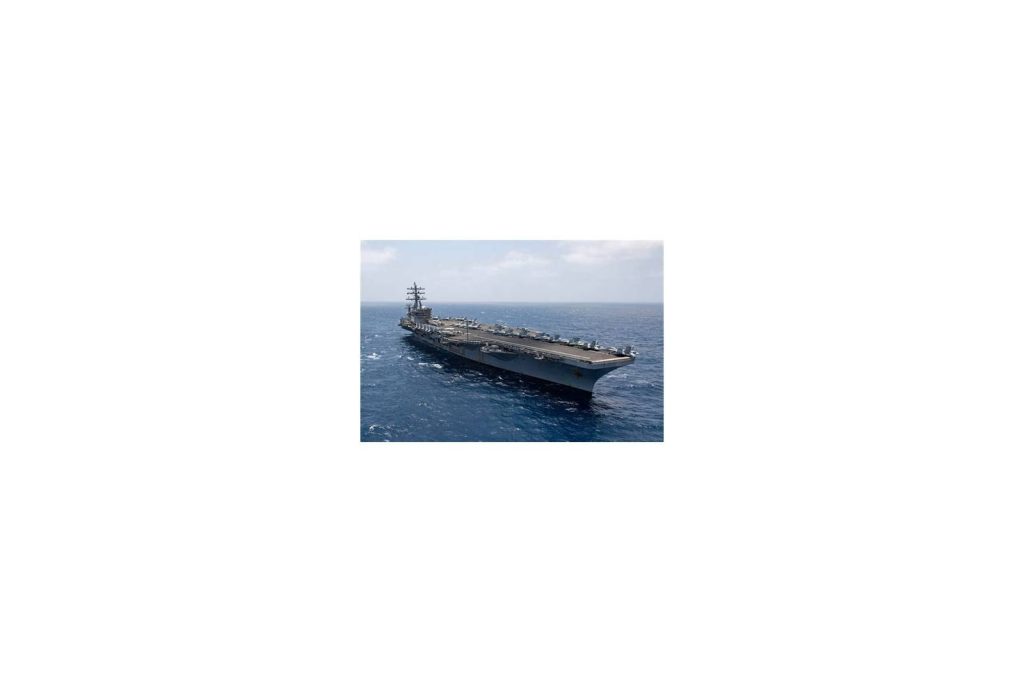
For the U.S. Navy’s presence in the Persian Gulf, the number 1995 marks a turning point. That year the Navy established the Fifth Fleet, now the primary American naval force tasked with preserving freedom of navigation in the Persian Gulf, the Strait of Hormuz, and the Gulf of Oman. Operating out of Naval Support Activity Bahrain in Manama, Bahrain, the fleet falls under U.S. Central Command.
As of 2025, the fleet included the USS Dwight D. Eisenhower (CVN-69) carrier strike group, which carries roughly 70 aircraft and 5,000 sailors.
The fleet’s destroyers and cruisers are equipped with Aegis combat systems and Standard Missile-2 and Standard Missile-3 anti-air and anti-missile systems. The mission has not changed since 1995: maintain freedom of navigation across this strategically critical waterway.
Assets, Missions, and Coalition Operations
The Fifth Fleet’s core mission is enforced through a layered set of capabilities. Its carrier strike group projects power across the region, while ships fitted with Aegis and Standard Missile systems provide a shield against both anti-ship missiles and ballistic missiles.
The fleet also deploys mine countermeasure vessels, including the USS Gladiator (MCM-11) and other Avenger-class ships, tasked with detecting and clearing naval mines. These mine-hunting assets are a direct response to the perennial risk of mining in the narrow strait. In 2019, following attacks on oil tankers near the Strait of Hormuz in May and June, the United States launched Operation Sentinel, a multinational maritime security initiative.
That effort brought together 10 nations, including the United Kingdom, Australia, and Saudi Arabia, to protect commercial shipping in the area. The fleet also regularly conducts large-scale exercises.
International Maritime Exercise (IMX) 2022 involved 60 nations, demonstrating the breadth of cooperative security efforts in the region.
The Strait of Hormuz: A Vital Waterway Under Pressure
The Strait of Hormuz is a narrow sea passage linking the Persian Gulf to the Gulf of Oman. It is bordered by Iran to the north and by Oman and the United Arab Emirates to the south.
For decades it has served as the sole maritime outlet for several Gulf states, making it a vital conduit for global energy supplies. The strait carries a large share of the world’s seaborne oil and liquefied natural gas. Disruptions to shipping there can trigger widespread energy shortages, affecting economies far beyond the Middle East.
Historically, the strait has remained open even during regional conflicts, though tensions have periodically flared, with threats of closure and preparations for mining. This vulnerability makes the Fifth Fleet’s posture a direct function of Iran’s behavior.
The 2019 tanker attacks that triggered Operation Sentinel underscored how quickly regional instability can threaten global energy flows. The fleet’s Aegis-equipped ships and Standard Missile systems are there to intercept incoming missiles. The mine countermeasure vessels are there to clear the path.
The carrier strike group is there to project power. The United States has also deployed F-35 fighter jets and B-52 bombers to the region as a deterrent.
Observers are watching for any change in the number of coalition partners participating in Operation Sentinel, or any shift in the deployment schedule of the USS Dwight D. Eisenhower. For now, the Fifth Fleet remains the primary American naval force in the Gulf, with a mission that has not changed since 1995: maintain freedom of navigation through the Strait of Hormuz and the surrounding waters.
{“@context”: “https://schema.org”, “@type”: “NewsArticle”, “headline”: “U.S. Navy’s Fifth Fleet Marks 30 Years Safeguarding Persian Gulf”, “description”: “MANAMA, July 12 — For the U.S. Navy’s presence in the Persian Gulf, the number 1995 marks a turning point. That year the Navy established…”, “datePublished”: “2026-07-12T09:30:00+00:00”, “author”: {“@type”: “Person”, “name”: “Sophie King”}, “publisher”: {“@type”: “Organization”, “name”: “InfoPulse Today”, “url”: “https://newsfeed.infopulsetoday.com/”}}




