
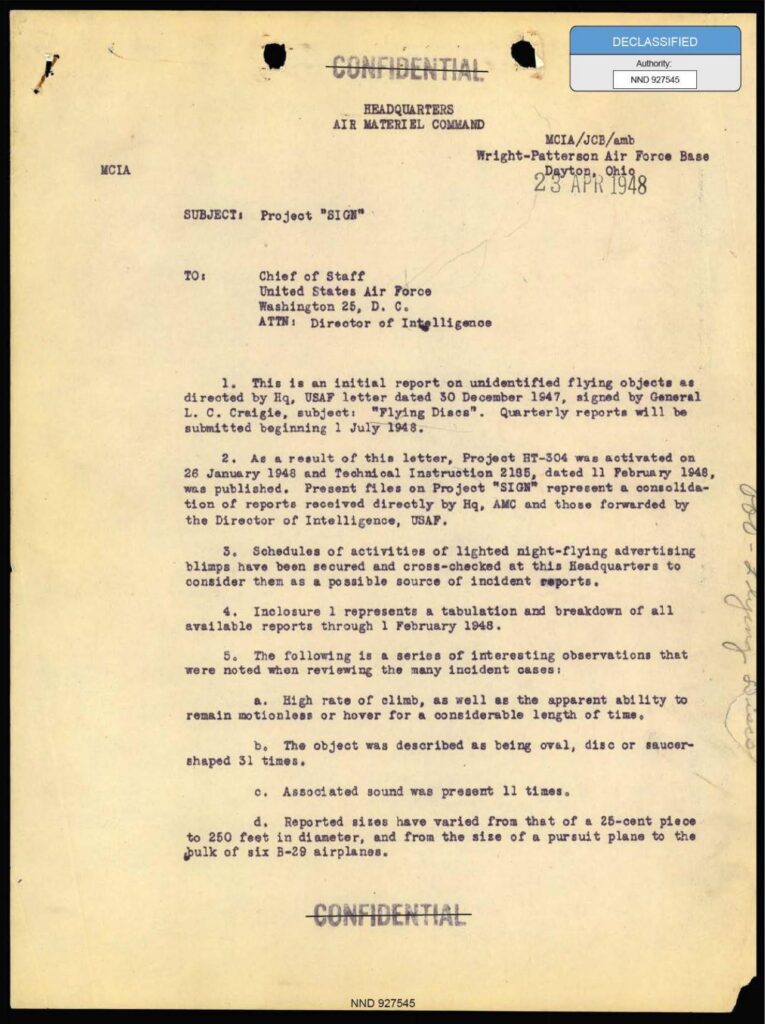
SEATTLE, July 10 — The Department of War has released a classified 1948 report on Project Sign, a U.S. Air Force initiative to investigate unidentified flying objects. The document, part of the PURSUE tranche released today, details 100 UFO sightings between 1947 and 1948. It includes technical analyses, pilot accounts, and a 1948 article from *The Aeroplane* magazine titled “The Biology of the Flying Saucer.” The report, obtained by InfoPulse Today, offers a window into Cold War-era efforts to understand the phenomenon.
The core of Project Sign was the Air Materiel Command’s attempt to catalog and analyze UFO activity. According to the file, the program was initiated by a letter from General L.
C. Craigie in December 1947. Quarterly reports were scheduled to begin July 1, 1948, and the current document consolidates findings up to mid-February of that year. The report notes a range of observations: objects described as oval, disc-shaped, or saucer-like, varying in size from 26 feet in diameter to 260 feet.
Some were said to hover or move at supersonic speeds, while others exhibited erratic maneuvers, including rapid descents and oscillations. Witness accounts varied widely.
Air Force pilots reported seeing multiple objects in tight formations, sometimes in “straight-line” patterns, while others described a single object descending at three times the speed of a parachute. One incident in Portland, Oregon, on July 4, 1947, involved a group of objects that “bobbed up and down” before vanishing. Another account from a private pilot mentioned a disc that “fluttered rapidly” before disappearing.
The report also includes technical speculation, such as the possibility of replicating the objects’ flight characteristics through “bouncy layer control” in aviation design. Not all experts were convinced.
Dr. Ining Langmuir, a scientist consulted by the Air Force, expressed skepticism about the existence of “flying discs.” He argued the data was insufficient for a definitive conclusion. However, the report suggests some officials were more open to the possibility. The document mentions a comparison between photographs of different incidents, noting “marked similarity” in their configurations.
This led to speculation about whether multiple sightings were linked to a single phenomenon or unrelated events. Project Sign’s scope was broad, encompassing both military and civilian observations.
The report includes 50 detailed incident logs, ranging from a 1946 sighting in Lockbourne, Ohio, to a 1947 event near Vancouver, Washington. Some accounts described objects “hovering” for extended periods, while others involved “trails of exhaust” or “oscillating” movements. The file also notes that witnesses included not only military personnel but also farmers, Coast Guard officers, and even Hungarian peasants, adding a layer of public curiosity to the phenomenon.
The release of this material today raises questions about how the U.S. government approached UFO investigations decades ago. While the report doesn’t confirm any extraterrestrial origins, it highlights the era’s blend of scientific inquiry and public fascination.
The 1948 *Aeroplane* article, for instance, speculates on the “biology” of such objects, reflecting a time when unexplained aerial phenomena were a topic of both academic and popular interest. The document’s release under the PURSUE tranche underscores the Pentagon’s ongoing, if limited, engagement with such cases. As the report makes clear, Project Sign was a collaborative effort.
It involved input from the Air Force’s Intelligence Directorate, photo analysis teams, and external experts. The file’s classification as “CONFIDENTIAL” suggests that some details were considered sensitive, even in 1948.
With the current administration’s focus on national security, the historical context of these investigations may take on new relevance. For now, the document stands as a primary source, offering a snapshot of a government’s early attempts to grapple with the unknown.




