
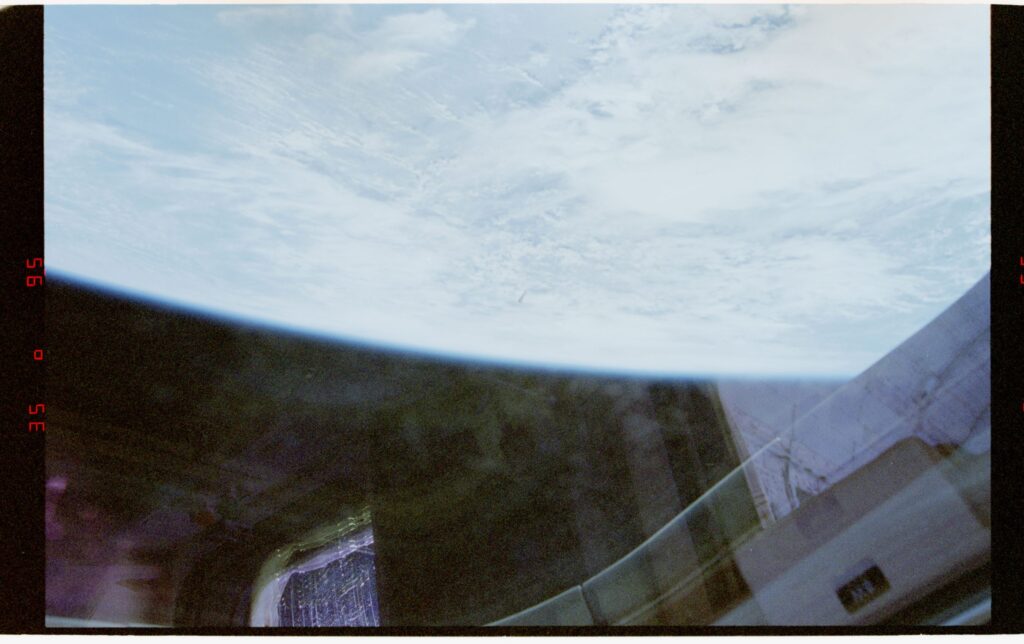
Washington, July 10 — On the night of December 7, 1996, astronauts aboard the Space Shuttle Columbia captured an image that would later be classified as one of NASA’s most enigmatic records. The third photograph in a series of three, designated NASA-UAP-D032, shows an unidentified object near the center of the frame, its trajectory intersecting with the Earth as viewed from the shuttle’s vantage point.
The image, released by NASA on July 10, 2026, as part of the PURSUE tranche, has now resurfaced in Pentagon files, reigniting questions about its origins. Collected during the STS-80 mission, which ran from November 19 to December 7, 1996, the photograph is part of a broader archive of anomalies documented by the crew. According to NASA’s release, the object appeared to be in low-Earth orbit, its path described as passing between the Columbia and the planet. No further details about its composition, size, or purpose were provided at the time.
The agency has not publicly commented on the object’s classification or the circumstances surrounding its capture. Residents near NASA’s Johnson Space Center in Houston, where the shuttle was based during the mission, recall the atmosphere of cautious optimism that surrounded the STS-80 mission.
“It was a routine operation, but there was an undercurrent of curiosity,” said a local resident who preferred anonymity. “Everyone knew something unusual was happening, even if no one said it out loud.” The crew’s focus remained on their primary objectives, but the image’s clarity and the object’s apparent movement sparked informal speculation among mission specialists. The Pentagon’s recent acquisition of the image has placed it at the center of renewed interest.
Officials have not disclosed the nature of their inquiry, though sources indicate it relates to broader efforts to catalog unexplained aerial phenomena. The object’s trajectory, as depicted in the photograph, has not been independently verified by external agencies.
No reports from other spacefaring nations or private entities have corroborated the image’s contents, leaving its significance unresolved. What makes the image particularly striking is its clarity. Unlike many other UFO-like phenomena captured by satellites or human observers, this photograph offers a detailed, close-up view of the object against the Earth’s curvature.
The lack of any official explanation from NASA or the Pentagon has left experts divided. Some argue it could be a fragment of space debris, while others suggest it may represent an unknown atmospheric phenomenon or even an extraterrestrial artifact.
However, no data from the shuttle’s instruments or the object itself has been released to support either theory. As of July 10, 2026, the image remains a symbol of the gap between public speculation and institutional transparency. The STS-80 mission itself was a success, achieving its scientific goals and returning safely to Earth.
Yet the photograph continues to linger, a silent reminder of the mysteries that still exist in the final frontier. For now, the object in the image stands as a single, unanswered question in a field that has seen few definitive answers.




