
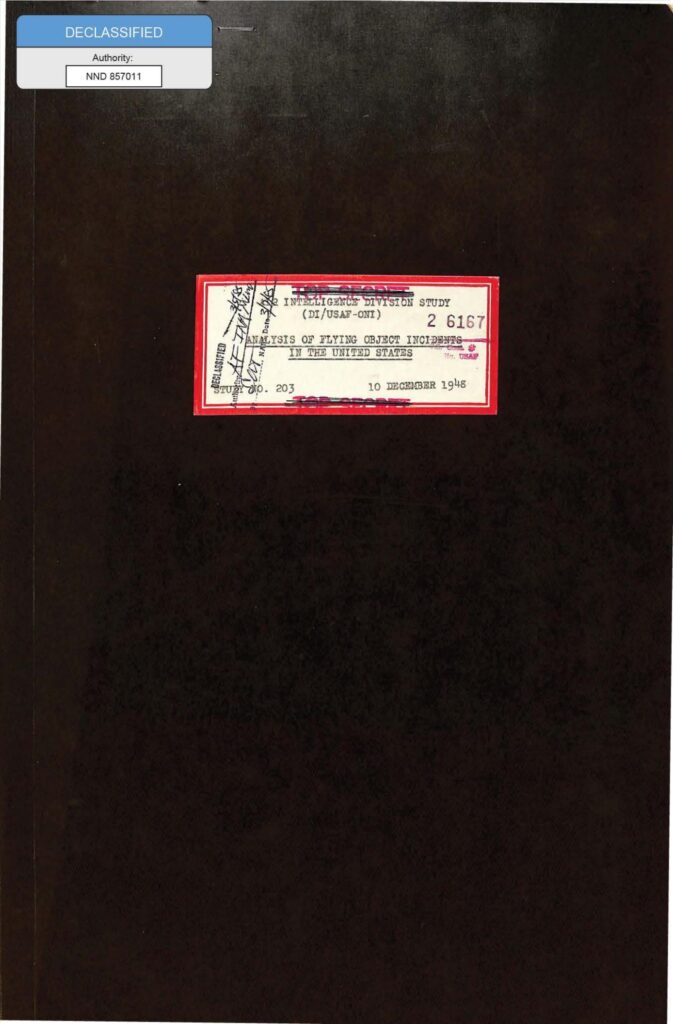
Washington, July 10 — A 1948 U.S. Air Force study on unidentified flying object incidents in the United States found no definitive explanation for the phenomena, though it suggested possible domestic or foreign origins. The analysis, titled “Analysis of Flying Object Incidents in the United States,” Study No. 203, concluded that while “it appears that some object has been seen,” identification remained elusive.
The document, released by the Department of War as part of the PURSUE tranche on this date, noted that if the objects were foreign, they could not be ruled out as Soviet in origin, given the technological context of the Cold War. The study reviewed 167 incidents reported across the country. Sightings clustered along the Eastern Seaboard and the Pacific Coast, with a smaller concentration in the Midwest.
The objects were described as silver disks, balls, or pencil-shaped figures, observed both day and night. Notably, some reports included claims of maneuverability, though most descriptions lacked consistent technical detail.
The study emphasized that the lack of verifiable data made it impossible to confirm whether the objects were conventional devices, such as weather balloons, test rockets, or experimental aircraft. One particularly notable report involved a 1947 incident observed by the U.S. Weather Bureau in Hampton, Virginia. Unlike other cases, this event could not be attributed to balloons or conventional objects.
The study acknowledged that such anomalies might stem from misidentification, natural phenomena, or even psychological factors. However, it also highlighted the geopolitical implications: if the objects were Soviet, they could signal advanced aeronautical development.
The document cited Soviet priorities in aviation research, particularly under Dr. Viktor K. Krūnovets, a German scientist working in the U.S.S.R. who may have influenced their efforts. Investors will note that the study’s findings reflect a broader Cold War anxiety.
The U.S. government’s focus on distinguishing between domestic and foreign threats underscores the era’s technological competition. The analysis did not find evidence of American secret projects, but it warned that Soviet advancements could outpace U.S. capabilities.
This tension is evident in the study’s suggestion that Soviet objects might employ unconventional propulsion or stealth to avoid detection. A key takeaway: the 1948 study remains a relic of a time when UFOs were often conflated with real threats. Its conclusions, based on limited data, mirror the era’s speculative mindset.
Today, such reports are viewed through a different lens, but the document serves as a historical marker of how technological uncertainty shaped national security concerns. The U.S. military’s continued interest in unexplained phenomena, however, suggests the questions raised by these incidents are far from obsolete.




