
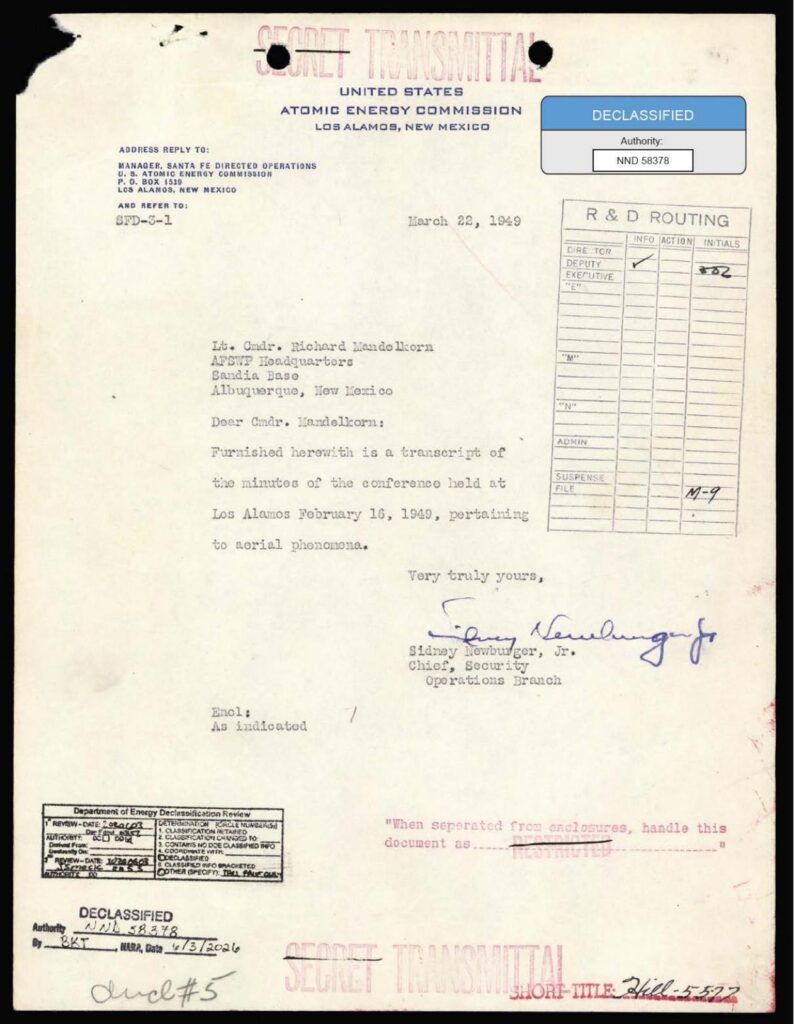
Los Alamos, New Mexico — July 10 The Department of Energy released a long-secret transcript from a 1949 conference at Los Alamos Scientific Laboratory, shedding light on early investigations into so-called “green fireballs” reported near the site. The document, part of the DOE’s PURSUE tranche released July 10, 2026, outlines how scientists and military officials grappled with an unexplained aerial phenomenon during the Cold War era. The conference, held in February 1949, brought together experts from physics, meteorics, and national security to analyze reports of glowing aerial events.
The attendees included Dr. Edward Teller, a key Manhattan Project scientist, and Dr. Lincoln LaPaz, a meteorite specialist. Their discussion centered on a series of sightings—particularly the “green fireballs”—that had sparked public and military concern.
Captain Beef, a Navy official, noted that reports began in December 1948 from airline pilots who described the objects as “green fireballs,” though no clear explanation emerged initially. Dr. LaPaz, who had been assisting the investigation for months, emphasized that the phenomenon bore no resemblance to known meteorite falls. He argued that conventional meteorites typically produced different visual and acoustic signatures, which were absent in the reported events.
Teller proposed an alternative theory, suggesting the fireballs might involve an “electron phenomenon” rather than a physical object. This hypothesis reflected the era’s fascination with nuclear and particle physics, but it was met with skepticism.
LaPaz countered that the absence of meteorite debris or other physical evidence made a cosmic explanation unlikely. He also referenced a case in Roswell, New Mexico, where multiple witnesses claimed to see a green fireball, though he acknowledged that such reports often attracted attention due to their novelty rather than their rarity. “Anyone who does field work in the search for extraterrestrial phenomena,” LaPaz noted, “will find observers who say they’ve seen strange lights, even if it’s just a meteor or a balloon.” The conference also highlighted the military’s cautious approach to the topic.
Commanders stressed the need to classify information under security protocols, as the reports could attract unwanted attention. Comdr.
Reed, a Navy officer, mentioned that witnesses had to submit their accounts through official channels in Washington, D.C., to avoid leaks. This bureaucratic hurdle underscored the government’s reluctance to publicize the phenomenon, even as scientists like Dr. Bradbury, an optical trajectory expert, examined visual records from New Mexico and Arizona. Bradbury noted that while some observers reported green fireballs, others, including a member of the American Meteorological Society, found nothing unusual. Key details from the transcript reveal a pattern of reports that defied easy categorization.
Ten incidents were described as “strictly analogous” to the December 12 green fireballs, with witnesses ranging from farmers to military personnel. Captain Reed emphasized that in one case, a meteorite was found after falling through ice on a pond, but no such physical evidence was linked to the fireballs.
The absence of a “long enduring train” of light—a common meteorite trait—further complicated the analysis. Dr. LaPaz pointed out that in other meteorite falls, people and animals had reacted visibly, such as dogs howling or horses fleeing, but this was not reported in the fireball cases. “We found no evidence of alarm by animals or humans,” he stated, adding that the phenomenon seemed to occur without the typical disruptions associated with meteorite impacts.
The document does not resolve the mystery but serves as a historical record of early 20th-century efforts to understand unexplained aerial events. It reflects the era’s blend of scientific curiosity and national security concerns, with participants balancing technical analysis against the need for secrecy.
While no consensus was reached, the meeting underscores how phenomena like the green fireballs were treated as potential security threats during the Cold War. The lack of definitive evidence or explanation at the time mirrors modern debates about unidentified aerial phenomena, though the 1949 context was shaped by different technological and geopolitical realities.




