
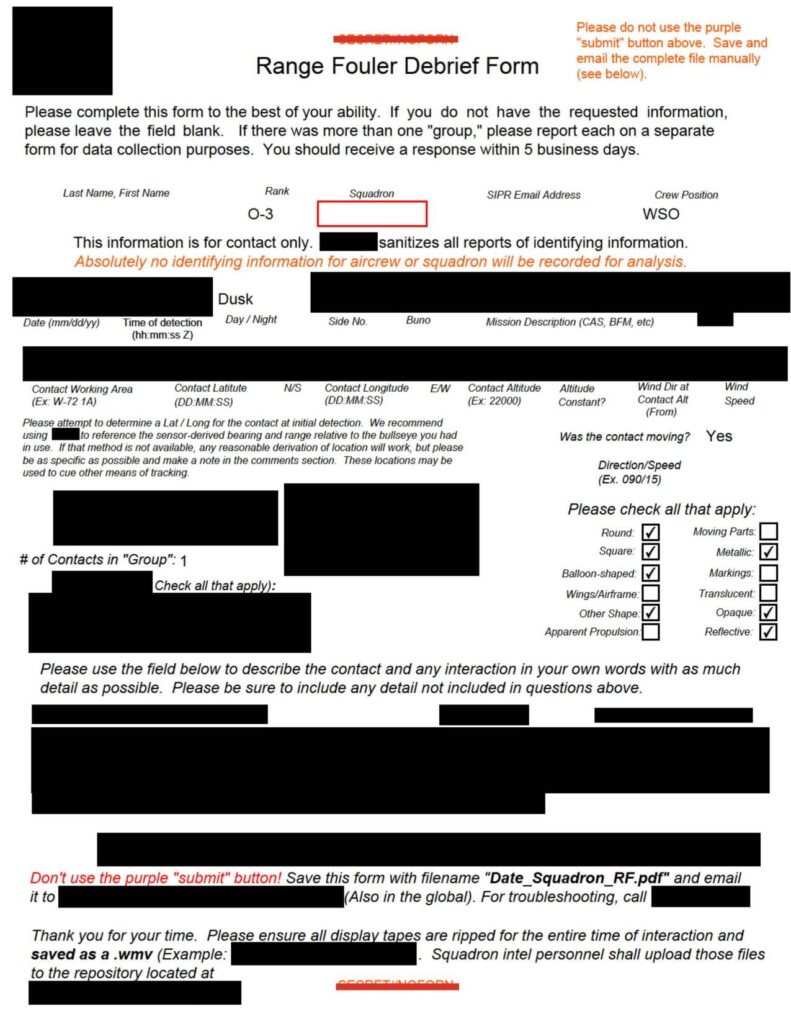
New York, July 10 — The U.S. Department of War released a Range Fouler Debrief document today linked to an incident in the Atlantic Ocean on July 10, 2020. The report, part of the PURSUE tranche of materials made public this week, details an unauthorized airspace intrusion observed by a military operator during active operations. The document, identified as DOW-UAP-D091, is a standardized form used by the Navy to document such events.
It includes a narrative description of the incident but does not confirm or deny the nature of the observed phenomenon. The operator described the object as “darker, maroonish color, approximately 12-15 feet in height.” This estimate is subjective, as the report explicitly states that all descriptive language reflects the observer’s interpretation at the time.
The phenomenon was noted to “travel with the wind” and “not maneuver or change direction.” The report further characterizes the object as “a large, somewhat deformed balloon.” These descriptions, however, are not presented as definitive evidence of the object’s physical properties or capabilities. The document emphasizes that such characterizations should not be interpreted as conclusive. Technical details in the debrief are sparse.
The contact’s location, altitude, and wind conditions are recorded but lack precise coordinates. The report includes placeholders for latitude, longitude, and altitude, with instructions to determine these values if possible.
Wind direction and speed are noted but not quantified. The object’s movement is described as “Constant? Was the contact moving?” with no definitive answer provided. Observations about potential features, such as “Round,” “Square,” or “Metallic,” are marked with checkboxes, most of which remain unchecked or incomplete.
The only confirmed detail is the balloon-shaped classification. The debrief also mentions an accompanying video titled “DOW-UAP-PR116,” which may offer additional context.
However, the document itself does not reference the video’s contents or its role in the incident. The operator returned to the ship after the event, landing “uneventfully,” according to the report. This suggests the encounter did not result in immediate threats or disruptions to military operations.
The document concludes with a note urging thorough documentation and troubleshooting, reflecting standard procedural rigor. The release of this 2020 report under the 2026 PURSUE tranche raises questions about U.S. military transparency regarding unidentified aerial phenomena.
While the document does not confirm extraterrestrial or advanced technology, it underscores the Navy’s protocol for investigating airspace incursions. The lack of conclusive data aligns with the military’s cautious approach to such incidents, which often rely on subjective observations. For now, the report serves as a factual record of an event that remains unexplained by conventional means.
This debrief, while limited in detail, fits into a broader pattern of U.S. military efforts to document and analyze anomalies. As the government continues to release such materials, the focus remains on procedural accuracy rather than definitive conclusions.
What this signals is a persistent, if unresolved, challenge in balancing operational security with public accountability. The full implications of this incident—and others like it—will likely depend on future disclosures or technological advancements in tracking and verification.




