
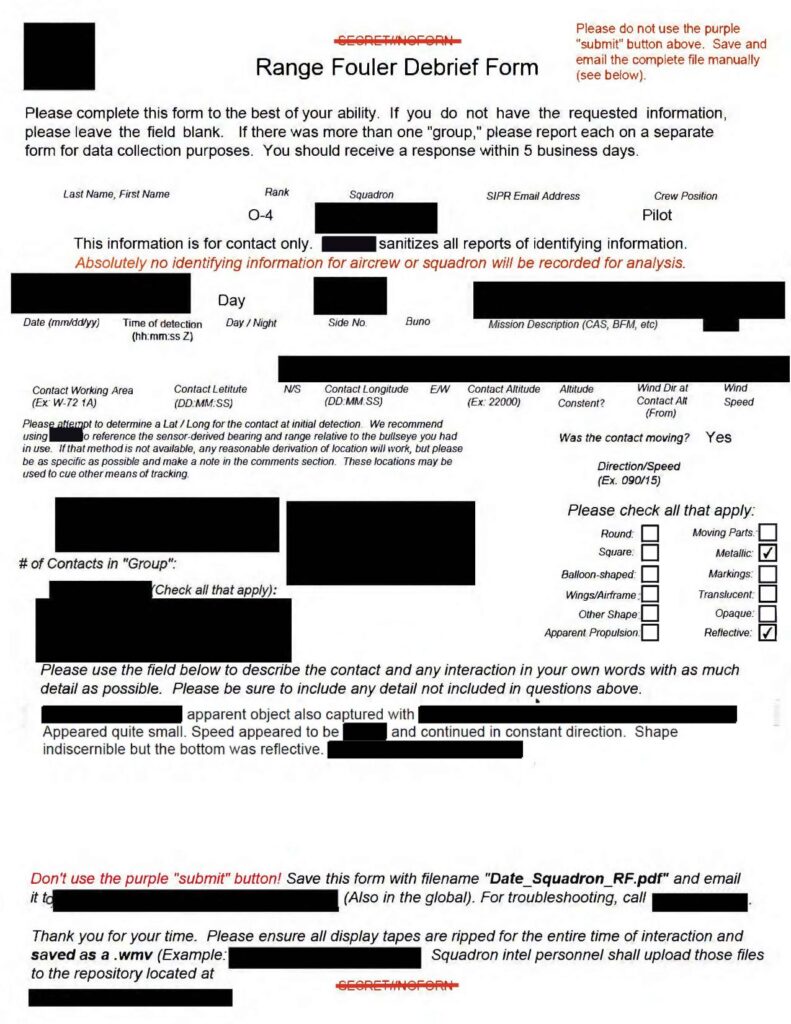
Baltimore, July 10 — The U.S. Navy has released a formal debrief on an unauthorized flight interception recorded over the Eastern United States on July 10, 2020. The document, labeled DOW-UAP-D089, is part of a standardized reporting format used by the military to document incidents involving objects entering restricted airspace.
This report, which accompanies the video “DOW-UAP-PR106,” details an encounter described by a military operator as “quite small” and moving “in a constant direction.” The lack of specific coordinates or timestamps in the document underscores the limitations of the sensor technology available at the time. The operator’s account, recorded in the narrative section of the debrief, notes that the object appeared metallic with a reflective underside. The shape was “indistinguishable,” a characterization that the report explicitly frames as the reporter’s subjective interpretation.
This caveat is critical: the document does not confirm the presence of any physical object, let alone its nature. The Navy’s language here is deliberately cautious, emphasizing that such descriptions “should not be interpreted as conclusive.” The term “reflective” is used without further technical analysis, leaving the exact properties of the observed phenomenon undefined.
What stands out in the debrief is the absence of quantifiable data. The report does not specify altitude, speed, or range, which are standard metrics in such incidents. Instead, it relies on the operator’s estimates, which are flagged as approximates.
The phrase “apparent object” is used repeatedly, reinforcing the ambiguity. The operator also mentioned the object’s “constant direction,” but no details on acceleration, deceleration, or maneuverability are provided.
This lack of technical precision is not unusual for Range Fouler reports, which prioritize qualitative observations over hard numbers. The technical reality of the incident hinges on the tools used. The document references a sensor-derived bearing and range, but the exact methodology is not outlined.
The Navy’s guidance for such reports allows for “reasonable derivation of location,” yet the final coordinates remain unspecified. This vagueness is intentional, as per the document’s instructions, to avoid overstating the certainty of the data.
The operator’s role is clear: they were tasked with describing the encounter in their own words, with no obligation to provide forensic analysis. The focus is on documenting the event as experienced, not on concluding its nature. For informed readers, the debrief raises more questions than answers.
The combination of a small, reflective object moving in a fixed trajectory could align with conventional phenomena, such as weather balloons or drone activity. However, without additional data—like radar signatures, thermal imaging, or post-event analysis—any speculation remains ungrounded.
The document itself does not attempt to resolve this ambiguity. It is, in essence, a record of an observation, not a determination. This aligns with the Pentagon’s broader approach to UAP (Unidentified Aerial Phenomena) cases, which often prioritize transparency over definitive conclusions.
What this debrief does reveal is the ongoing tension between military operational needs and the public’s desire for clear answers. The Navy’s use of standardized forms ensures consistency in reporting, but it also limits the scope of what can be communicated.
The operator’s language—“quite small,” “constant direction,” “reflective underside”—is precise in its vagueness, a reflection of the constraints of the moment. As the document notes, such characterizations are subjective, a reminder that the technology and human perception are both fallible. For now, this remains one entry in a long series of reports, each adding a fragment to a puzzle that may never be fully assembled.




