
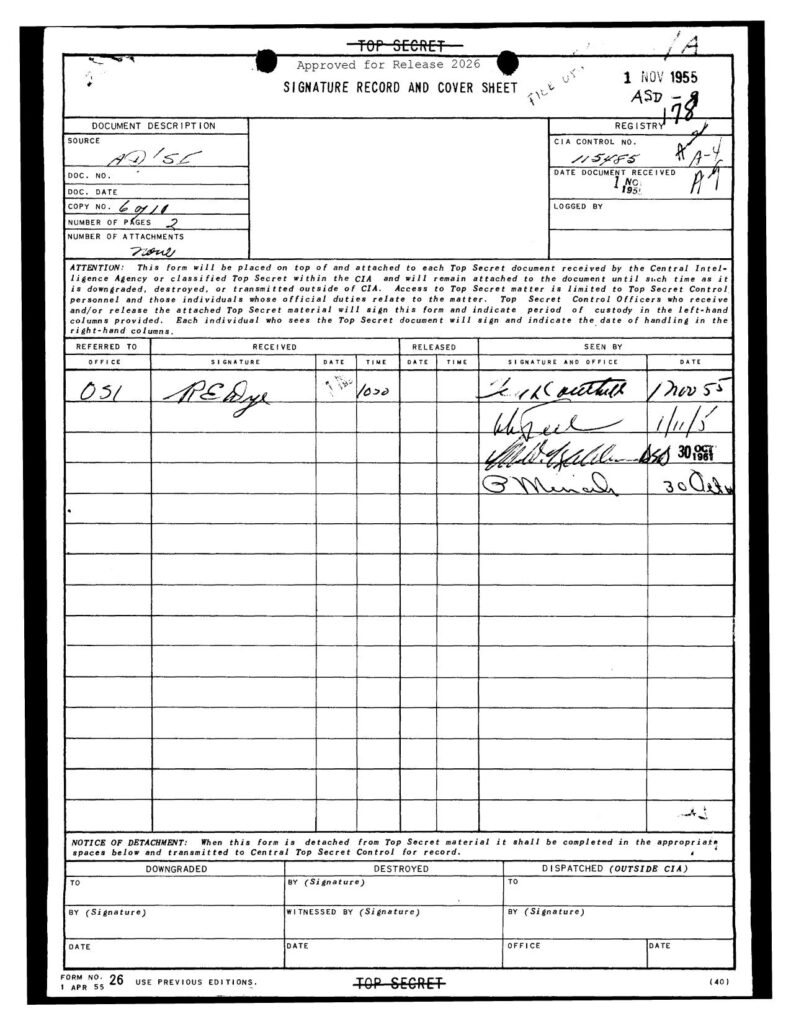
Baku, July 10 — The Pentagon’s release of a 1955 memorandum detailing an alleged sighting of an “unconventional aircraft” during a train journey through Soviet Azerbaijan has reignited interest in Cold War-era UFO reports. The document, declassified by the CIA under the PURSUE tranche, outlines a debriefing of four witnesses, including Senator Richard Russell, who observed a “greenish-yellow” luminescent object near Baku and Tiflis (now Tbilisi) in 1955.
The account, however, leaves little room for speculation about extraterrestrial technology. The witnesses described a rapidly ascending object with varying appearances. Senator Russell noted a single glowing “ball,” while military personnel reported a shadowy shape with a single light at its apex. Another attendee estimated the object’s size to be comparable to a jet fighter, though no evidence of interaction with conventional aircraft was found.
The report explicitly states that no definitive conclusion can be drawn about the object’s origin, with the CIA concluding it “probably be explained as steep climbing aircraft or missiles.” Witness accounts differ in detail. One government official claimed to see a triangular object with three lights that appeared to be ejected from a launch site.
Others described erratic flight patterns, including sharp turns or spiraling motion. However, the report emphasizes that these descriptions lack corroborating physical evidence. A separate technical analysis reiterates that the observations do not meet the threshold required to confirm an unprecedented technological breakthrough by the Soviet Union.
The memorandum’s tone is cautious, bordering on dismissive. It acknowledges the witnesses’ accounts but underscores the lack of “sufficiently firm evidence.” This aligns with the CIA’s historical approach to such reports, which often prioritized dismissing anomalies as misidentifications or natural phenomena.
The document does not reference any classified follow-up investigations, suggesting the incident was treated as a low-priority debrief rather than a national security concern at the time. The inclusion of a sitting U.S. Senator adds a political dimension, though the report does not explore whether his testimony influenced Cold War defense policies. The object’s observation during a routine train journey in a remote region of the Soviet Union further complicates its significance.
Without radar data, photographs, or physical remains, the sighting remains anecdotal—a footnote in a broader pattern of similar reports from the era. For context, the 1955 incident occurred during heightened Cold War tensions, when both superpowers were investing heavily in advanced aviation and missile technology.
The CIA’s conclusion that the object could be explained by “steep climbing aircraft or missiles” reflects the technological limitations of the time. Modern analysts might re-examine the account through the lens of 1950s radar capabilities or misidentification of natural phenomena, but the document itself offers no such analysis. The release of this memorandum, decades after the original event, raises questions about why it was declassified now.
The CIA’s PURSUE tranche typically focuses on materials with contemporary relevance, but this report seems more like a historical curiosity. Its inclusion in the tranche may reflect a broader effort to catalog Cold War-era UFO reports, though the lack of dramatic conclusions suggests it was not prioritized for public release at the time.
As with many such documents, the real value lies in what it does not reveal. The absence of technical specifications, radar intercepts, or follow-up missions implies that the sighting was never treated as a serious threat. For readers familiar with later UFO disclosures, the 1955 account feels almost anticlimactic.
Yet for those studying the intersection of Cold War paranoia and technological optimism, it serves as a reminder of how quickly such reports can fade into obscurity—unless preserved by bureaucratic inertia.




