
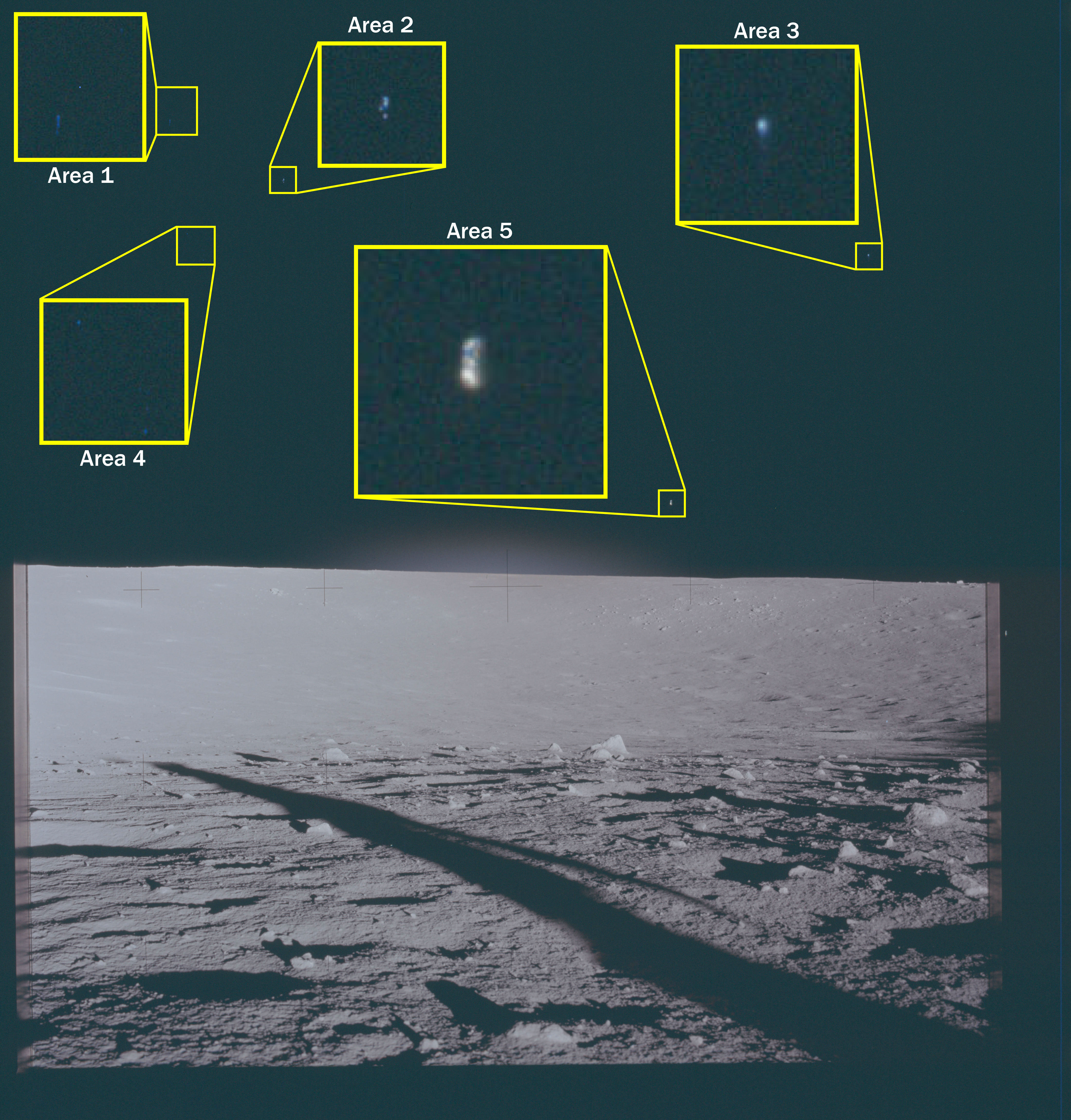
 An archival photograph from the Apollo 12 mission, released by the U.S. Department of War under the PURSUE archive, depicts the lunar surface with five highlighted areas of interest where “unidentified phenomena” are visible, according to official NASA records. The image, dated 1969 and titled “NASA-UAP-VM5, Apollo 12, 1969,” was made public on May 8, 2026, and offers a rare glimpse into government documentation of anomalous sightings during the Apollo era.
Official Description and Context from NASA Records
According to NASA records released under PURSUE, the photograph shows the lunar surface as viewed from the landing site of Apollo 12. The image features five highlighted areas of interest, labeled “Area 1” through “Area 5,” positioned above the horizon.
In these areas, the document states, “unidentified phenomena are visible.” The official description notes that the image “has been modified from its original state to assist viewers in identifying specific areas of interest.” It further clarifies that these highlights are “provided for contextual purposes only” and that “such alterations do not constitute an analytical judgment, investigative conclusion, or factual determination regarding the nature or significance of the subject matter.” The record’s official summary offers limited detail beyond the presence of these highlighted unidentified phenomena, leaving the precise nature of the objects or lights in the five areas open to interpretation.
The document does not specify the size, distance, or behavior of the phenomena, nor does it offer any explanation for their appearance in the photograph. The release is part of a broader effort by the U.S. Department of War’s PURSUE archive to declassify and share historical records related to unidentified aerial and anomalous phenomena.
Broader Context: NASA’s Modern Approach to UAP Studies
The release of this Apollo 12 photograph comes amid ongoing governmental efforts to study unidentified anomalous phenomena (UAPs). Per a Wikipedia summary of the NASA Unidentified Anomalous Phenomena Independent Study Team, the agency convened a panel of sixteen experts in 2022 to recommend a roadmap for the analysis of UAPs by NASA and other organizations. The panel, chaired by David Spergel, was tasked with providing a structured approach to studying these phenomena, which have been reported by military pilots, astronauts, and other credible observers for decades.
Wikipedia’s entry on the study team notes that the group was formed to address the growing need for a scientific framework in evaluating UAP reports. While the Wikipedia summary does not directly link the Apollo 12 photograph to the 2022 study team, it underscores NASA’s formal interest in understanding such phenomena.
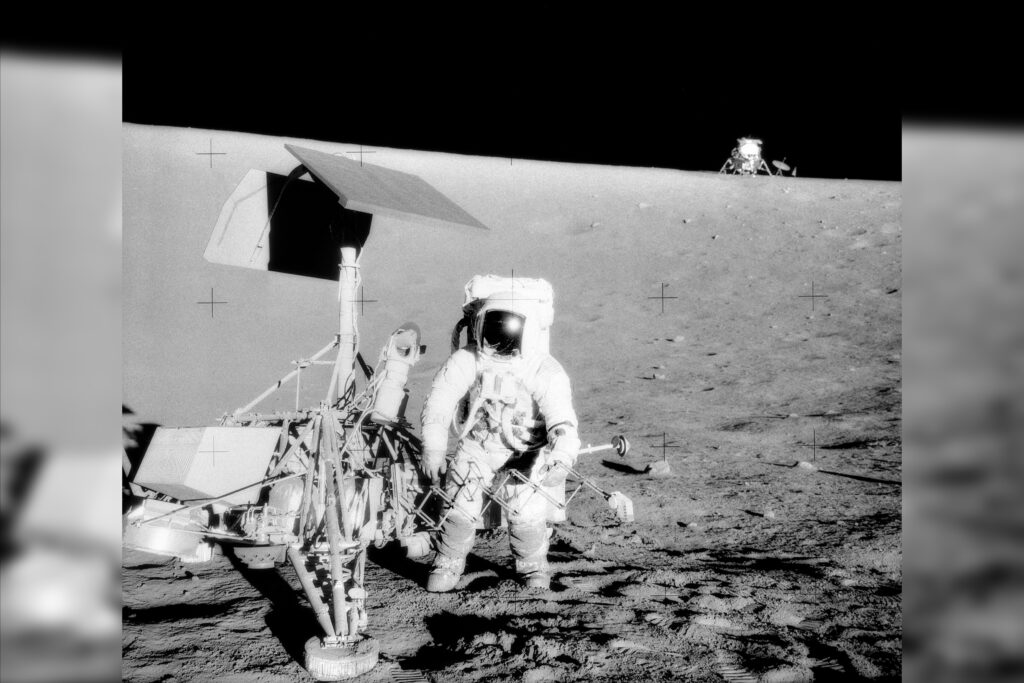
The PURSUE archive release of the Apollo 12 image aligns with this broader push for transparency, offering historical data that researchers might examine using modern analytical tools. The Apollo 12 mission, which landed on the Moon in November 1969, was the second crewed lunar landing. Astronauts Charles Conrad Jr. and Alan L.
Bean spent over 31 hours on the lunar surface, conducting experiments and collecting samples. The photograph in question, taken during that mission, has now been made available for public scrutiny, though the official description cautions that the highlighted areas are not conclusive evidence of any specific phenomenon.
What Remains Unanswered
Several key questions remain unanswered following the release of this document. The official description does not identify what the five highlighted phenomena are, nor does it explain why they were considered noteworthy enough to be marked for attention. The document does not indicate whether the phenomena were observed by the astronauts themselves or only later identified in the photograph during analysis.
Additionally, the record does not specify what original state the image was modified from, leaving the extent of the alterations unclear. The PURSUE archive is expected to release further documents in the coming months, as part of a larger declassification initiative.
Readers should watch for additional Apollo-era photographs and reports that may shed light on the frequency and nature of such sightings during the early space program. Future releases could include corroborating data from other missions, such as Apollo 11 or Apollo 14, or ground-based observations from the same period. Until then, the Apollo 12 photograph stands as a curious artifact—a government-acknowledged record of unidentified phenomena on the Moon, presented without definitive explanation.




