
On May 8 2026 the Department of War’s PURSUE archive made public a NASA transcript that captures two moments during the 1969 Apollo 12 mission when the crew described phenomena they could not identify. The file, titled “NASA‑UAP‑D1, Apollo 12 Transcript, 1969,” is part of a series of records released since 2024 under a congressional directive to disclose military and intelligence material related to unidentified anomalous phenomena (UAP), the contemporary term for what were once called UFOs.
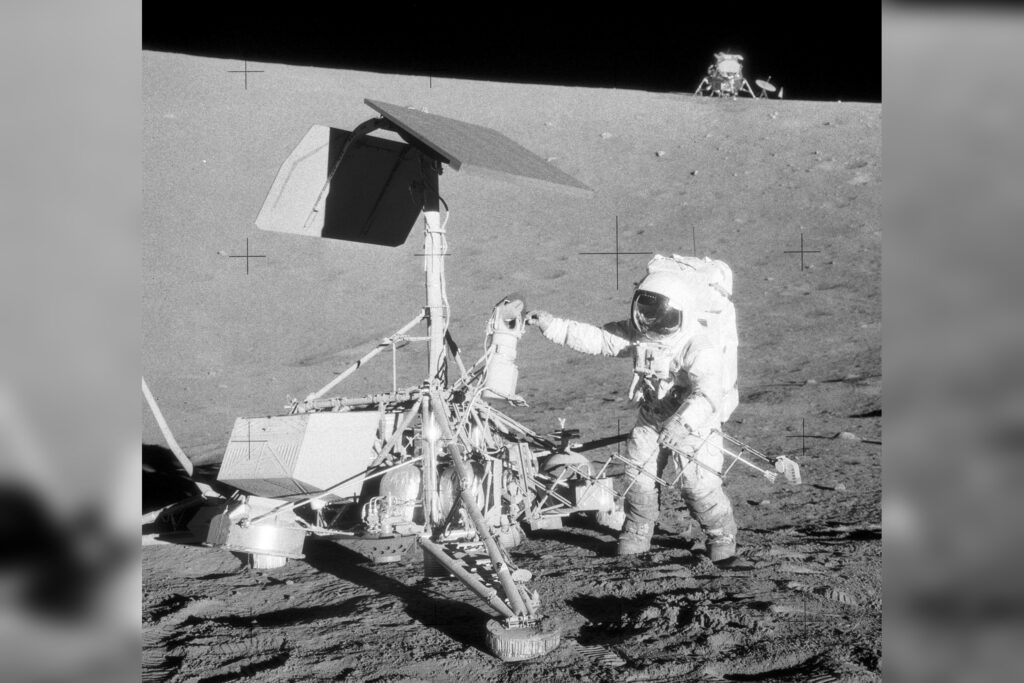
Apollo 12, the fourth U.S. crewed lunar flight and the second to land on the Moon, launched in November 1969, four months after Apollo 11. The three‑person team—Commander Charles Conrad Jr., Command Module Pilot Richard F.
Gordon Jr., and Lunar Module Pilot Alan L. Bean—spent ten days in orbit and on the lunar surface. The newly released transcript highlights two distinct intervals: a one‑hour segment on the mission’s fifth day and a brief two‑minute window on the sixth.
The longer excerpt, recorded at mission elapsed time 05:19:27:25 on Day 5, features Bean speaking from the Lunar Module’s Alignment Optical Telescope (AOT). The AOT, a small star‑sighting instrument used for navigation, allowed Bean to look into a dark quadrant of the sky.
He reported “particles of light” and “flashes of light” appearing to originate from the left side, describing them as “sailing off in space.” Bean initially suggested the lights might be steam from the spacecraft’s water boiler—a heat‑exchange system that vents water vapor into space—but then added that the objects “look like they’re escaping the Moon.” He concluded that the phenomena “really haul out of here and just press off at the stars.” Houston’s response was a single “Roger,” after which the conversation moved on.
Bean’s reference to the water boiler is notable because engineers on the ground would have quickly considered vented steam as a plausible explanation. Yet his own observation that the lights seemed to emanate from the Moon itself indicates he was not satisfied with that mechanical answer.
The transcript contains no further questioning from Mission Control, leaving the observation without additional clarification. The second, two‑minute interval on Day 6 is mentioned only in the archive’s summary, which again labels the content as “unidentified phenomenon.” No detailed dialogue from that period is included in the released material, so it remains unclear whether the crew reported a similar visual event or something different. During the Cold War era, every anomaly recorded by the Apollo program was first evaluated for possible equipment malfunction or Soviet interference before any other interpretation was entertained.
The Bean exchange exemplifies that process: a hypothesis is offered, promptly qualified, and then the ground team acknowledges receipt without further probing. Although astronaut memoirs have long referenced Bean’s description of “moon sprites” or “moon flashes,” this raw transcript provides an unfiltered snapshot—time‑stamped, without editorial smoothing, and presented exactly as it was spoken aboard the spacecraft 240,000 miles from Earth.
The release does not resolve what Bean saw, but it does confirm that the official mission record contains a first‑hand account of an event the astronaut could not fully explain and that Mission Control did not pursue further. Fifty‑seven years after the original sighting, the PURSUE archive’s disclosure adds a concrete piece of evidence to the ongoing discussion of UAPs in spaceflight history, underscoring both the mystery of the Apollo 12 observation and the limited response it received at the time.




