
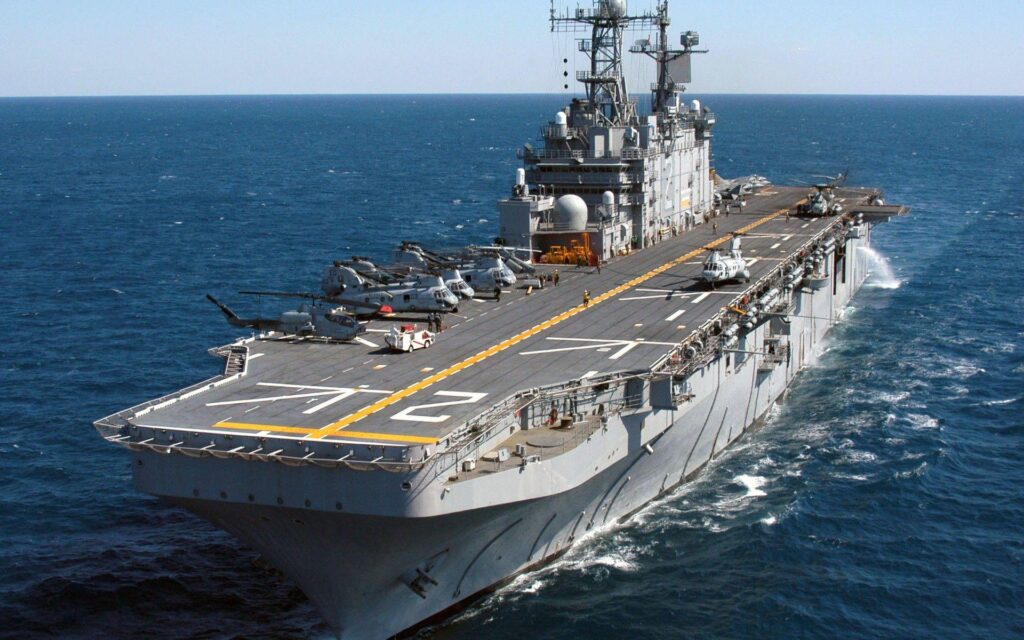
MANAMA, July 16 — On the ground at Naval Support Activity Bahrain, the United States Fifth Fleet remains the Navy’s primary muscle in the Middle East, a force that traces its lineage to World War II but operates in the present tense. Established on April 26, 1944, the fleet was deactivated in 1947, then reactivated on July 1, 1995, to meet the demands of post-Cold War regional security.
Its headquarters sits in Manama, Bahrain, where commanders oversee naval forces across the Persian Gulf, Red Sea, Arabian Sea, and parts of the Indian Ocean. The fleet typically fields one aircraft carrier strike group, amphibious ready groups, and support vessels.
As of 2025, that included the USS Dwight D. Eisenhower (CVN-69) carrier strike group. The Fifth Fleet operates under U.S. Central Command, or CENTCOM, the unified combatant command responsible for the Middle East.
Vice Admiral George Wikoff has served as the fleet’s commander since 2024.
A history of operations
The Fifth Fleet’s modern mission has roots in some of the U.S. military’s most consequential Middle Eastern operations. During the Iran-Iraq War, the fleet supported Operation Earnest Will from 1987 to 1988, protecting reflagged Kuwaiti tankers in the Persian Gulf. In 1991, it played a central role in Operation Desert Storm, the campaign to eject Iraqi forces from Kuwait.
Today, the fleet conducts ongoing maritime security patrols, a mission that has become a near-constant presence in regional waters.
Partnerships and the IMSC
The Fifth Fleet does not operate alone. It runs regular exercises with regional partners, and in 2019, the International Maritime Security Construct, or IMSC, was formed under its umbrella. The construct is a multinational coalition focused on protecting merchant shipping and deterring threats in the Gulf and surrounding seas.
The fleet’s reactivation in 1995 was a strategic pivot, a recognition that the post-Gulf War security environment required a standing, numbered fleet in the region. Nearly three decades later, the Fifth Fleet remains a fixed point in the U.S. military’s Middle East posture.




