
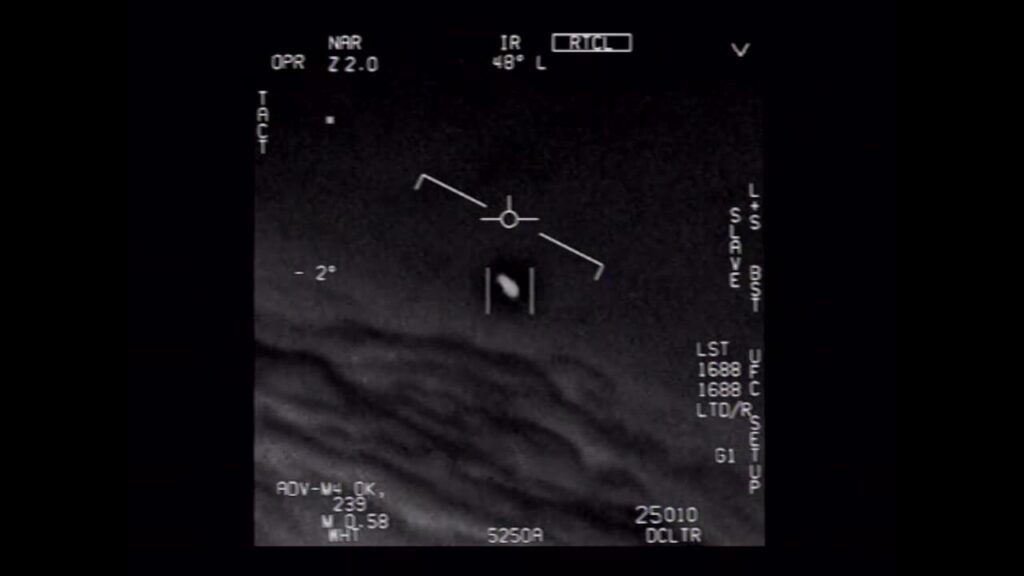
The Department of War has officially declassified a video captured in 2015 that shows an unidentified anomalous phenomenon (UAP) encountered by a U.S. Navy F/A‑18 Super Hornet off the Virginia Coast. The clip, known as “Gimbal UAP,” was originally recorded by the aircraft’s advanced targeting pod and first surfaced publicly in an unofficial leak in 2017.
The recent release follows a review under the department’s PURSUE policy, which directs the controlled disclosure of UAP‑related material while safeguarding national‑security interests. According to the accompanying metadata, the recording took place on 21 January 2015 at 1:52 p.m. local time during a routine training sortie near Virginia Beach, Virginia. The targeting pod’s infrared sensor captured a small, oblong object at roughly 10 nautical miles distance.
The object lacked any discernible wings, engine exhaust, or conventional control surfaces, and the infrared camera showed it rotating in a manner described as “gimbaling” as it moved. Sensor data released with the video indicate the phenomenon maintained a steady altitude and heading despite the Super Hornet’s own maneuvers, and there was no observable propulsion system or thermal signature associated with the object.
The footage therefore depicts an aerial vehicle that appears to sustain flight without any visible means of thrust and that can rotate in ways that do not match known aircraft designs. The Department of War’s statement emphasizes that the release is part of an ongoing effort to address UAP reports through the All‑Domain Anomaly Resolution Office (AARO). Established in 2022, AARO coordinates the collection and analysis of anomalous aerial observations across the Department of Defense and partner agencies.
The “Gimbal” case was included in AARO’s historical review of UAP incidents, and analysts noted the object’s ability to hold position in high winds and its lack of a detectable propulsion heat signature as particularly unusual. While the AARO assessment flags the flight characteristics as anomalous, officials have not dismissed the possibility that the sighting could result from sensor artifacts or a misidentified, advanced conventional platform.
The Office of the Secretary of Defense clarified that the declassification does not constitute a determination regarding the object’s origin. The release aligns with a broader transparency initiative that began after Congress heightened interest in UAP phenomena. Since the creation of AARO, the department has declassified several other recordings, including the 2004 Nimitz encounter and multiple East Coast sightings from 2014‑2015.
Under the PURSUE framework, enacted in 2023, UAP records are to be reviewed for declassification unless doing so would jeopardize security. Looking ahead, AARO plans to request additional information from the Navy and other services—such as radar logs, maintenance records, and pilot or sensor‑operator interviews—to further examine the Gimbal incident.
The office may also deploy additional sensors in the region to detect similar phenomena. A comprehensive report on historical UAP cases, expected later this year, is slated to include a deeper analysis of the Gimbal video. This declassification reflects the department’s continued response to public and congressional scrutiny of unexplained aerial events, while maintaining the caution required to protect sensitive defense information.




