
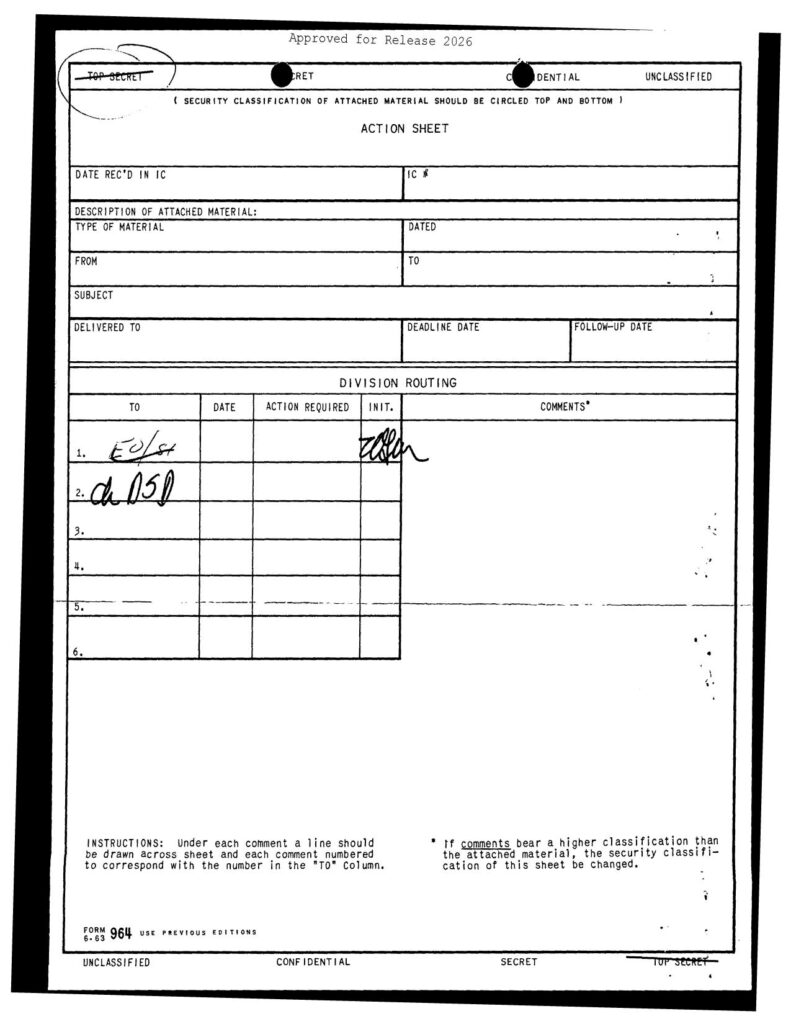
Puerto Rico, August 7 — A classified intelligence file released today by the CIA details an unidentified object sighting near the island in 1964, reigniting questions about Cold War-era surveillance and technological anomalies. The document, labeled CIA-UAP-D022, was part of a tranche of materials made public under the PURSUE initiative on August 7, 2026. It centers on an incident observed by a U.S. Naval aviator on November 19, 1964, who described a “delta-shaped” object roughly the size of a jet fighter traveling at Mach 3 — approximately 2,200 mph — according to a cockpit estimate.
Radar data from the USS Gyatt, a Navy destroyer in the Atlantic Fleet Weapons Range, recorded a higher velocity of 3,800 knots, or about 4,373 mph, creating a discrepancy that remains unresolved. The memoranda exchanged between the CIA’s Assistant Director for Special Activities (AD/SA) and Assistant Director for Scientific Intelligence (AD/SI) suggest the object was considered a potential foreign intelligence asset.
The AD/SI assessed it might be linked to reconnaissance activities in the Atlantic Fleet Weapons Range, where the Soviet Union was reportedly testing missiles. The AD/SA, overseeing classified aerial reconnaissance missions using platforms like the U-2 and A-12 OXCART, explicitly ruled out domestic aircraft, including the YF-12A OXCART, as the source of the sighting. This analysis reflects the strategic calculus of the era.
With the Cold War in full swing, the U.S. military prioritized identifying foreign technological threats. The AD/SI’s focus on Soviet missile testing underscores how such incidents were routinely scrutinized for geopolitical implications.
The file does not allege any hostile action, but the object’s speed and trajectory — exceeding known capabilities of both U.S. and Soviet aircraft at the time — raised concerns about its origin. The AD/SA and AD/SI considered it “conceivably associated with foreign intelligence gathering,” though no definitive conclusion was reached. The technical details in the file highlight the limitations of 1960s reconnaissance technology.
The disparity between the pilot’s Mach 3 estimate and the radar’s 3,800-knot reading illustrates the challenges of tracking high-speed, high-altitude phenomena. The USS Gyatt’s AN/SPS-49 radar system, while advanced for its time, may not have fully captured the object’s true velocity or characteristics.
This gap in data has left historians and analysts debating whether the sighting was a natural phenomenon, a Soviet experimental project, or something else entirely. The release of this document as part of the 2026 PURSUE tranche signals a broader strategic interest in Cold War-era intelligence. By declassifying materials from the AD/SA and AD/SI, the CIA appears to be contextualizing past operations within modern geopolitical frameworks.
The file’s emphasis on foreign technological threats — particularly Soviet missile development — aligns with the U.S. military’s historical focus on countering adversarial capabilities. Yet, the lack of attribution in the 1964 incident remains a gap, raising questions about how such data is interpreted in the absence of clear evidence.
What this file underscores is the enduring tension between secrecy and transparency in intelligence work. The 1964 sighting near Puerto Rico, though now over six decades old, continues to be framed as part of a larger chessboard of Cold War espionage and technological competition. For modern audiences, it serves as a reminder of how rapidly evolving threats — whether from foreign adversaries or unknown technologies — have shaped U.S. defense strategies.
As new UFO reports emerge, this historical document offers a lens through which to assess patterns of uncertainty and the methods used to address them.




