
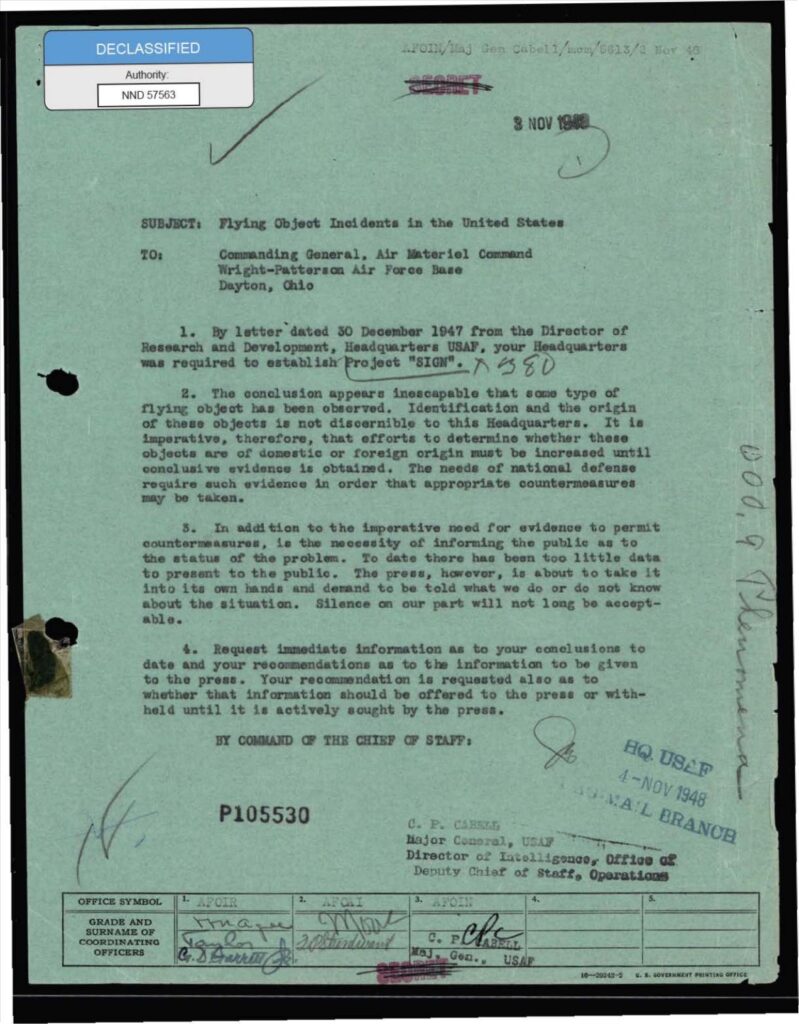
Dayton, August 7 — The U.S. Air Materiel Command released its findings on unidentified flying object reports from 1947 and 1948 today. The document, part of the “Project Sign” investigation, concluded that most sightings could be explained by weather balloons, celestial phenomena, or misidentifications. The report specifically noted that a significant number of objects described as “rounded” or “balloon-shaped” were likely scientific balloons, though definitive confirmation was often unattainable.
AMC’s analysis identified three primary categories of reported objects: flat discs, cigar-shaped craft without visible wings or fins, and spherical or luminous entities. It linked several sightings to Venus, which appeared as a “round, silvery object” during daylight, a conclusion supported by astrophysical analysis.
One notable aspect of the report was its dismissal of extraterrestrial origins. While AMC did not rule out the possibility of “vehicles from another planet,” it stated that “tangible evidence to support such conclusions is completely lacking.” The study examined correlations between reported incidents and planetary approaches, but no consistent pattern was found. This conclusion aligns with the broader scientific skepticism of the era, which prioritized terrestrial explanations for unexplained phenomena.
The report’s recommendations were practical rather than definitive. AMC advised the Department of War to avoid public commentary on “flying discs,” emphasizing the need to focus on verified cases—such as weather balloons and astronomical events—to manage public expectations. This guidance reflected the military’s awareness of growing media and public interest, which could pressure an official response. The document also highlighted the limitations of the investigation, noting that “no physical evidence of the existence of the unidentified sightings has been obtained.”
Scientific experts were involved in the review. Dr. Irving Langmuir of General Electric was consulted, though his initial assessment in 1948 lacked sufficient data for a definitive explanation. AMC planned to re-interview him with the expanded dataset, hoping for insights into “balls of light” descriptions. The study also considered psychological factors, collaborating with the Aero-Medical Laboratory to explore whether some reports stemmed from hallucinations or optical illusions.
Despite the extensive effort, the report acknowledged gaps. A small number of incidents lacked “a reasonable everyday explanation,” but AMC stressed that this did not equate to proof of anything extraordinary. The findings underscore the challenges of 1940s aerospace science, where technological gaps and limited data made interpretation of anomalous reports inherently uncertain.
For context, Project Sign emerged during the early Cold War, a period defined by rapid aerospace advancements and heightened defense concerns. The Air Force’s urgency in seeking answers—cited as an “imperative need”—reflects the era’s anxiety about potential threats. However, AMC’s findings suggest that most reports were rooted in natural or human-made phenomena, even if they appeared extraordinary at the time.
What remains unclear is why certain reports persisted despite the lack of evidence. AMC’s decision to withhold public statements on “flying discs” may have been a strategic move to avoid amplifying speculative narratives. The report’s cautious language—such as “no conclusive proof” and “limits of personal experience”—highlights the tension between scientific rigor and public curiosity.
Today’s release of the 1948 document adds a historical layer to ongoing debates about UFOs. While modern investigations often rely on advanced technology and data, the 1947-48 case illustrates how early efforts to categorize the unknown were constrained by both scientific understanding and institutional caution. For now, the Air Materiel Command’s conclusions stand as a reminder of the era’s blend of skepticism and earnest inquiry.”




