
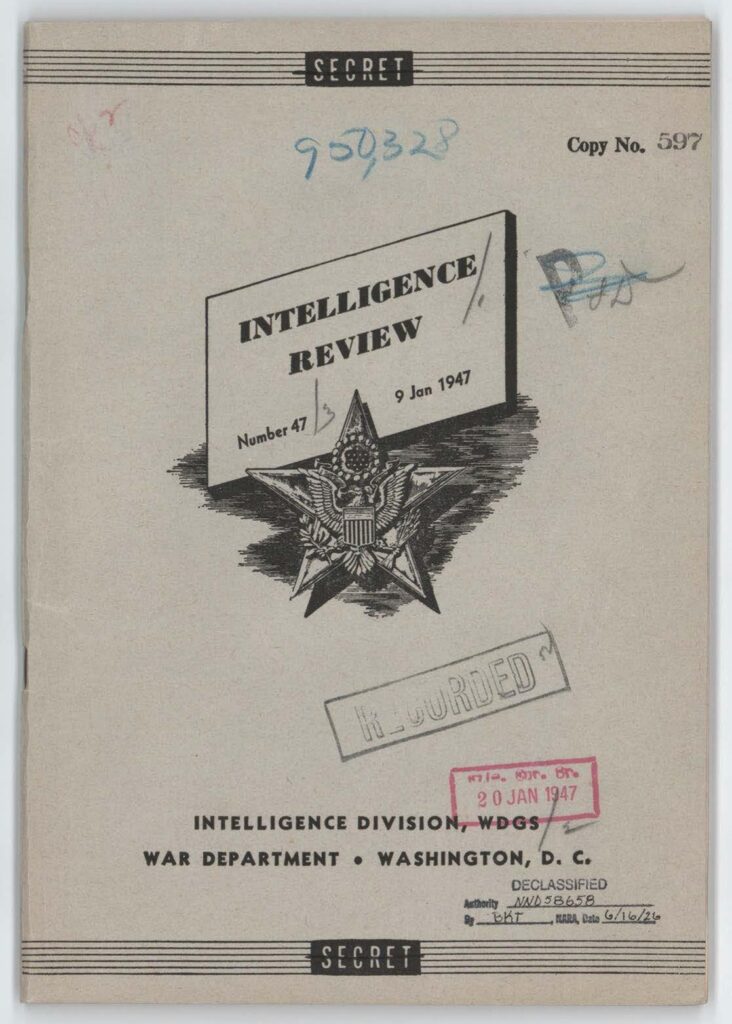
Stockholm, August 7 — The U.S. Department of War released an intelligence review Tuesday examining reports of unidentified “Ghost Rockets” over Sweden and other Scandinavian nations in 1946. The document, part of the PURSUE tranche of declassified files, acknowledges the limited and conflicting nature of the evidence available at the time. According to the review, sightings began in late May 1946, with reports spreading to Finland and Denmark by June.
Descriptions varied widely — from “a ball of fire with a tail” to “a shiny cigar-shaped object” — and details about altitude, speed, and trajectory were inconsistent. Most accounts came from untrained observers, though a Swedish Air Force pilot provided a rare firsthand account.
He described a dark, cigar-shaped object 50 feet long and 3 feet in diameter flying at 200 feet altitude and 6,500 feet away at 400 mph. However, the review notes his report raises questions, as maintaining a steady altitude over hilly terrain without visible wings or propulsion systems contradicts known aircraft technology of the era. Sweden’s public stance shifted notably during the period.
Initially, the Defense Staff privately attributed the incidents to Soviet V-1 missile tests launched from Peenemünde, a German site occupied during World War II and linked to V-1 and V-2 rocket development. But by October, officials publicly claimed the objects had “celestial origins.” The review suggests this change was a calculated move to avoid escalating tensions with the Soviet Union.
“The evidence does not support the initial claims,” the document states, “but the shift in narrative appears politically motivated.” The Swedish investigation faced logistical and political challenges. Many key personnel were on leave when reports surged, and official communications to the press lacked consistency. Early August statements claimed the missiles were Soviet, yet no physical evidence — fragments, impact sites, or direct military observations — was ever presented. The U.S. military attaché in Stockholm noted the absence of credible proof, despite 1,000 reports submitted by the public.
The review concludes that most sightings likely resulted from natural phenomena, such as meteors or fireworks, though it acknowledges “best evidence” points to 2–5 incidents involving low-flying V-1 missiles, possibly from Soviet tests using captured German technology. Geopolitical tensions likely shaped the narrative.
The document highlights that Sweden, seeking to reduce defense spending amid public pressure, may have downplayed the threat to avoid implicating the Soviets. The report notes that three witnesses mentioned sounds resembling V-1 outboard motors, while others described silent flights, suggesting possible variations in rocket types or misidentifications. The U.S. military attaché observed that the Swedish Defense Staff’s contradictory statements — privately acknowledging Soviet involvement but publicly denying it — undermined their credibility.
By September and October 1946, reports of similar objects appeared across Europe and Africa, including Belgium, Greece, and Morocco. The review dismisses these as largely explainable, attributing them to meteors, fireworks, or flares.
The Swedish shift to “celestial” explanations coincided with a broader pattern of downplaying aerial threats, the document suggests. “The lack of verifiable evidence and the political sensitivity of the issue made it difficult to pursue the truth,” the review states.




