
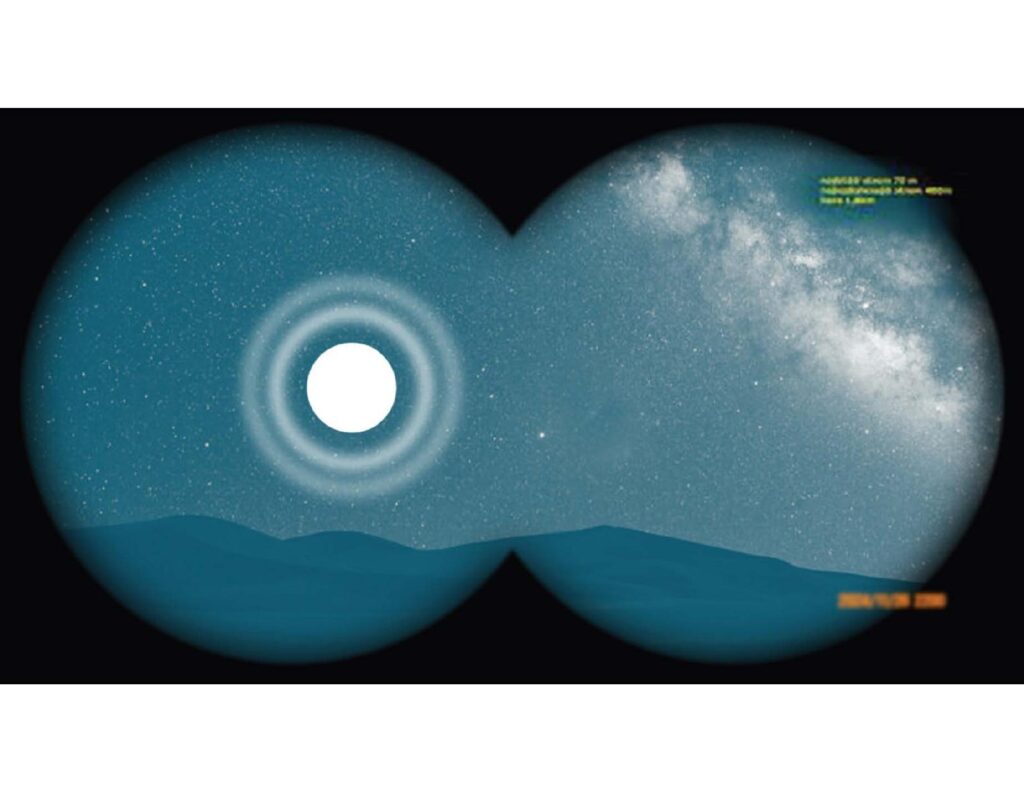
Cedar Rapids, August 7 — The FBI released a digital rendering on Saturday depicting a night sky scene featuring a large, bright object surrounded by concentric circles, viewed through binoculars. The image, labeled FBI-UAP-D039, is part of the bureau’s PURSUE initiative and is based on a first-hand description provided by two U.S. individuals, as outlined in the earlier FBI-UAP-D037 report. The rendering, described as an artistic interpretation, does not include specific measurements or verified locations, adhering strictly to the qualitative details provided by witnesses.
This visual aid emerged as part of the FBI’s ongoing efforts to investigate unidentified anomalous phenomena (UAP) in the western United States. The bureau has not released further details about the incident’s circumstances, such as the object’s size, altitude, or exact date of occurrence.
The concentric circles in the rendering are interpreted as a representation of the witnesses’ observations, though the FBI has not confirmed their technical or scientific significance. A single sentence captures the core of the release: the image is not a photograph but a reconstructed visualization. This distinction is critical, as the FBI explicitly states it is an “artistic interpretation” crafted to aid public understanding of the reported event.
The bureau emphasized that the rendering aligns with accounts from two U.S. persons, though it has not verified the identities or backgrounds of these individuals. No additional eyewitnesses or corroborating evidence were mentioned in the dataset.
The release underscores the federal government’s focus on UAP cases under the PURSUE initiative, which aims to address reports of unexplained phenomena. While the FBI has not ruled out conventional explanations for the sighting, the use of a digital rendering suggests an effort to visualize ambiguous data. Analysts note that such imagery is often employed in UAP cases to help contextualize fragmented or subjective descriptions, though it does not constitute proof of any specific phenomenon. What this signal indicates about broader geopolitical dynamics remains unclear.
The FBI has not linked the incident to foreign actors, nor has it provided any evidence of technological or military activity. The lack of specifics—such as the object’s origin, trajectory, or potential threat level—leaves room for speculation.
However, the bureau’s decision to release this rendering publicly signals a strategic shift in how UAP-related information is shared, potentially aiming to manage public perception while maintaining operational secrecy. It is worth reiterating that this is one of many UAP cases under scrutiny. The federal government has not commented on whether this particular case will lead to further investigations or policy changes.
For now, the digital rendering stands as a tool in the bureau’s arsenal, reflecting the tension between transparency and the need to handle sensitive data carefully. As the PURSUE initiative continues, the balance between disclosure and security will likely remain a central challenge.




