
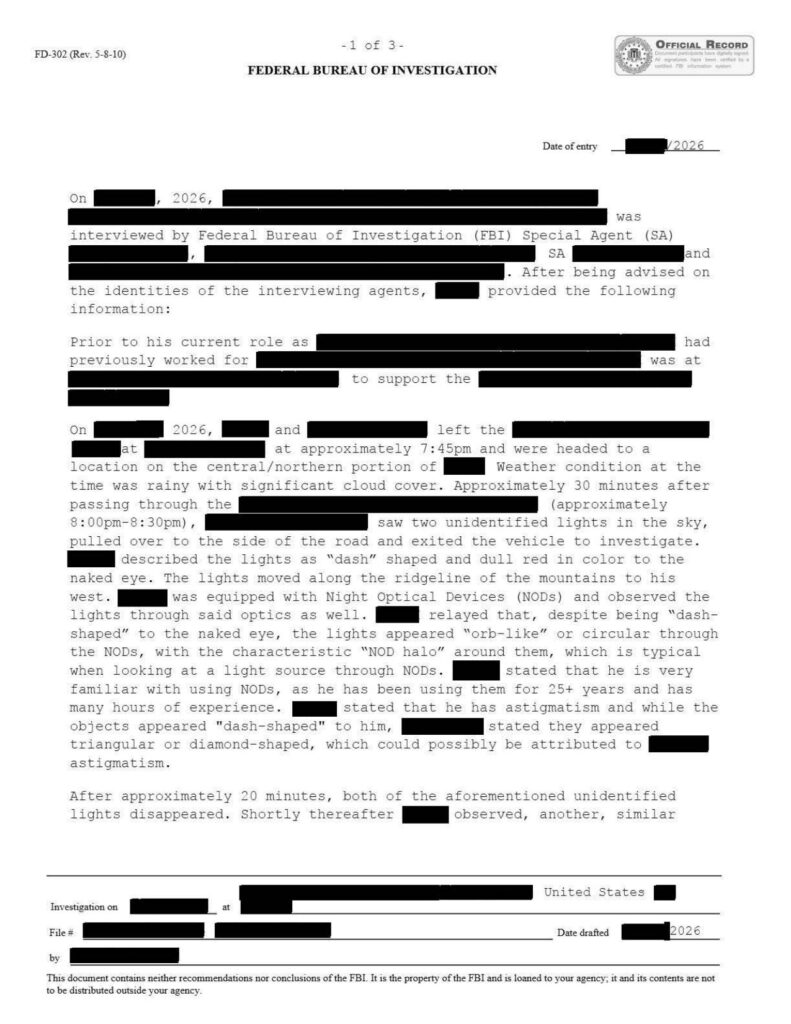
Cradle of American military power, Fort Belvoir, August 7 — A string of three unidentified aerial phenomena sightings in the western United States on a rainy night in 2026 has reignited interest in the Pentagon’s classified investigations into anomalous events. The FBI released a new FD-302 form detailing an interview with an eyewitness who described seeing two “dash-shaped” red lights moving along mountain ridges, which appeared circular through night vision optics.
A second witness, interviewed in a separate record labeled FBI-UAP-D040, corroborated aspects of the account. At approximately 8:00pm, the first witness, who had left a job at an unspecified location earlier that evening, pulled over during a rainstorm with heavy cloud cover. Using Night Optical Devices (NODs) — equipment he claimed to be highly experienced with after 25 years of use — he observed the lights.
The objects, described as “dash-shaped” to the naked eye, displayed a “NOD halo,” a phenomenon typical of light sources viewed through such devices. The witness noted his astigmatism might have altered their perceived shape, suggesting they could have appeared triangular or diamond-like.
The lights vanished after 20 minutes, only for a third object to appear shortly after. This third sighting, described similarly in both interviews, adds complexity to the pattern. The FBI’s digital renderings, FBI-UAP-D038 and FBI-UAP-D039, are based on these descriptions but do not include specific measurements or coordinates.
The agency has not released details about the locations beyond the “central/northern portion of [unspecified region],” leaving key geographic context unclear. What these incidents signal remains a matter of debate.
The clustering of three UAP events within a five-hour window in 2026, captured on FBI records, aligns with a broader trend of reports that have eluded definitive explanation. While the agency has not classified these as extraterrestrial or hostile, the pattern raises questions about the boundaries of conventional aviation and national security protocols. The witnesses, both identified as U.S. persons, provided consistent narratives under FBI scrutiny, though neither offered insights into the objects’ origins or intent. This case underscores the evolving calculus of UAP research in the United States.
The FBI’s release of these documents as part of the PURSUE tranche in August 2026 reflects a shift toward transparency, albeit limited. The agency has made no public conclusions, stating the records contain neither recommendations nor assessments.
For now, the focus remains on cataloging, not interpreting. Yet the persistence of such reports — often dismissed as anomalies — challenges the notion that such events are mere flukes. They demand a framework that balances skepticism with the recognition that the unknown can have real-world implications.
As the U.S. continues to navigate its approach to UAP phenomena, the details of FD-302 — the lack of official conclusions, the reliance on witness accounts, and the absence of corroborating physical evidence — highlight the challenges inherent in such investigations. What remains clear is that these incidents, like others before them, sit at the intersection of military, scientific, and geopolitical concerns.
The next steps, whether in research, policy, or public discourse, will likely hinge on how the nation chooses to address the unresolved questions they raise.




