
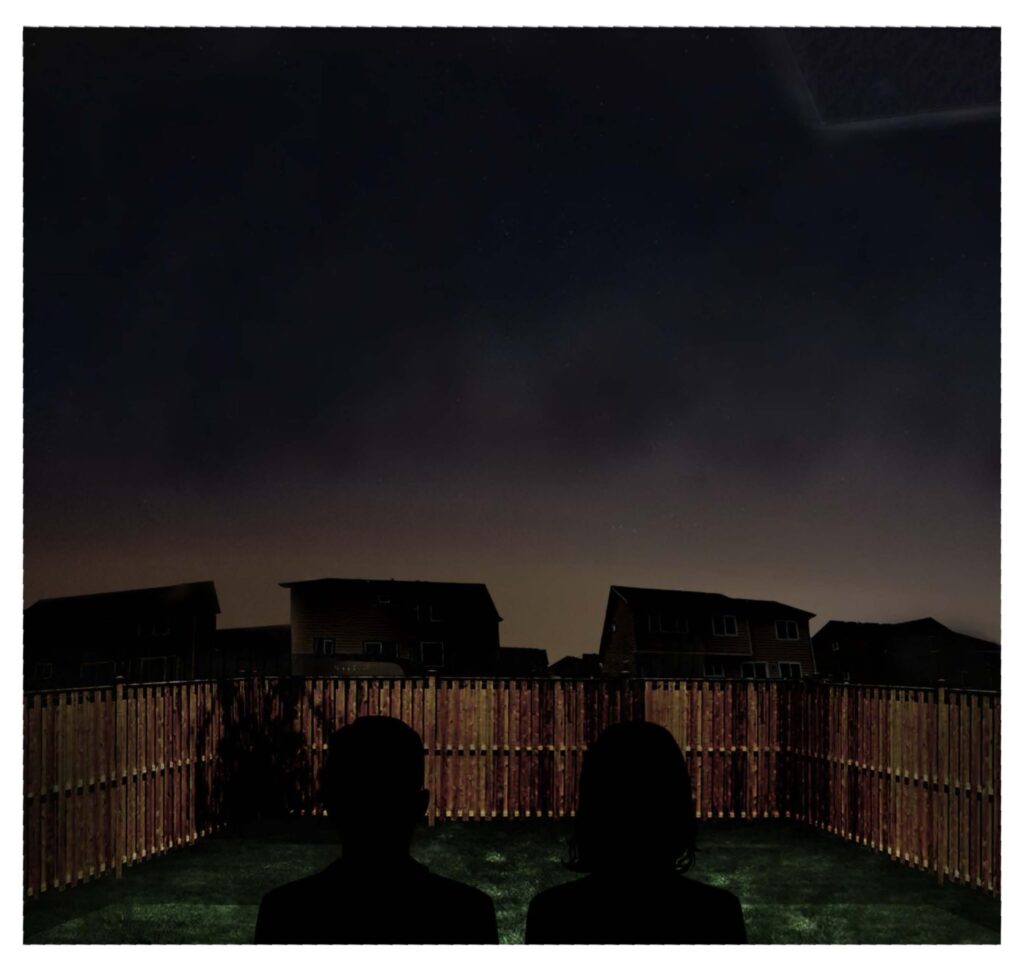
On August 7, 2026, the FBI released a digital rendering of a reported unidentified anomalous phenomenon (UAP) incident near Colorado Springs, Colorado, as part of its PURSUE initiative. The image, labeled FBI-UAP-D027, is an artistic interpretation based on a description provided by a former Department of War employee, as detailed in FBI-UAP-D026.
It depicts two figures observing a dark, translucent triangular object in the night sky. The rendering was prepared in 2026 to aid public understanding of the incident, which allegedly occurred in October 2023. The FBI’s decision to create this visualization underscores its effort to contextualize UAP reports through tangible imagery.
The agency has previously emphasized that such renderings are not photographs but conceptual tools to illustrate witness accounts. The source material explicitly states that the digital model is derived from a first-hand account, though no specific details about the object’s size, speed, or behavior are included.
This intentional vagueness reflects the limitations of the original description, which the FBI has not elaborated on further. The triangular form of the object remains a focal point of interest. While the rendering is described as “dark translucent,” the source does not clarify whether this refers to the object’s physical properties or the visual effect of its appearance under low-light conditions. The inclusion of two figures in the image suggests an attempt to humanize the account, positioning observers as active participants rather than passive witnesses.
However, the FBI has not confirmed the identities or roles of these figures, nor has it verified their presence at the reported location. This release aligns with the broader PURSUE initiative, which aims to systematically investigate UAP sightings.
The FBI has not disclosed whether this particular case has led to any follow-up actions or investigations. The agency’s reliance on a single eyewitness account—provided by a former military personnel—highlights the challenges of corroborating UAP reports. No additional technical data, such as radar logs or surveillance footage, is mentioned in the source material, leaving the account reliant on subjective testimony.
Sebastian Smith notes that the rendering’s artistic nature raises questions about its evidentiary value. “It’s a visual aid, not a forensic document,” Smith observes.
The absence of quantitative details—such as altitude, duration, or proximity—means the rendering cannot be independently validated. This lack of specifics is not unusual for UAP cases, where witnesses often struggle to convey precise measurements under stress. As of August 7, 2026, the UAP incident near Colorado Springs remains classified under the FBI’s internal documentation.
The release of FBI-UAP-D027 is part of a series of disclosures intended to demystify the agency’s approach to such phenomena. However, without corroborating evidence or further analysis, the digital rendering serves more as a narrative tool than a definitive record.
The public’s ability to assess the incident’s significance is thus constrained by the information provided.




