
View original document (0.6 MB) PDF viewer unavailable in this browser. Download the PDF to view.
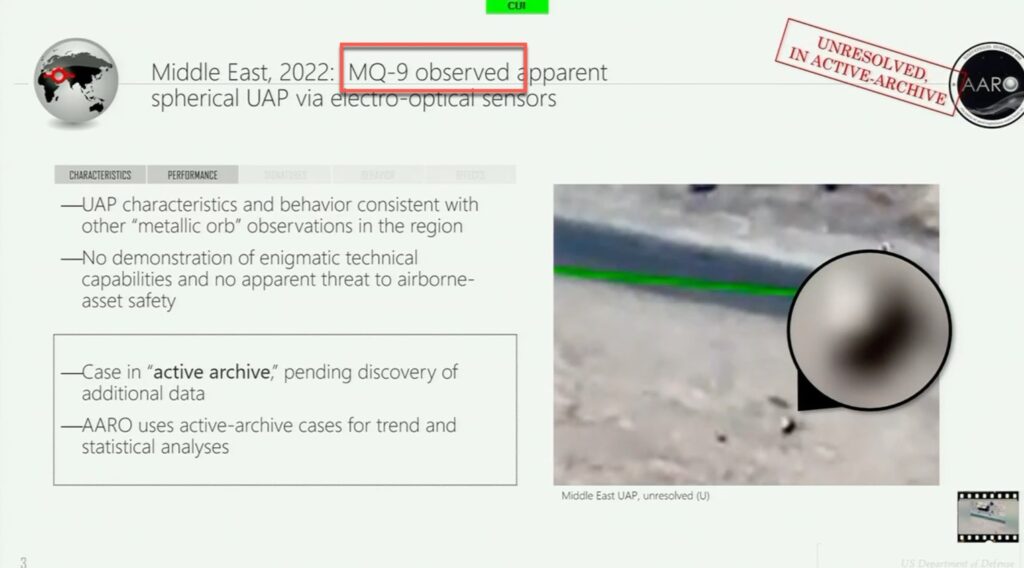
A newly declassified U.S. military mission report from May 2022 describes an operator observing five objects in the sky over Iraq, with the report noting that four of the objects were considered “possible birds” and one a “possible missile.” The document, released by the Department of War as part of its PURSUE archive, offers a rare, if ambiguous, glimpse into the real-time reporting of Unidentified Anomalous Phenomena (UAP) by American forces.
According to Department of War records released under PURSUE, the document, titled “DOW-UAP-D10, Mission Report, Middle East, May 2022,” is a standardized Mission Report (MISREP) used by the U.S. military to record operational circumstances. The records state that military services often use MISREPs to report UAP to the All-domain Anomaly Resolution Office (AARO). The report was declassified by Major General Richard A.
Harrison, USCENTCOM Chief of Staff, on October 7, 2025. The incident is dated May 6, 2022, and occurred in Iraq.
The document’s narrative section, which is classified as SECRET and releasable to the USA and FVEY (Five Eyes) partners, details a mission that began at 0246Z. The operator, identified by the callsign “1.4a,” took off and conducted signals intelligence (SIGINT) collection and target development for Operation INHERENT RESOLVE. At 1514Z, the operator “observed 1x UAP (SEE OBSERVATION 1).” The Department of War’s official description of the document provides crucial context for this observation.
It states that a U.S. military operator reported observing “5x UAP fly across the screen.” The description continues by noting that the report characterizes one of those observations as a “possible missile” and the remaining four as “possible birds.” The Department of War explicitly cautions that all descriptive and estimative language in the report “reflects the reporter’s subjective interpretation at the time of the event.” It further states that such characterizations “should not be interpreted as a conclusive indication of the presence or absence of any intrinsic object features or performance characteristics.” The mission report itself is heavily redacted, with numerous sections containing “1.4a” or other codes in place of specific unit names, aircraft types, and locations.
The mission type is listed as RECXCAS (Reconnaissance and Close Air Support), and the aircraft was equipped with “fully mission capable sensors.” The report notes that full motion video from the mission was exploited by DGS1 (Distributed Ground Station 1). The single observation is listed as “1 OBSERVATION (S/RELIDO)” in the mission narrative admin section.
AARO Context and the PURSUE Archive
Per a Wikipedia summary of the All-domain Anomaly Resolution Office, AARO is an office within the United States Office of the Secretary of Defense that investigates UFOs and other phenomena in the air, sea, and/or space and/or on land. Wikipedia’s entry on AARO notes that its first director was physicist Sean Kirkpatrick, and its current director is Jon T. Kosloski.
The release of this document through the PURSUE archive at war.gov aligns with the Department of War’s stated mission to provide transparency regarding UAP investigations. The document’s official summary offers limited detail beyond the operator’s subjective interpretation.
The report does not provide any definitive conclusions about the nature of the five objects. The record notes that the mission was part of Operation INHERENT RESOLVE, the U.S.-led operation against ISIS in Iraq and Syria. The report was approved for release to AARO, indicating it was formally submitted to the office responsible for analyzing such incidents.
What remains unanswered is whether the objects were ever identified. The document does not contain any follow-up analysis or a final determination.
The operator’s description of “possible birds” and a “possible missile” leaves the incident unresolved. The redacted nature of the report also obscures the specific unit, aircraft, and sensor systems involved, which could provide further context for the observation. Readers should watch for future PURSUE releases that may contain additional mission reports from the same timeframe or region.
The Department of War has indicated that the PURSUE archive will continue to release declassified documents related to UAP. Future releases could provide more quantitative data, such as radar tracks or sensor readings, that might clarify the nature of the objects observed in this and other incidents.




