
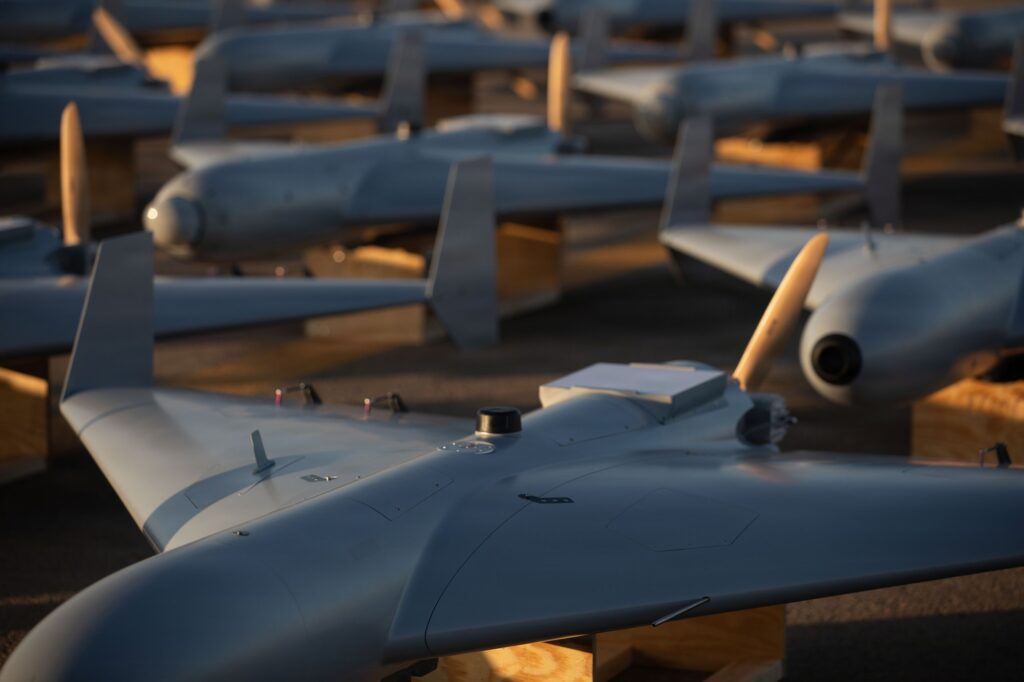
WASHINGTON, Jul 19 — The one-way attack drone employed in the January 28 strike against a U.S. outpost belongs to a class of weapon that military planners have spent years trying to outpace, with only partial success. According to officials familiar with the incident, the munition was a fixed-wing unmanned aerial vehicle designed to fly a pre-programmed route to its target and detonate on impact — a capability that blurs the line between a missile and a reconnaissance drone.
The weapon system carries warheads, unlike the multirotor platforms used for battlefield surveillance, and operates without the need for a pilot in the loop once launched. Iran’s Shahed series, including the Shahed-136 and Shahed-131 models, has become the most widely recognised example of the type, and these systems have been transferred to Russia for use in Ukraine.
The Shahed-136 has an approximate range of 1,000 kilometres, a payload of about 40 kilograms, and is propelled by a small piston engine — a design that trades speed for endurance and low cost. That combination of range, cheap construction and expendable nature makes the platform a persistent problem for air defence networks. Traditional radar and electronic warfare systems remain the backbone of counter-drone operations, but low-flying drones can slip beneath detection envelopes, especially when launched in numbers.
U.S. forces have fielded a tiered set of countermeasures. The Coyote drone is used to ram or shatter incoming UAVs.
The Stryker-mounted Directed Energy M-SHORAD system brings a laser to the fight, engaging targets at the speed of light. Still, officials acknowledged after the January 28 event that neither system guarantees protection. The Tower 22 attack demonstrated that even hardened bases with layered defences can be penetrated by swarms of low-cost drones, a reality that has driven renewed investment in electronic warfare and directed-energy technologies.
The January 28 strike was not an isolated event. U.S. officials noted that a similar one-way attack drone was used in a previous attack on a U.S. base in Syria in 2023, suggesting the method has become a standard tactic for adversaries seeking to challenge American air superiority without risking airframes or pilots. The pattern of attacks indicates that fixed-wing loitering munitions — cheap, pre-programmable and difficult to detect — are being treated as a strategic instrument, not just a battlefield nuisance.
What the January 28 incident laid bare is the vulnerability of forward-deployed bases to a weapon that costs tens of thousands of dollars to produce but forces billions of dollars in defensive systems to adapt. The technical challenge remains: interceptors and lasers can defeat individual drones, but a coordinated salvo can saturate even capable defences.
As the U.S. administration reviews force posture in the region, the record shows that the one-way attack drone has become a permanent feature of the threat landscape — one that air defence planners will need to solve, not simply manage.




