
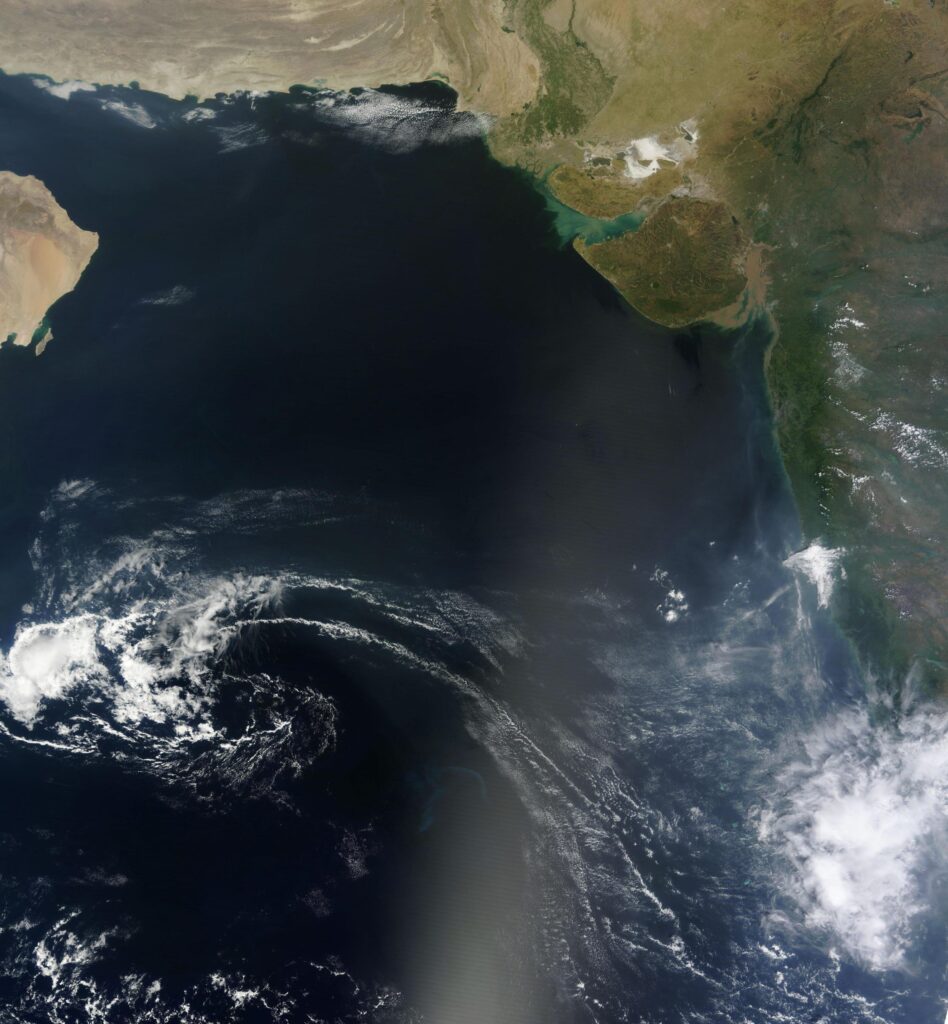
A newly published U.S. Department of War document describes a nighttime encounter in August 2020 when a Navy pilot spotted three unknown aircraft over the North Arabian Sea. The report, made public on May 8, 2026, through the Department’s PURSUE archive, is a standardized Range Fouler Debrief Form used by the Navy to log unauthorized entries into controlled airspace during active missions or training exercises. Filed on August 24, 2020, the document—cataloged as “DOW-UAP-D56”—states that a U.S. military operator detected three “unidentified small air contacts” at 00:04:30 Zulu.
The operator, identified as an O-3 pilot assigned to squadron HSM-73, initially observed the first object heading west. After losing sight of it behind a cloud, the pilot regained visual contact and reported two additional objects to the east of the first.
According to the form, all three objects “appeared to maintain their relative course, speed, and altitude.” The reporting form includes a checklist for describing the objects’ characteristics. The operator indicated a “wings/airframe” structure and checked boxes for “Metallic” appearance and “Other Shape.” Boxes for “Balloon-shaped,” “Translucent,” “Opaque,” “Reflective,” and “Markings” were left unchecked. The report notes that the operator did not achieve a “Tally” (visual acquisition) and that the radar trackfile was not stable. The contact’s speed was listed as unknown, with a direction of 270 degrees.
No electronic attack indications were reported. The contact altitude was recorded as 31,000 feet, with a wind direction of 310 degrees and a constant wind speed of 5 knots.
The Department of War’s official description of the document cautions that all descriptive and estimative language reflects the reporter’s subjective interpretation at the time of the event. The agency states that such characterizations “should not be interpreted as a conclusive indication of the presence or absence of any intrinsic object features or performance characteristics.” The form is used for data collection purposes, and the Navy’s SPEAR office sanitizes all reports of identifying information. The document’s summary offers limited detail beyond the operator’s narrative.
The mission description field marked “LFE” (likely a large force exercise) as “Yes.” The pilot’s crew position and the aircraft’s Bureau Number have been sanitized per policy. The incident occurred in the Arabian Sea, a region of active military operations and training.
The document does not specify the exact mission type beyond “LFE,” and the operator’s report does not identify the objects as any known aircraft or drone. The lack of a stable radar trackfile and the operator’s inability to achieve visual tally suggest the encounter was brief and inconclusive from a tracking perspective. Several questions remain unanswered by this document.
The report does not provide any explanation for the objects’ origin, propulsion, or purpose. The operator’s description of “wings/airframe” structure suggests a conventional aircraft design, but the absence of electronic attack indications and the objects’ ability to maintain formation after the pilot’s initial loss of contact leave the nature of the encounter open to interpretation.
The Department of War’s caution that the report reflects subjective interpretation underscores the limitations of the data. Readers should watch for future PURSUE archive releases, which may include additional debrief forms, sensor data, or analysis from other incidents in the region. The Department of War has not indicated a schedule for further releases, but the PURSUE archive remains a public resource for reviewing historical UAP reports.
As with this document, future records may provide further context for understanding the frequency and characteristics of unauthorized airspace intrusions reported by U.S. military personnel.




