
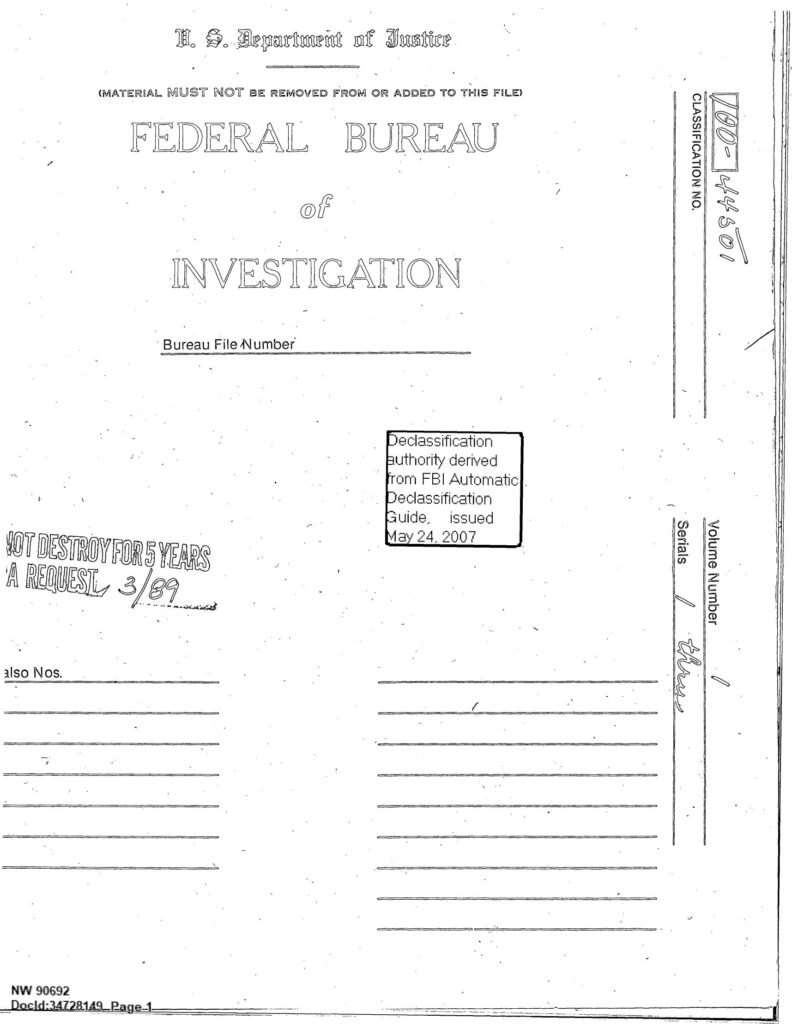
Chicago, July 10 — The FBI released a pair of decades-old documents today tied to UFO sightings, offering a rare glimpse into how the agency handled reports of unidentified aerial phenomena in the mid-20th century. The files, part of the 2026-07-10 PURSUE tranche, include a 1967 account from an 11-year-old child and a 1974 correspondence with a man named Larry Bryant.
The first document, dated September 22, 1967, describes a sighting reported by a child in Chicago. According to the file, the boy heard a “weird” noise and saw a “flash of light going north in the sky” around 8:30 PM. He provided no further details. The report was forwarded to Sergeant Eugene Ripka of the Army-Air Force 755th Radar Squadron. No follow-up actions or investigations are noted in the document.
The second set of correspondence, dated September 30 and October 10, 1974, involves Larry Bryant inquiring about an alleged UFO sighting from April 8, 1954. Bryant claimed to have received a U.S. Army report about an “occupied unidentified flying object” that was pursued by West Coast Coast Guard personnel. The report, according to the Army, describes the object landing briefly and discharging its occupants, who then returned to it. The document states at least three civilians observed the event. Bryant requested copies of FBI files related to this incident and any other UFO-related cases between January 1, 1954, and December 3, 1954.
The FBI’s response, dated within the same timeframe, explicitly states it maintains no records of the 1954 sighting. It also clarifies that, as of 1974, the bureau no longer collected information on UFO sightings. This policy shift is highlighted in the letter, which notes the change in the agency’s focus. Bryant’s request for additional documentation was denied, with the FBI citing a lack of records.
The release of these files underscores the historical context of UFO reports during the Cold War era. The 1967 child’s account reflects public fascination with unexplained phenomena, while the 1974 exchange illustrates how the FBI’s approach evolved. At the time, the agency’s lack of systematic data collection on UFOs suggests a broader national skepticism or bureaucratic neglect of such claims.
Investors and analysts may note the files’ significance in the broader narrative of government transparency. The 2026 release aligns with a trend of declassifying historical records, though these documents do not confirm or debunk any extraterrestrial activity. Instead, they reveal how institutions like the FBI managed—or ignored—sightings that once carried public intrigue.
The FBI’s 1974 statement that it no longer tracks UFO sightings remains a key detail. It suggests a deliberate shift in priorities, possibly influenced by changing societal attitudes or resource allocation. Without modern-era comparisons, it is unclear whether this policy change was permanent or situational. The documents themselves offer no evidence of extraterrestrial contact, only bureaucratic records of public reports.
For now, the files serve as a historical artifact. They provide no new insights into the existence of UFOs but do document how authorities processed claims decades ago. The child’s 1967 report, brief and unverified, contrasts sharply with Bryant’s 1974 inquiry, which references a military report. Both cases highlight the gap between public curiosity and official response.
The release of FBI-UAP-D014 adds to a growing archive of Cold War-era UFO correspondence. While the 1954 and 1967 incidents lack corroborating evidence, their documentation reflects a time when such reports were treated with a mix of curiosity and indifference. As of 2026, the FBI’s stance on UFOs remains unchanged, focusing instead on other national security priorities.
What to watch next includes potential future releases of similar records or renewed public interest in UFO phenomena. The 2026 disclosures may also fuel debates about government accountability in handling unexplained events. For now, these files remain a snapshot of a bygone era’s approach to the unknown.”




