
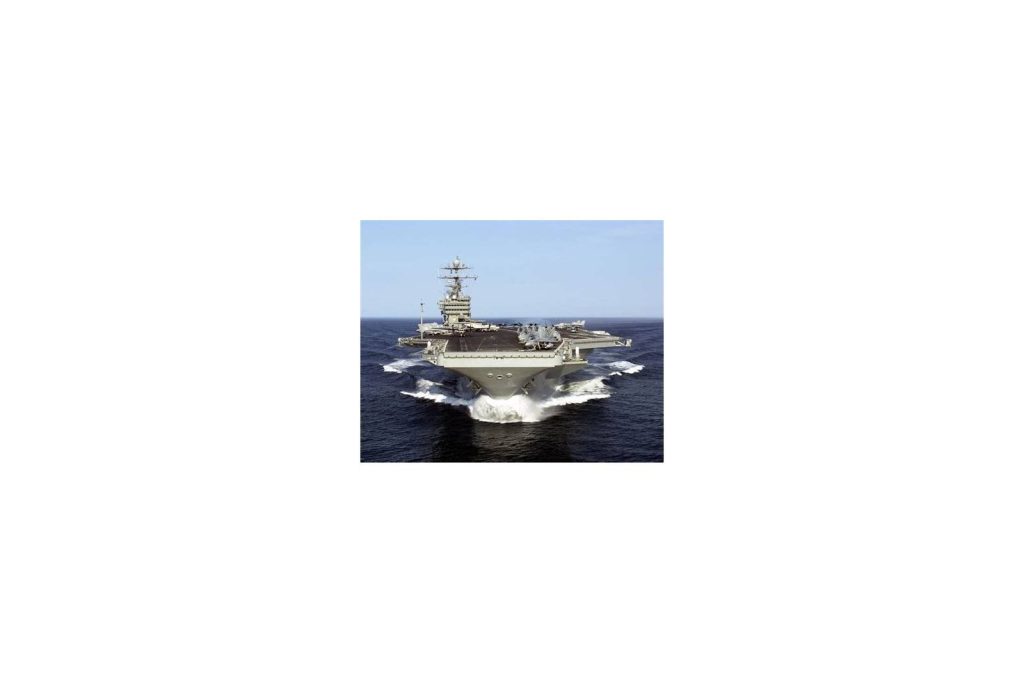
Washington, July 8 — The U.S. Navy’s USS Dwight D. Eisenhower carrier strike group remains deployed in the Persian Gulf, operating past its scheduled rotation under orders from the Department of Defense issued on March 31, 2025. That directive followed a declaration by President Trump on the same day. In response, Iran’s Foreign Minister Abbas Araghchi warned that Iran would “defend its territorial waters” if challenged.
The move underscores a deepening standoff centered on the Strait of Hormuz, the narrow waterway that handles roughly 25 percent of all seaborne oil trade and about 20 percent of the world’s liquefied natural gas shipments annually.
Diplomatic and Economic Pressures
The international community has begun to mobilize. The United Nations Security Council scheduled a meeting for April 2, 2025, to address the crisis. The European Union, through foreign policy chief Josep Borrell, called for restraint and urged both sides to return to negotiations. The economic stakes are substantial.
The International Monetary Fund issued a warning on March 31, 2025, stating that a prolonged disruption of shipping through the strait could cut global GDP growth by 0.3 percent in 2025. Analysts at the Center for Strategic and International Studies have suggested that the United States may impose additional sanctions specifically targeting Iranian oil exports, with a focus on Chinese refineries that process Iranian crude.
These measures would aim to further squeeze Iran’s petroleum revenue without directly closing the waterway. The UN Security Council meeting on April 2 represents the next major diplomatic milestone. The European Union’s call for negotiations offers a parallel, softer approach to de-escalation.
Meanwhile, the Eisenhower strike group remains on station in the Gulf, a visible projection of naval power. The IMF’s GDP warning serves as an economic canary in the coal mine, highlighting the global consequences should the standoff continue or escalate.
Historical Context and Recurring Tensions
The waters of the Persian Gulf and the narrow Strait of Hormuz have been a recurring flashpoint between the United States and Iran for decades. The two countries have been locked in antagonism since the 1979 Iranian revolution.
That rift deepened during the Iran-Iraq war in the 1980s, when both sides attacked oil tankers, prompting the U.S. Navy to escort reflagged Kuwaiti vessels through the strait. In more recent years, the 2015 nuclear deal offered a brief period of diplomatic thaw, but that agreement collapsed after the United States withdrew from it in 2018 and reimposed economic sanctions. Tensions escalated sharply again in 2020, when a U.S. airstrike killed a top Iranian general. Each outbreak has followed a similar pattern: naval deployments, warnings from Tehran, and international calls for calm.
The current situation mirrors that pattern. The core of this standoff is a question of potential military and diplomatic scenarios.
These span the range from renewed negotiations and sanctions pressure to direct confrontation. The immediate focus, however, remains on the Eisenhower strike group’s extended presence in the Gulf and the scheduling of the UN Security Council meeting on April 2. The IMF’s growth warning underscores the broad economic exposure, while the CSIS analysis points to a specific lever Washington might pull.
For now, all eyes are on whether diplomacy can gain traction before the crisis deepens.




