
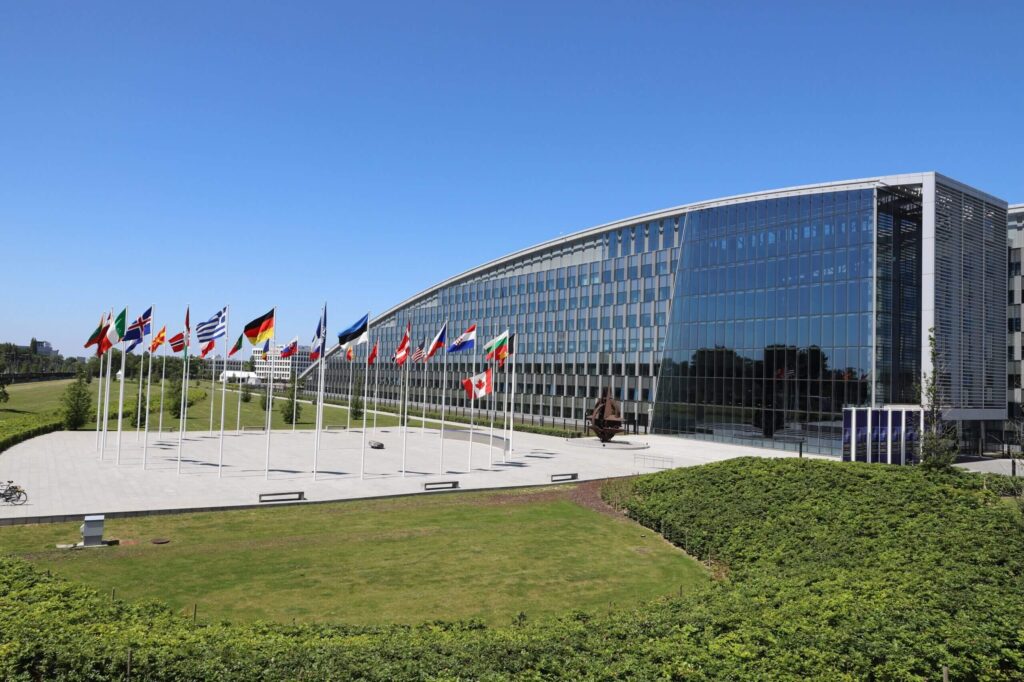
A quiet but consequential shift is reshaping one of the bedrock commitments of the North Atlantic Treaty Organization. For years, the alliance’s 2% defense spending target functioned largely as a political aspiration rather than a binding rule. Now, as war grinds on along Europe’s eastern flank, the trend underneath points toward real accountability.
The numbers themselves are beginning to tell a different story. Agreed upon at NATO’s 2014 Wales Summit, the 2% target was a direct response to Russia’s annexation of Crimea.
It was meant to send a clear signal that member states would reverse years of post-Cold War cuts to their defense budgets. Yet follow-through was slow. As of 2024, only 11 of NATO’s 32 members met the threshold, leaving more than 20 allies — including several major European economies — below the line.
The old excuses were beginning to wear thin, and the pressure to deliver was mounting.
Denmark’s Pledge and the Path Forward
Denmark offers a case study in what is changing. In 2024, Copenhagen’s defense spending sat at roughly 1.65% of its gross domestic product, according to NATO estimates. That figure remains below the target, but the Danish government has already laid out a clear path to close the gap. In 2023, it pledged to hit the 2% benchmark by 2025, backed by a planned increase of 19 billion Danish kroner — about $2.7 billion — spread over five years.
If Denmark follows through, it will join a growing list of allies moving from promise to delivery. Denmark’s commitment extends beyond the spending percentage.
As a founding member of NATO since 1949, the country has contributed troops and resources to alliance missions in Afghanistan, Iraq, and the Baltic states. In 2024, Copenhagen signed a new defense cooperation agreement to host United States troops on its soil for the first time in decades. This marked a significant step for a Nordic nation that has historically maintained a more cautious security posture, reflecting a broader reassessment among Nordic countries in the wake of the conflict on Europe’s eastern flank.
Prime Minister Mette Frederiksen reinforced the message in February 2025. She reaffirmed Denmark’s commitment to NATO, including the defense of Greenland, which remains part of the Danish kingdom.
The statement came amid heightened geopolitical interest in the Arctic, a region where strategic competition is intensifying. The Danish Realm includes the autonomous territories of the Faroe Islands and Greenland, giving Copenhagen strategic interests in the North Atlantic that are increasingly relevant.
Burden-Sharing Under a New Imperative
The alliance was founded in 1949 on the principle of collective defense, with its core guarantee — Article 5 — holding that an armed attack on one member is an attack on all. Created to counter Soviet expansion during the Cold War, NATO adapted after the Soviet Union collapsed by taking on missions in the Balkans and beyond.
For decades, Denmark contributed to these operations but kept its own defense spending relatively low, mirroring a broader post-Cold War trend across Europe. That approach to burden-sharing shifted sharply after Russia’s annexation of Crimea in 2014. The 2% target agreed at the Wales Summit was meant to reverse years of cuts, yet for years most allies remained below the benchmark.
Today, the war on Europe’s eastern flank has turned that political aspiration into a practical imperative. The trend underneath is clear: the alliance is no longer content with aspirational targets.
The expectation is growing that defense spending will become a binding obligation, not a voluntary goal. Such steps matter because they test the alliance’s credibility. If a founding member like Denmark meets the target and strengthens its commitment, it reinforces the collective defense guarantee at a time when that guarantee is under direct challenge.
For Denmark and others, the clock is ticking. The old excuses are wearing thin, and the pressure is on every member to deliver as the alliance reshapes itself for a new era of strategic competition.




