
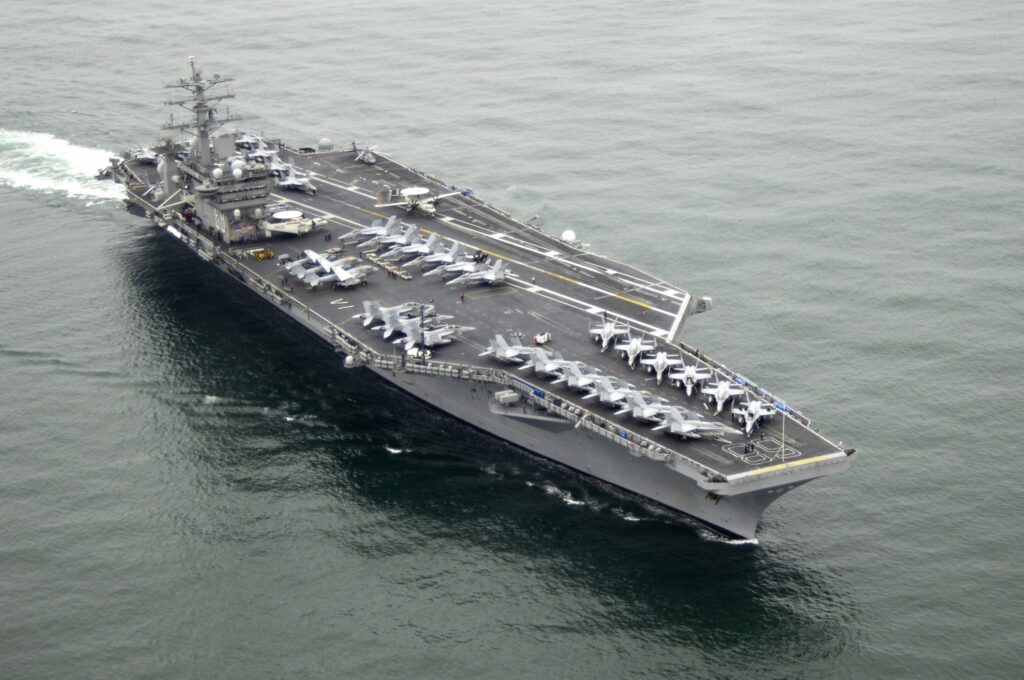
2004 Nimitz Encounter: A Tic-Tac Over the Pacific
On November 14, 2004, Commander David Fravor and Lieutenant Commander Alex Dietrich were flying F/A‑18F Super Hornets as part of the USS Nimitz Carrier Strike Group when they observed an object that defied conventional explanation. The object was white, shaped like a tic‑tac, and approximately 40 feet long with no visible wings or exhaust. According to the declassified records, it moved from a stationary hover to hypersonic speed instantly. The USS Princeton, equipped with SPY‑1 radar, tracked the object throughout the engagement. The entire encounter lasted roughly five minutes.
The USS Nimitz itself carries a storied history. As the lead ship of its class of nuclear‑powered aircraft carriers, it was named after Fleet Admiral Chester W. Nimitz, the commander of U.S. forces in the Pacific during World War II. Commissioned in the mid‑1970s, the vessel has outlasted other Cold War‑era ships and is now the oldest active carrier in the U.S. Navy. Its home port has changed multiple times—from Norfolk, Virginia, to a berth in Washington state, and later to California—reflecting shifting strategic priorities over decades.
That 2004 observation marked a turning point for the Navy. The behavior of the object—no known aircraft can accelerate from a hover to hypersonic speeds without wings or an exhaust plume—led officials to reconsider how such incidents were documented. Formal reporting procedures were established within the Navy in 2019, partly driven by the Nimitz encounter and later reports.
Roosevelt Sightings: Daily Encounters Off the East Coast
The second major incident detailed in the declassified documents involves the USS Theodore Roosevelt Carrier Strike Group. From 2014 to 2015, while operating off the East Coast, multiple F/A‑18E/F pilots—including Lieutenant Ryan Graves—reported seeing objects on a near‑daily basis. Witnesses described objects with no visible means of propulsion, often appearing at 30,000 feet and then descending rapidly toward the ocean. Radar data from the ship’s Aegis system tracked some of these objects moving at speeds up to Mach 2.5.
The Navy officially released three videos in 2020 capturing these encounters: the FLIR1 video from the 2004 Nimitz incident, and the GIMBAL and GOFAST videos from the 2014‑2015 Roosevelt incidents. These videos, recorded by targeting cameras on Navy jets, provided visual evidence of objects that could not be immediately explained. The declassified documents include not only the videos but also the accompanying pilot testimony, radar logs, and sensor data.
The term used by the government for such phenomena is “unidentified aerial phenomena,” or UAP. Military pilots and radar operators have reported such observations for years, but the topic remained largely outside public discussion until a series of declassified incidents drew widespread attention. The 2004 Nimitz encounter and the Roosevelt sightings pushed the Navy to treat these reports as a matter of operational security, leading to the overhaul of reporting procedures in 2019.
Policy Shift and the Significance of Declassified Records
The formal reporting procedures established in 2019 represent a significant shift in how the Navy approaches UAP. Where earlier reports might have been handled informally or not documented at all, the service now has a standardized process for recording sightings by pilots and radar operators. The declassified documents provide the public and researchers with a rare look at official records, grounding a subject long relegated to speculation in factual data.
The Pentagon has released three videos so far, but the radar logs and pilot testimony suggest a much larger dataset exists. What observers are watching for next is whether additional sensor data from these encounters will be released. The 2004 Nimitz encounter, in particular, showed that a single five‑minute observation could prompt a wholesale change in military policy on how unknown objects are reported and investigated.
Even for an institution as established as the U.S. Navy, the skies remain a realm of potential surprise. The USS Nimitz continues to serve, a reminder that the protocols put in place after 2004 were born from a moment when pilots and radar operators saw something that did not fit any known profile—and chose to record it.




