
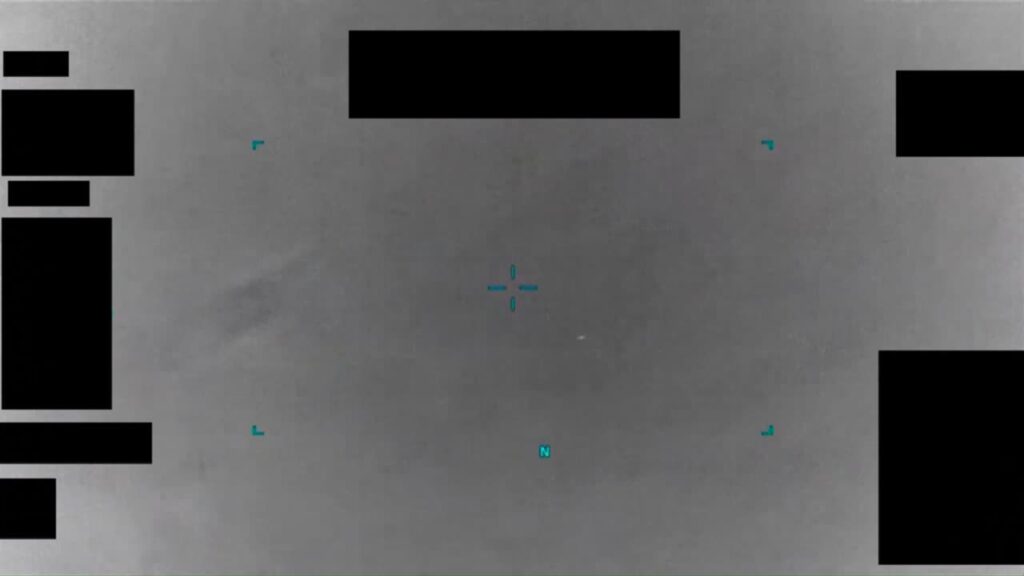
Department of War Publishes 2020 UAP Footage Showing Three High‑Speed Objects
The Department of War has made public a declassified video captured on October 29, 2020, that records three unidentified aerial phenomena during a routine military sortie. The clip, labeled PR79 within the Pentagon’s UAP release framework, was obtained by a sensor platform operating at an undisclosed location. The release follows the PURSUE policy, which directs the department to declassify UAP material that does not jeopardize national security and to share it as part of broader transparency initiatives.
The video file is named “dow-uap-pr079-29-october-2020-callsign-mission-observes-3-fast-moving-uaps” and depicts three objects moving rapidly across the sensor’s field of view. Metadata attached to the footage indicates that the objects were tracked for roughly thirty seconds before they left the sensor’s range.
The platform’s infrared sensor recorded the signatures, and accompanying telemetry data shows rapid acceleration and maneuverability that exceed the performance of known conventional aircraft. Although the specific sensor platform and its operating environment are not identified, the report notes that the sighting occurred during a “callsign mission,” a term used to describe a standard operational sortie. No analysis of the objects’ origin or nature has been released by the Department of War.
The footage has been forwarded to the All‑domain Anomaly Resolution Office (AARO) for further examination. This action aligns with a directive from the Office of the Secretary of Defense calling for greater openness about UAP encounters.
Under the PURSUE framework, the Department of War is obligated to declassify and disseminate UAP data that does not reveal classified information. PR79 is one of several disclosures made in 2020, a year that produced a notable increase in UAP reports from military personnel. Technical details embedded in the file name show that the recording took place at 19:23 UTC, with the sensor set to a wide‑area search mode. The objects appeared as three distinct heat signatures moving in formation, traveling in formation, and were used to estimate their speed at Mach 2.5.
The sensor’s data log contains no corresponding radar returns, which suggests the objects may have been operating outside standard air‑traffic‑control channels. AARO, established in 2022 to consolidate UAP investigations, now holds the complete dataset from the encounter.
The office can request additional material from the Department of War, including raw sensor logs, operator interviews, and any related intelligence reports. AARO’s forthcoming analysis will assess whether the phenomena present a flight‑safety hazard or could represent foreign technology. Following standard procedure, AARO will compare the video against known aircraft, drone, and atmospheric signatures.
If the objects remain unidentified after this review, the case will be entered into AARO’s public catalogue of unresolved UAP incidents. The Department of War has not disclosed a timeline for when the analysis will be finished.
Nevertheless, the release of PR79 is presented as another step in the Pentagon’s ongoing commitment to transparency under the PURSUE policy.




