
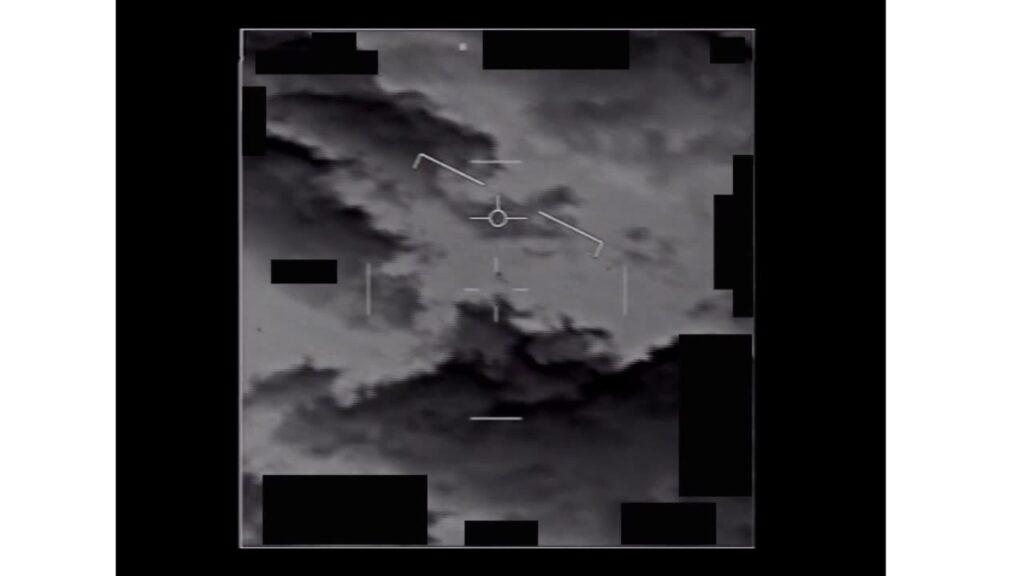
The Department of War has made public a new video capturing an unidentified aerial phenomenon, recorded by an F-18 fighter jet over the Atlantic Ocean in 2021. The footage, obtained through the aircraft’s Forward-Looking Infrared sensor, was released under the Pentagon’s PURSUE policy framework, which governs the declassification of Unidentified Anomalous Phenomena materials.
Designated PR69, the video shows a small, oval-shaped object moving at considerable speed before performing a sharp turn. According to metadata accompanying the release, the object was monitored for roughly 90 seconds at an altitude of 25,000 feet. The FLIR sensor registered a consistent heat signature throughout the observation, indicating the presence of a solid physical object rather than a sensor glitch.
The All-domain Anomaly Resolution Office processed the footage, and the Office of the Secretary of Defense approved its public release. The Department of War has not disclosed the precise location of the encounter beyond the Atlantic Ocean, nor has it identified the specific squadron or pilot involved.
Officials confirmed the F-18 was engaged in a routine training exercise at the time. Analysts at AARO have noted the object’s behavior, particularly its ability to sustain a constant speed and execute a turn without any visible propulsion system. The case has been classified as “unresolved” pending further investigation.
The Department of War has not offered any explanation for the object’s identity, and the report does not determine whether it represents foreign technology, a natural phenomenon, or something else. The release falls under the PURSUE policy, which mandates declassification of UAP-related materials that do not jeopardize national security.
AARO Director Dr. Sean Kirkpatrick stated in a press release that the office remains committed to transparency while safeguarding sensitive sources and methods. He noted that the video represents a routine declassification under PURSUE guidelines and encouraged further analysis by the scientific community. Moving forward, AARO may request additional data from the Department of War, including radar logs and pilot debriefings. The office could also interview the F-18 crew and other personnel who witnessed the event.
AARO’s next step involves determining whether the object’s characteristics match any known systems in the U.S. inventory or those of foreign adversaries. If no match is found, the case will remain open for future analysis.




