
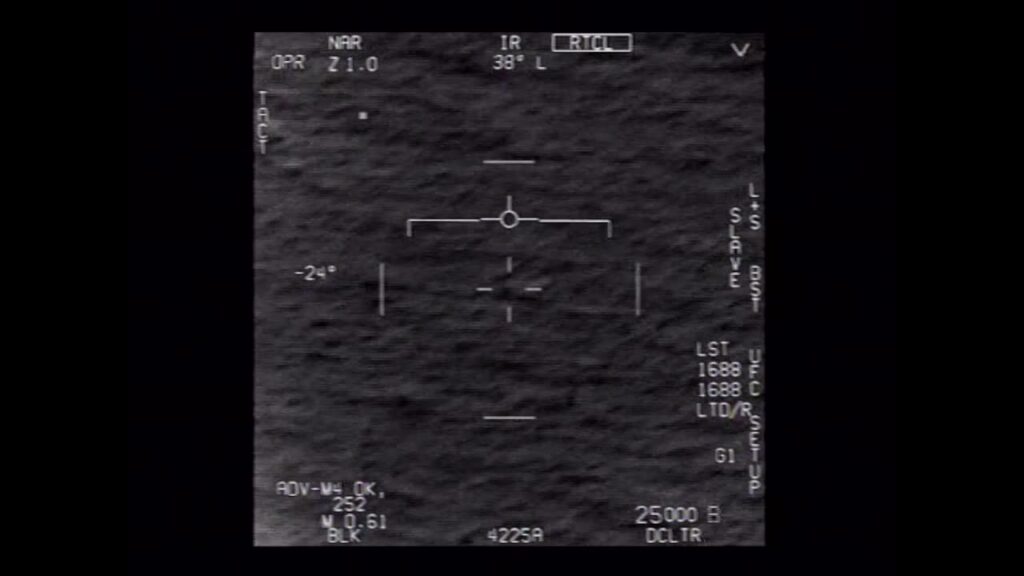
The Department of War has made public a short video of an unidentified aerial phenomenon (UAP) that was captured in 2019 by a U.S. Navy F/A‑18 Super Hornet. Designated “Go Fast,” the footage was recorded with the aircraft’s AN/ASQ‑228 Advanced Targeting Forward‑Looking Infrared (ATFLIR) sensor and is now accessible through the department’s online UAP repository. According to the embedded metadata, the recording occurred on July 2, 2019 at about 16:30 local time during a routine training sortie from the carrier USS Theodore Roosevelt (CVN‑71).
The mission took place over a training area off the coast of Virginia, near the Navy’s Atlantic Test Ranges. While the ATFLIR pod was set to a narrow field‑of‑view mode, it tracked a small, dark object moving rapidly across a clear blue sky.
The ten‑second clip shows the object traveling from left to right across the sensor’s view at an estimated range of roughly 4.5 nautical miles. Speed calculations derived from the video place the phenomenon at about 120 knots. The footage does not reveal the object’s altitude or a detailed flight path, and no unusual maneuvers beyond the reported velocity are evident.
The release is part of the Pentagon’s ongoing transparency initiative under the PURSUE policy framework, announced in 2024. PURSUE outlines procedures for the controlled declassification of UAP‑related material, aiming to balance public disclosure with national‑security considerations.
The department has indicated that additional UAP content will be released in accordance with this framework. Oversight of the new material now falls to the All‑domain Anomaly Resolution Office (AARO), an entity within the Office of the Secretary of Defense created to coordinate the collection, analysis, and resolution of UAP incidents across air, sea, space, and other domains. AARO analysts are expected to request supplementary data from the Navy, including radar tracking logs, other sensor recordings, and any debriefing notes from the flight crew involved in the 2019 encounter.
Interviews with the aircrew may also be conducted to gather firsthand observations. The primary objective of the investigation is to determine whether the “Go Fast” object can be identified as a known aircraft, drone, atmospheric phenomenon, or other conventional explanation, or if it remains unexplained.
AARO continues to encourage service members to report UAP sightings through official channels, reinforcing the department’s commitment to systematic documentation. While the video does not provide definitive answers, its release adds to a growing catalog of declassified UAP recordings, including previously disclosed footage from 2022 in Syria and a 2023 video captured during a Middle‑East operation. Together, these materials form a broader evidentiary base that analysts hope will clarify the nature of such phenomena.
For those interested in reviewing the clip, the Department of War has placed the “Go Fast” video on its public UAP archive, where it can be accessed alongside related documentation.




