
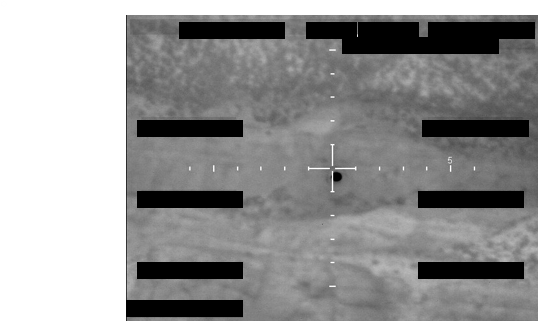
 The Federal Bureau of Investigation (FBI) submitted a report to the All-domain Anomaly Resolution Office (AARO) consisting of a single, redacted still image of an unidentified anomalous phenomenon (UAP), according to official records released under the U.S. Department of War’s PURSUE archive on May 8, 2026. The document, titled “FBI Photo A2,” is a monochrome image described in the official summary as displaying a “mottled background with a central crosshair reticle” and a “dark, circular object” at the center of that reticle.
The record’s official summary offers limited detail beyond the physical description of the image, noting that the date and location of the event have not been provided. The FBI document, released as a still image derived from a U.S. government system, was altered with redactions before being submitted to AARO.
An accompanying mission report was not provided. The operator who captured the original imagery reported that they were unable to positively identify the UAP. The official narrative description of the image, provided for informational purposes, states that the background has a “textured, uneven appearance suggesting a varied landscape or surface.” The document explicitly cautions that readers “should not interpret any part of this description as reflecting an analytical judgment, investigative conclusion, or factual determination regarding the described event’s validity, nature, or significance.”
Context of the PURSUE Archive Release
The release of “FBI Photo A2” is part of a broader declassification effort.
Per a Wikipedia summary of the United States UFO files, these records are “a collection of declassified United States government records concerning UFOs, also called unidentified anomalous phenomena (UAPs), released by the administration of Donald Trump beginning on May 8, 2026, and announced to continue as repeated, ongoing, expanding releases of UFO materials.” The Wikipedia entry notes that the files are also referred to as the “UFO files” or the “UAP files.” The PURSUE archive, hosted at war.gov, is the designated portal for these releases, with the FBI photo appearing as the first item in a series labeled “release_1.”
The FBI’s submission to AARO, the Pentagon’s office established to investigate UAPs across all domains, underscores the interagency nature of the reporting process.
However, the official description of “FBI Photo A2” is notably sparse. It confirms that the image originated from a U.S. government system but does not specify which branch or sensor type captured the data. The redactions applied to the original imagery further limit what can be independently verified from the released file.
The absence of a mission report means that contextual details such as the operator’s identity, the duration of the observation, or any subsequent analysis are not included in the public record.
What Remains Unanswered
The release of “FBI Photo A2” raises several questions that the current documentation does not address. The official summary does not explain why the date and location of the incident were withheld, nor does it clarify the nature of the redactions applied to the original image. The operator’s inability to positively identify the UAP leaves open the possibility that the object could be a known aircraft, a natural phenomenon, or something else entirely—but the record offers no further analysis.
The textured background described in the narrative could suggest a variety of environments, from mountainous terrain to a body of water, but without location data, this remains speculative.
Readers should watch for future PURSUE releases, which the Wikipedia entry notes are expected to be “repeated, ongoing, expanding releases of UFO materials.” The Department of War has not announced a schedule for subsequent uploads, but the initial release of “FBI Photo A2” establishes a precedent for how these documents will be presented: with official descriptions that are careful to avoid analytical conclusions, and with redactions that preserve operational security or privacy concerns.
As more files are made public, the broader context of the U.S. government’s UAP collection efforts may become clearer, potentially shedding light on the circumstances surrounding the FBI’s submission and the nature of the phenomenon it documented.




