
WASHINGTON, September 28 — The Pentagon has disclosed new research files concerning unidentified aerial phenomena (UAP), delving into advanced propulsion concepts such as warp drives and futuristic weapon systems, according to RBC-Ukraine’s reporting. This release forms part of the U.S. Department of Defense’s efforts to boost transparency regarding UAP investigations, following the establishment of the All-domain Anomaly Resolution Office (AARO) in 2022, succeeding earlier initiatives like the Advanced Aerospace Threat Identification Program (AATIP) that operated from 2007 to 2012.
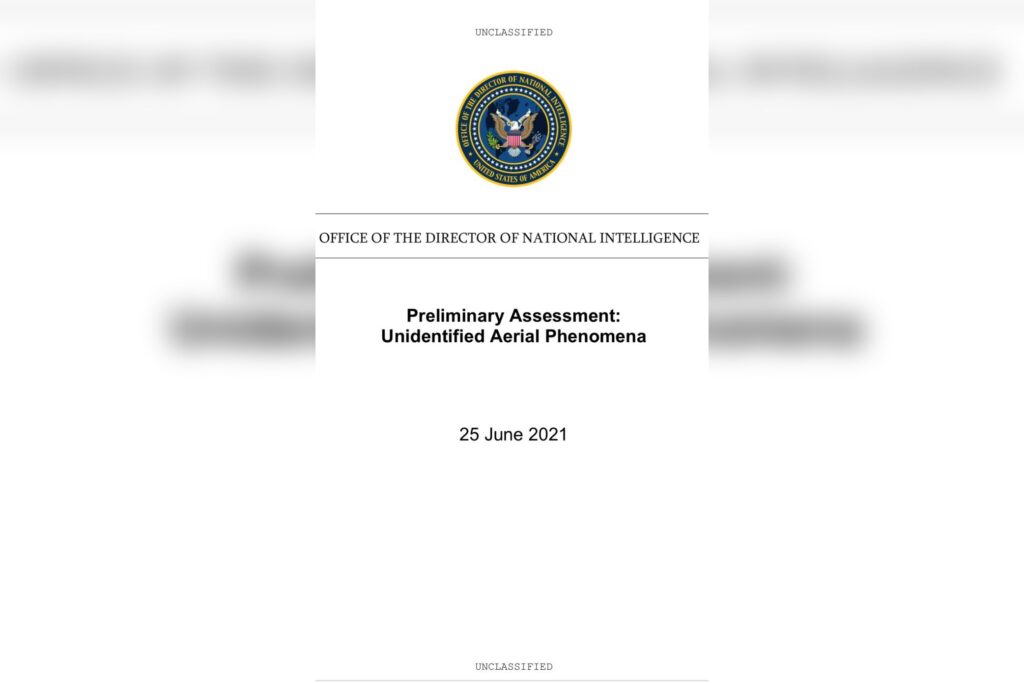
The newly unveiled documents do not verify the existence of operational warp drive technology or deployed futuristic weapons but include theoretical analyses and references to peer-reviewed scientific concepts, such as the Alcubierre metric. These documents also reference historical UAP sightings investigated by U.S. military personnel, including incidents involving radar tracking, infrared sensor data, and pilot visual encounters, some of which were previously detailed in preliminary assessments released by the Office of the Director of National Intelligence (ODNI) in June 2021 and June 2022.
In June 2021 and June 2022, the ODNI reports analyzed 144 UAP encounters reported by military aviators between 2004 and 2021, concluding that while no evidence indicated extraterrestrial origin, the objects exhibited flight characteristics inconsistent with known aircraft, including sudden acceleration, hypersonic velocity without detectable propulsion, and trans-medium movement. The Pentagon’s latest disclosure includes unclassified summaries of defense-funded research into exotic energy sources, quantum vacuum engineering, and inertial mass reduction—concepts occasionally discussed in aerospace literature as potential enablers of advanced propulsion, though none have been demonstrated in scalable, reproducible experiments.
The documents emphasize that such studies remain exploratory and are conducted under the purview of the Defense Intelligence Agency (DIA), the Air Force Research Laboratory (AFRL), and the Defense Advanced Research Projects Agency (DARPA), which routinely fund high-risk, high-reward physics research with potential long-term defense applications. No specific budget figures for these UAP-related research programs were disclosed in the released files, though prior public statements have indicated annual funding for AARO in the tens of millions of dollars.
The Pentagon continues to encourage reporting of UAP sightings by military and civilian personnel through standardized channels, citing national security and flight safety concerns. The release does not alter the official U.S. government position that there is no conclusive evidence linking UAP to extraterrestrial intelligence, but acknowledges that certain observed phenomena remain unexplained due to limitations in sensor data and observational scope.
The RBC-Ukraine report frames the disclosure within broader public interest in UAP transparency, noting increased congressional oversight, including hearings held by the House Subcommittee on National Security, the Border, and Foreign Affairs in 2023 and 2024, during which Pentagon officials testified about UAP data collection, analysis protocols, and interagency coordination efforts. Looking ahead, the U.S. government’s ongoing commitment to UAP research and transparency will likely continue to draw attention and scrutiny from both the public and Congress.
The future of these investigations and potential technological breakthroughs will undoubtedly remain a topic of interest and debate.




