
The chokepoint is just 21 miles wide at its narrowest, a ribbon of turquoise water between the jagged coast of Iran and the Omani peninsula. Through that ribbon moves one-fifth of the world’s petroleum, a daily procession of supertankers so vital to global energy markets that their uninterrupted passage has been a central preoccupation of American naval strategy for half a century.
The Strait of Hormuz connects the Persian Gulf to the Gulf of Oman and the open Indian Ocean. For the United States, keeping that passage open has meant maintaining a permanent naval presence in the region since the 1940s, a commitment that deepened after the British withdrawal from east of Suez in 1971. What began as a modest show of force evolved into the most concentrated naval deployment on earth, centered on the US Fifth Fleet, based in Bahrain.
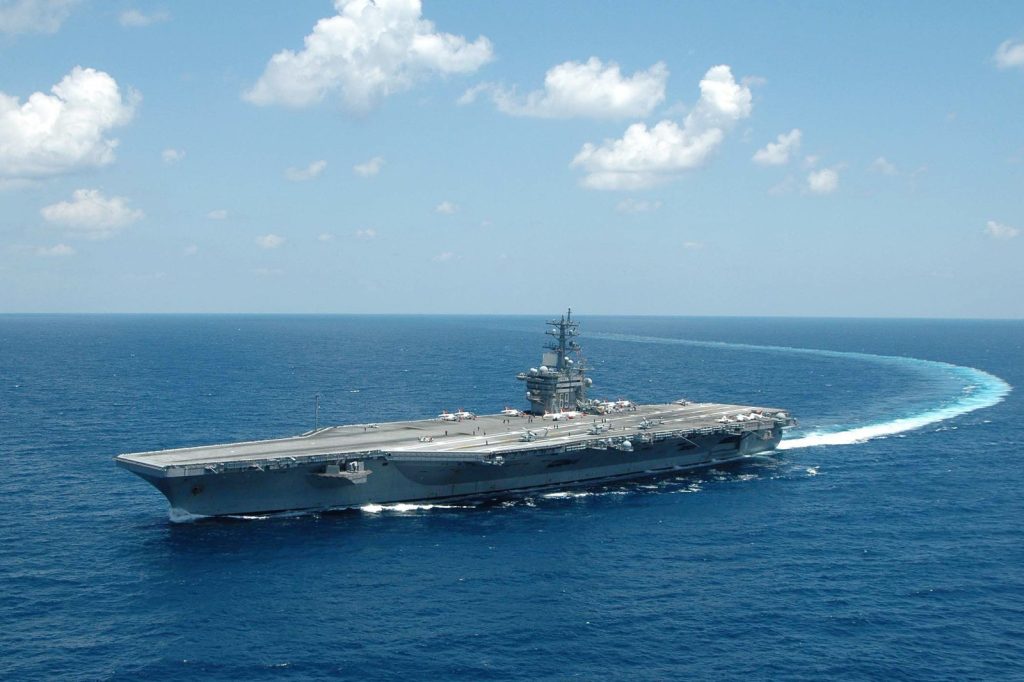
The Fifth Fleet was established during World War II to command operations in the Pacific, then deactivated in 1947. It lay dormant for nearly five decades until the Pentagon resurrected it in 1995, a direct response to the growing instability in the Gulf after the Iran-Iraq War and the 1991 Gulf War. The fleet’s area of responsibility covers roughly 2.5 million square miles of water, an expanse that includes the Red Sea, the Gulf of Oman, the Arabian Sea, and the Persian Gulf. Its flagship, typically an amphibious assault ship or an aircraft carrier, serves as the floating nerve center for a rotating task force of destroyers, cruisers, submarines, and support vessels drawn from the US Navy’s Atlantic and Pacific fleets.
The fleet’s core mission has always been deterrence, but deterrence in Hormuz is a delicate business. The strait lies within Iran’s territorial waters for much of its length, and Tehran has long asserted its right to control passage through the waterway. Under international law, the strait is subject to the right of transit passage, meaning ships and aircraft may pass freely as long as they do not threaten the coastal state. Iran has signed the United Nations Convention on the Law of the Sea but has not ratified it, leaving the legal status of its claims in a gray zone that both sides have exploited.
The first major test of American resolve came during the Iran-Iraq War, when Iran began attacking neutral tankers in the Gulf in an attempt to strangle Iraq’s economy. The United States responded in 1987 with Operation Earnest Will, a campaign to reflag Kuwaiti tankers under the American flag and escort them through the Gulf under naval protection. It was the largest convoy operation since World War II. US Navy frigates and destroyers shepherded columns of commercial vessels through mine-infested waters, while minesweepers cleared paths ahead. The operation lasted until 1988 and cost the lives of 37 American sailors, most of them killed when the USS Stark was struck by an Iraqi Exocet missile in a tragic case of mistaken identity.
The lessons of Earnest Will shaped American thinking for decades. The Navy learned that mines were the most persistent threat, cheap to lay and expensive to clear. It learned that small attack boats could swarm larger vessels faster than anyone expected. And it learned that the political calculus of escort missions was brutal: every ship lost was a propaganda victory for Iran, every successful passage a quiet triumph of logistics over chaos.
In 2008, the pattern repeated. Iran threatened to close the strait in response to international pressure over its nuclear program. The US Navy responded by increasing the rotation of carrier strike groups through the Gulf, maintaining at least one carrier on station at all times. The strategy worked, but the tension never fully dissipated. Tehran had discovered that the mere threat of closure could move oil prices, and it used that leverage repeatedly.
The most serious confrontation came in 2019, after the United States withdrew from the Joint Comprehensive Plan of Action, the nuclear deal with Iran. A series of attacks on tankers near the strait, which the US and its allies attributed to Iran, prompted the creation of Operation Sentinel, an international maritime security framework designed to protect commercial shipping without escalating into direct conflict. The operation involved the United States, the United Kingdom, Australia, Bahrain, Saudi Arabia, the United Arab Emirates, and several other nations. It was a coalition of the willing, but it was also a coalition of the exposed: any ship in the Gulf was a potential target, and no amount of naval power could guarantee absolute safety.
The human cost of these operations is rarely visible from the bridge of a destroyer. Sailors on escort duty spend months at sea in the heat of the Gulf, where summer temperatures exceed 120 degrees Fahrenheit and the humidity makes sleep almost impossible. They watch the same horizon for weeks, scanning for mines, small boats, and the telltale wake of a submarine periscope. The psychological strain is real, but it is also hidden. The Navy does not release statistics on mental health incidents during Hormuz deployments, and the sailors themselves rarely speak about it publicly.
Geopolitically, the stakes have only grown. Iran’s naval capabilities have expanded significantly since the 1980s. It now fields a fleet of fast attack craft, midget submarines, anti-ship cruise missiles, and a growing inventory of drones. The Islamic Revolutionary Guard Corps Navy, which operates separately from the regular Iranian navy, has developed a doctrine of asymmetric warfare designed to exploit the strait’s narrow confines. The IRGC Navy’s strategy is not to defeat the US Navy in a conventional battle, which it cannot do, but to impose costs high enough to make the strait effectively unusable.
The United States has responded by dispersing its forces, using smaller and more agile ships, and investing heavily in mine countermeasures. The Navy has also increased its use of unmanned systems, including underwater drones for mine detection and surface drones for surveillance. The goal is to create a layered defense that can detect and neutralize threats before they reach the shipping lanes.
Yet the fundamental dilemma remains unchanged. The strait is too narrow for a purely defensive posture to be fully effective. A single mine, a single missile, a single suicide boat can stop a convoy for hours or days. The escorts are there to reduce the risk, not to eliminate it. The merchants who sail through Hormuz know this. They accept the risk because the alternative, a closed strait and a global economic crisis, is worse.
The Fifth Fleet remains on station, as it has for decades, a floating reminder of the American commitment to free passage. The ships come and go, the crews rotate, the threats evolve. But the mission endures: keep the strait open, keep the oil flowing, keep the crisis contained. In the Gulf, that is the only measure of success that matters.




