
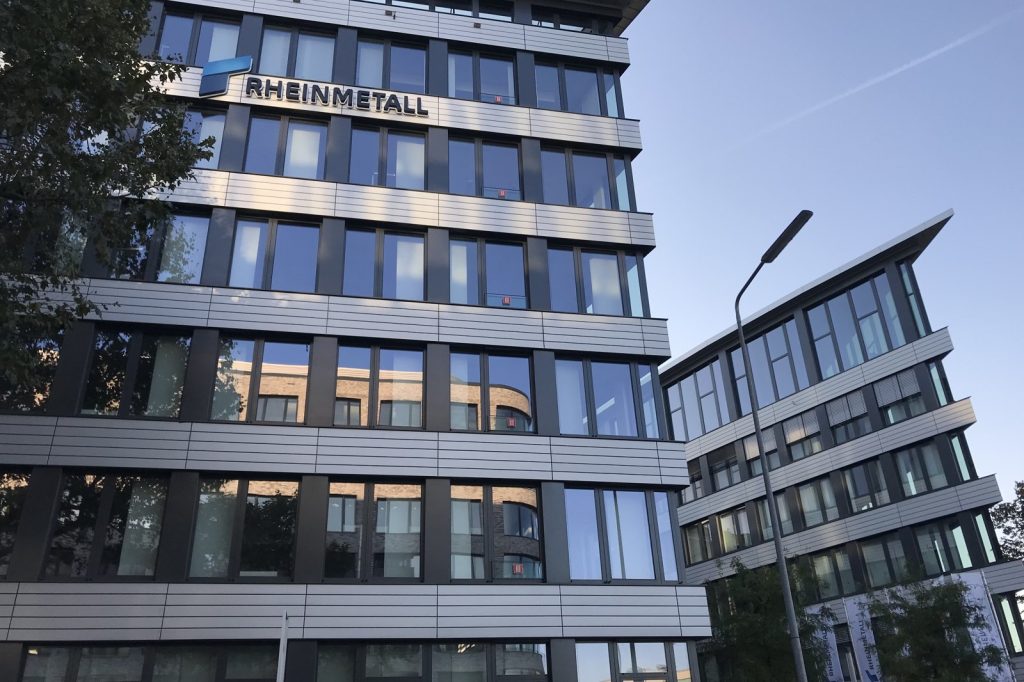
DÜSSELDORF, July 12 — Rheinmetall AG has emerged as a leading candidate in the competition to supply Ukraine with 50,000 strike drones, according to officials tracking the procurement process. The German defense contractor, headquartered in Düsseldorf, is now the subject of intense scrutiny as Berlin moves to accelerate deliveries of advanced unmanned systems to Kyiv. The scale of the requirement is significant.
The German government has set a target of 50,000 strike drones, and the selection of a primary supplier will determine not only the pace of deliveries but also the technological character of the systems reaching Ukrainian forces. Rheinmetall’s position as a frontrunner reflects the company’s deep integration into NATO’s defense supply chains and its existing relationship with the German defense ministry.
Rheinmetall’s portfolio and the Hero loitering munition
Rheinmetall produces a broad range of military equipment, including the Lynx infantry fighting vehicle and the Skyranger air defense system. For the drone requirement, the company’s most relevant offering is the Hero loitering munition, developed in partnership with the Israeli company UVision. This system is designed to loiter over a target area before striking, a capability that aligns with Ukraine’s stated need for precision strike drones that can engage high-value targets behind Russian lines.
Rheinmetall’s stock has risen significantly since the start of the war. The share price moved from around €100 in early 2022 to over €500 by early 2025, reflecting the broader increase in European defense spending and the company’s central role in supplying Ukraine.
The record shows that investor confidence has tracked closely with the trajectory of the conflict and the scale of Western military aid commitments.
Other contenders: MBDA and Helsing
Rheinmetall is not the only candidate. Another potential supplier is MBDA, a European missile manufacturer with German operations. MBDA produces the Brimstone missile and the Taurus KEPD 350 cruise missile.
The company’s experience with guided weapons systems makes it a credible alternative, though its production capacity for large numbers of drones would need to be assessed. The German government has also contracted with Helsing, a Munich-based AI defense startup, for drone technology.
Helsing specializes in artificial intelligence for autonomous systems, and its involvement signals that Berlin is looking beyond traditional defense contractors for innovation in this field. The startup’s technology could be integrated into platforms produced by larger manufacturers, or Helsing could serve as a prime contractor for a portion of the order. The procurement process, officials confirmed, will involve competitive bidding and production capacity assessments.
The goal is to deliver drones as quickly as possible, a timeline that places a premium on existing supply chains and proven manufacturing lines. Rheinmetall’s existing production infrastructure and its partnership with UVision give it a potential advantage in speed, but MBDA’s missile production experience and Helsing’s AI capabilities are also being weighed.
Strategic context and the German defense calculus
The decision on the drone supplier comes at a moment of heightened urgency. Ukraine has repeatedly called for more long-range strike capability, and drones have proven effective at striking Russian logistics hubs, ammunition depots, and command posts. The 50,000-drone requirement represents a significant commitment from Berlin, both in financial terms and in the signal it sends about Germany’s willingness to sustain Ukraine’s defense over the long term.
German defense officials have been careful not to publicly favor one company over another, insisting that the process will be transparent and based on capability. However, Rheinmetall’s close relationship with the German government is well documented.
The company has been a major beneficiary of the Zeitenwende — the shift in German defense policy announced after the Russian invasion — and has expanded production capacity across multiple product lines. The competition also highlights a broader trend: the increasing importance of drones in modern warfare. Both Russia and Ukraine have invested heavily in unmanned systems, and the conflict has become a testing ground for new technologies.
The German procurement decision will effectively endorse one technological approach over others, and the chosen system will likely see extensive combat use in Ukraine, providing real-world data that will shape future European drone programs. What to watch next is the formal tender process.
The German defense ministry is expected to issue a request for proposals in the coming weeks, with a decision targeted before the end of the year. The scale of the order — 50,000 units — means that production capacity will be as important as technical specifications. Rheinmetall’s existing partnership with UVision and its track record of scaling production quickly make it the company to beat, but MBDA and Helsing are both positioned to challenge that lead.




