
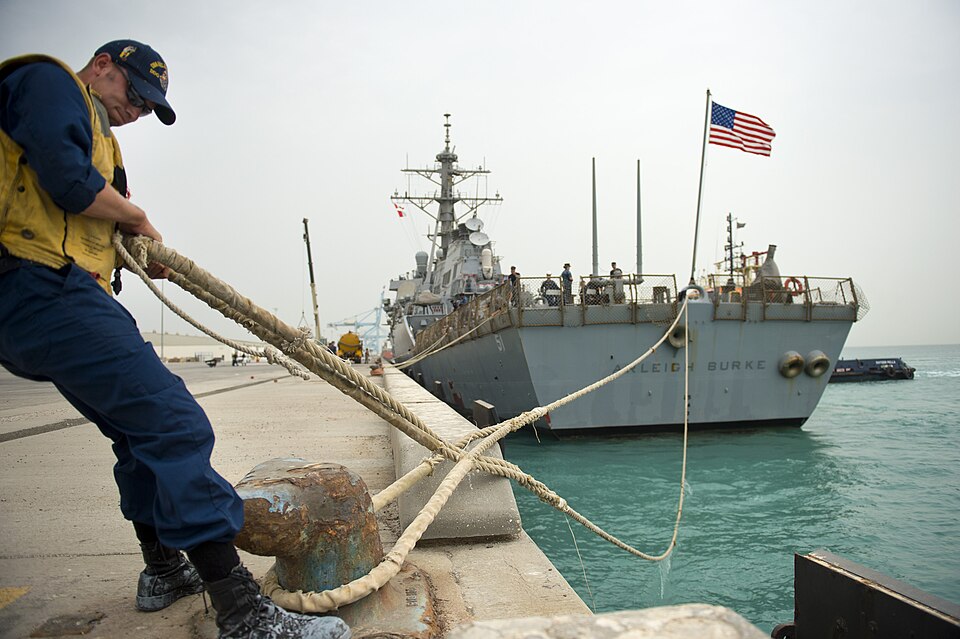
YOKOSUKA, Sept 6 — The United States Navy is deepening its reliance on allied shipyards in Japan, South Korea and the Philippines for major maintenance and repair of its warships, a shift driven by the decline of its domestic shipbuilding base and intensifying competition with Beijing. The arrangement came into sharp focus in July when the Arleigh Burke-class destroyer USS Benfold suffered a power failure in the South China Sea.
The vessel was towed to Subic Bay in the Philippines for emergency repairs, which took about 10 days before the ship resumed operations. US law mandates that major warships be built domestically.
But outsourcing maintenance, repair and overhaul (MRO) work to foreign yards offers more flexibility, particularly for forward-deployed vessels. Naval ships homeported outside the United States are not strictly barred from receiving foreign MRO services, and deployed US-homeported ships may also be serviced by foreign workers under specific conditions. The capacity of regional allies matters given their distance from the continental US.
The Washington-based Centre for Strategic and International Studies noted in a recent report that “by establishing the ability to repair and sustain larger numbers of ships closer to potential conflict areas in the Indo-Pacific, the United States could potentially support extended deployments – including during wartime – by reducing the need to recall ships to the US mainland for repairs.” South Korea and Japan’s advanced shipbuilding industries rank second and third in the world, respectively, in terms of capacity; China ranks first, accounting for more than half the world’s shipbuilding capacity.
The US Navy operates the US Naval Ship Repair Facility and Japan Regional Maintenance Centre (SRF-JRMC), headquartered at Yokosuka Naval Base in Kanagawa prefecture, with detachment sites in Sasebo, Nagasaki prefecture, and Singapore’s Changi Naval Base. The organisation employs local workers and occasionally outsources tasks to local contractors. The Navy has also expanded a network of private companies through its Master Ship Repair Agreement (MSRA), which certifies a shipyard to bid on and perform MRO work on military and support vessels.
Last month, the Navy issued solicitation notices inviting bids from MSRA and Agreements for Boat Repair (ABR) holders for minor repair and maintenance of the America-class amphibious assault ship USS Tripoli and San Antonio-class amphibious transport dock USS New Orleans, both homeported in Sasebo. In Japan, Mitsubishi Heavy Industries’ Yokohama Dockyard & Machinery Works is the largest ship repair yard in the country, with two dry docks, seven piers and seven jib cranes, capable of accommodating ships up to 270,000 tonnes.
The yard serviced the destroyer USS Milius in 2019 in a pilot trial — the first time the US Navy outsourced such work to local Japanese firms. Last year, MHI became the first Japanese yard to secure a regular overhaul contract, for the USS Miguel Keith, a Puller-class expeditionary mobile base.
Sumitomo Heavy Industries Marine & Engineering is another prominent MSRA holder, focusing on repair work mainly for the US Navy in Yokosuka in recent years, providing services to ships of the Seventh Fleet.




