
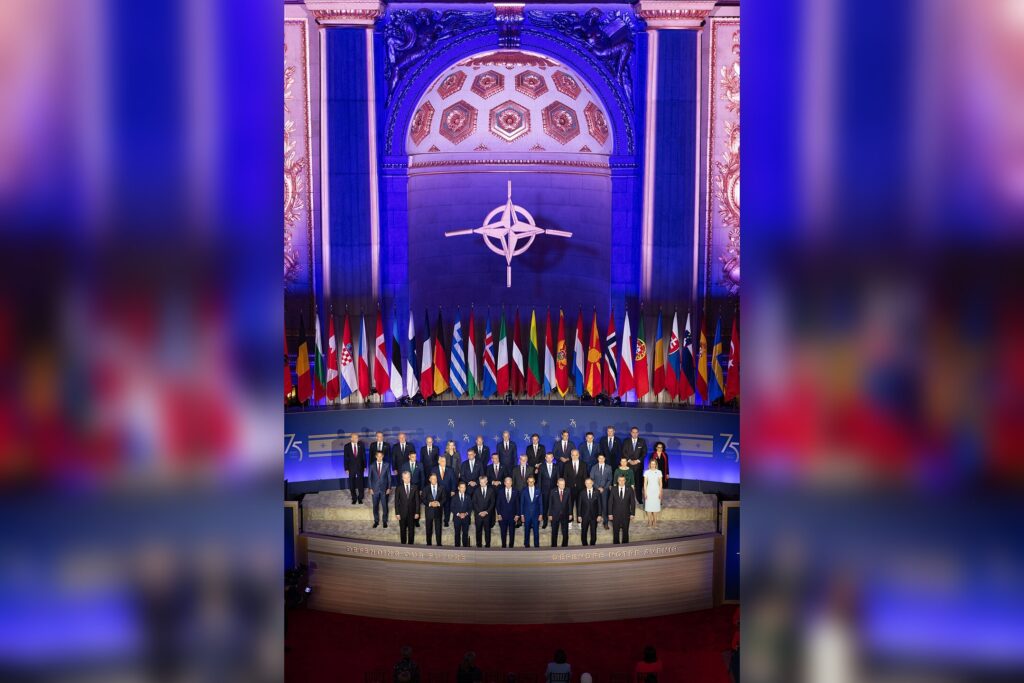
Defense Spending and Internal Friction
The North Atlantic Treaty was signed on April 4, 1949, establishing the alliance that now includes 31 member states as of 2024. Finland joined on April 4, 2023, followed by Sweden on March 7, 2024. The 2 percent GDP defense spending benchmark has been a recurring source of contention among allies. While several NATO countries have increased their military budgets in recent years, not all have reached the target. The summit is expected to press allies on this commitment, a debate sharpened by Trump’s history of criticizing NATO partners. Trump has previously suggested he would encourage Russia to attack those not meeting spending commitments, according to the source material. That position has intensified the burden-sharing debate within the alliance ahead of the Washington meeting.
Ukraine’s Place at the Table
The reported exclusion of Ukrainian President Volodymyr Zelensky from speaking at the summit reflects the delicate balance between maintaining solidarity with Ukraine and navigating U.S. domestic politics, according to the source material. Ukraine’s relationship with NATO deepened after the Euromaidan protests of 2013–2014, which triggered a change of government in Kyiv and Russia’s annexation of Crimea. Since then, the alliance has treated Ukraine as a partner in need of security assistance rather than a prospective member. The full-scale Russian invasion of February 2022 transformed that partnership into a frontline defense of Europe’s postwar order. NATO summits have become the main diplomatic stage where allies weigh how far to extend military, financial, and political backing without triggering direct conflict with Russia. The Washington summit’s debate over Ukraine’s role—symbolized by whether its president addresses the gathering—mirrors a broader question: how much risk the alliance is willing to assume to uphold a European state’s territorial integrity.
Ukraine is a sovereign nation in Eastern Europe, bordered by Russia to the east, Belarus to the north, and several European Union states to the west and southwest. Its capital is Kyiv, a city whose history predates the Christianization of Rus’ in 988. The modern Ukrainian state traces its origins to Kievan Rus’, a loose federation of Slavic tribes that flourished between the ninth and 13th centuries before fragmenting under external pressure. Centuries of rule by Lithuania, Poland, the Ottoman Empire, and the Russian Empire followed, punctuated by brief periods of self-rule such as the Cossack Hetmanate in the 17th century. After the Russian Revolution in 1917, Ukraine declared independence for a time, only to be reabsorbed into the Soviet Union in 1922. The Soviet era brought industrialization and centralized control, but also the Holodomor, a catastrophic famine in the early 1930s that killed many Ukrainians. During World War II, German occupation and the Holocaust brought further devastation. Ukraine regained full sovereignty in 1991 when the Soviet Union dissolved, though internal corruption and weak institutions slowed its transition to a market democracy.
Alliance Unity Under Scrutiny
Looking ahead, the alliance faces the challenge of maintaining unity on Ukraine while managing the political dynamics in Washington. The reported exclusion of Zelensky from the speaker list underscores how U.S. electoral politics influence NATO’s handling of the war. The outcome of the summit will signal whether NATO can sustain its collective posture amid these pressures. With defense spending disparities unresolved and the future of Western aid to Ukraine uncertain, the Washington meeting will test the durability of the transatlantic bond that has defined Europe’s security architecture for three-quarters of a century.




