
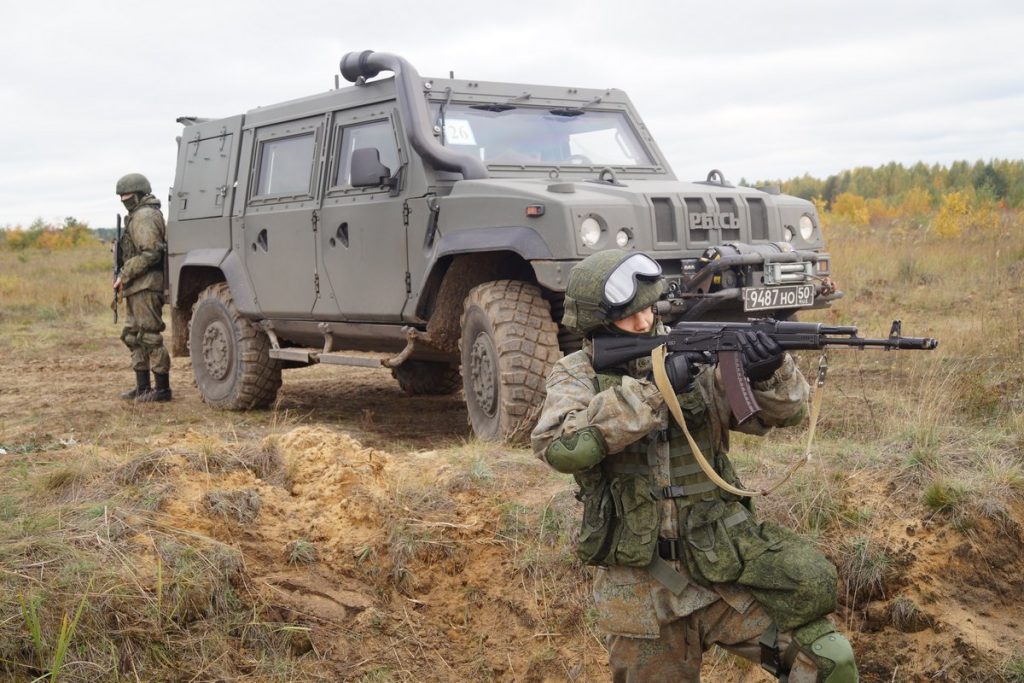
The battalion tactical group, a combined-arms unit of roughly 600 to 800 officers and soldiers, has become the standard combat formation in the Russian Army, marking a clear departure from Cold War-era doctrine. These formations, known by the acronym BTG, are built around a mechanized infantry battalion of two to four companies, reinforced with air-defense, artillery, engineering, and logistical support elements drawn from a garrisoned army brigade. A tank company and rocket artillery typically reinforce such groupings.
The result is a force equipped with approximately 10 tanks and 40 infantry fighting vehicles, of which roughly 200 personnel are infantrymen. As of August 2021, Russia’s defense minister stated the country had about 170 BTGs, each kept at high readiness.
From Soviet Regiments to Modern BTGs
The trend underlying the BTG’s rise is a long evolution in Russian military organization. During the Cold War, the Soviet Army used maneuver regiments as the smallest combined-arms force, with battalions operating as pure tank or motorized rifle formations. Temporary combined-arms groupings were formed only during field exercises.
By 1987, the term “battalion tactical group” described Soviet combined-arms battalions, and the concept was employed in the Soviet–Afghan War. A plan known as “Division 87” called for a permanent tank company in every motorized rifle battalion, but the experiment was abandoned due to cost and a lack of experienced junior commanders.
After the dissolution of the Soviet Union, the Russian Ground Forces faced severe shortages of manpower and equipment. During the First and Second Chechen Wars and the 2008 Russo-Georgian War, the army again formed ad-hoc BTGs out of necessity. These temporary groupings allowed the military to field combined-arms units despite its reduced resources, but they were not intended as a permanent structure.
The Reform That Stuck
Following the 2008 war with Georgia, the Ministry of Defence announced reforms in October 2008 to create “permanent readiness” brigades. That plan shifted after Sergei Shoigu replaced Anatoliy Serdyukov as defense minister in November 2012. The new approach was to form “permanent readiness” BTGs within garrison brigades, planned to be 100% staffed by contract soldiers.
The BTG was no longer a temporary expedient — it became a core maneuver unit for a military that values rapid response. What is changing now is the scale.
With about 170 BTGs claimed in 2021, the Russian military has moved away from the old regimental system. The BTG is a temporary formation built around a mechanized infantry battalion, reinforced with tank, artillery, air-defense, engineering, and logistical elements drawn from a parent brigade. It is designed for rapid deployment as a self-contained fighting force, kept at high readiness for immediate use.
Background and Why It Matters
The battalion tactical group is a combined-arms maneuver unit of the Russian Army, kept at high readiness. It is a temporary formation built around a mechanized infantry battalion, reinforced with tank, artillery, air-defense, engineering, and logistical elements drawn from a parent brigade. The BTG is designed for rapid deployment as a self-contained fighting force.
The concept emerged from Soviet military thinking. During the Cold War, the smallest permanent combined-arms formation was the regiment; battalions were pure tank or motorized rifle units.
By 1987, the term “battalion tactical group” described ad-hoc combined-arms battalions, and the idea was tested in the Soviet–Afghan War. A plan to make a tank company permanent in every motorized rifle battalion was abandoned as too costly and because of a shortage of experienced junior commanders. Understanding the BTG’s structure and history helps readers grasp the kind of force Russia can deploy quickly and the constraints that come with relying on temporary, composite units rather than standing combined-arms regiments.
These formations were the mainstay of Russia’s military intervention in Ukraine from 2013 to 2015, particularly in the war in Donbas. As of August 2021, Russia reported having about 170 BTGs, each kept at high readiness.
The BTG has become the standard combat formation for Russia’s military operations, representing a shift from Cold War doctrine toward a more flexible, rapid-response capability.




